Part 4
Does that make Amber right? No. Her evidence is thin. "I saw people over her mother's house" is not a paternity test. "Random text messages" is not proof of infidelity. If Amber were the sole reason Rick doubted his kids, that would be a problem. But she wasn't. Rick had his own reasons — the pattern of leaving, the timing of the pregnancies, the gut feeling that something didn't add up. Amber didn't create that. She confirmed it.
And here's the kicker the "Amber is the villain" crowd never quite accounts for: if Amber were lying, the paternity test would have exposed her. That's the beauty of this format. Since 1991, Maury's team has run thousands of these tests, and the results don't care who's popular. If Amber had fabricated everything, Kazari and Zyla would have come back "you are not the father," and Amber would have been the one apologizing. Instead, Rick got the two words that ended the argument: "You are the father." Twice.
[[AD]]
So no, Amber wasn't poisoning Rick. She was handing him the only evidence he had — imperfect, secondhand, but real to her. Whether you believe her is a separate question from whether she was acting in bad faith. And nothing she said on that stage suggests bad faith. It suggests a sister who wanted to know if the little girls in her family were actually her family. That's not a villain's motive. That's a relative's motive.
The consensus says Amber is the problem. I say Amber is the excuse we use so we don't have to ask the harder question: why did Rick need his sister's word in the first place? The answer isn't in Amber's mouth. It's in Whitney's disappearing act — and in what a paternity test can and can't prove. That's where we're headed next.
The Paternity Test Proved Biology — It Didn't Prove Whitney Was Trustworthy
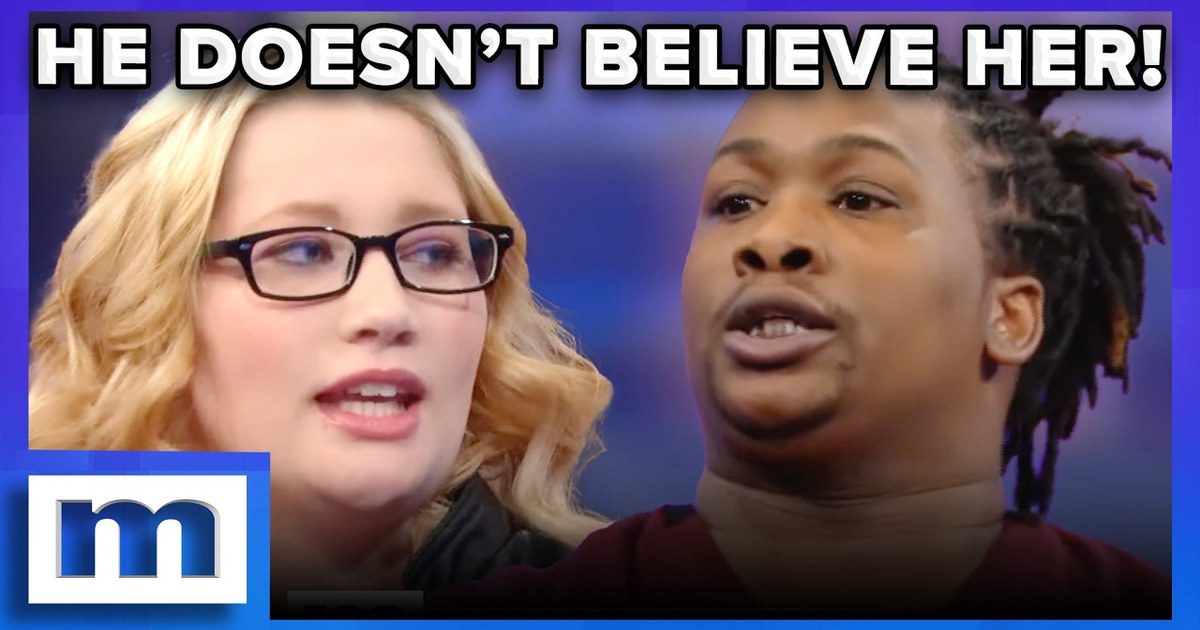
The Maury Povich Show has been delivering paternity test results since 1991, and in that time, the formula has become as predictable as a Marvel post-credits scene. The man doubts, the woman cries, Maury reads the envelope, and the audience erupts. On this episode, when Maury told Rick he was the father of both Kazari and Zyla, the crowd cheered for Whitney like she'd just won an Oscar. Rick mumbled, "I apologize. I apologize. I apologize." And just like that, the consensus was cemented: Whitney was vindicated, Rick was humiliated, and justice was served.
But hold on. A paternity test answers exactly one question: who contributed the DNA. It does not answer whether Whitney was faithful. It does not answer why she disappeared for days, weeks, even months at a time. It does not answer whether Rick's suspicion was reasonable. The test is a scientific fact, not a moral verdict. And treating it as the latter is exactly the kind of lazy thinking that makes daytime TV so addictive — and so misleading.
Let's be clear: Rick was already acting as a father. He said it himself: "I take care of them already. I do, but you know, I just don't know." That's not a deadbeat dad. That's a confused man in a chaotic relationship. He wasn't refusing to support his kids — he was refusing to pretend everything was fine when Whitney's behavior gave him every reason to wonder. The test results didn't change his actions. They only changed the narrative.
What the Test Didn't Fix
Whitney got her "I told you so" moment. She stood there, arms crossed, as Maury confirmed what she already knew. But here's what the applause didn't acknowledge: the relationship was still broken. The months of disappearances didn't vanish. The Facebook accusations didn't disappear. The sister-in-law war between Whitney and Amber didn't end. The test results were a single data point in a sea of dysfunction.
Think about it like this: if your partner disappears for weeks at a time, refuses to explain where they went, and you hear rumors from family members, are you unreasonable for doubting? No. You're human. Rick's suspicion wasn't born from cruelty — it was born from inconsistency. And no paternity test can erase that. The Maury Show loves to frame these moments as binary: the man is either a hero or a villain, the woman is either a saint or a liar. But real life doesn't work that way. Real life is messy, and trust is built on patterns, not on a single test result.
Maury's final line — "Go raise those little girls" — was the only sensible takeaway. But the audience applause for Whitney missed the point entirely. Rick was not a deadbeat. He was a man who wanted certainty in a relationship that offered none. And when the test finally gave him that certainty, he apologized. Not because he was wrong to doubt, but because he was wrong to do it on national television.
The Cruelty Was Real — But So Was the Doubt
Here's the strongest counter-argument, and I'll give it its due: Rick humiliated Whitney on national television. He denied his children in public. He sat there while Maury read the results and made Whitney beg for an apology. That is cruel. Whitney did not deserve that. No one deserves to have their most vulnerable moments broadcast to millions of viewers, especially when the stakes are two innocent little girls.
But cruelty and correctness are not mutually exclusive. Rick was wrong to do it on Maury. He was not wrong to doubt. The two truths can coexist. And if we're honest, the Maury Show itself is built on this tension. It thrives on humiliation. It packages pain as entertainment. The audience cheers for Whitney because they've been trained to see the woman as the victim and the man as the villain. But that's a narrative, not a fact.
The real tragedy isn't that Rick doubted. It's that Whitney's disappearances made doubt inevitable. Trust is built on consistency. You show up. You communicate. You don't vanish for weeks and then expect blind faith. Whitney may have been faithful — the test suggests she was — but she wasn't consistent. And without consistency, trust crumbles. That's the lesson Maury missed. That's the lesson the audience missed. And that's the lesson we should all take away.
The Maury Show turns complex relationship failures into binary morality plays. It's been doing it for over 30 years, across more than 5,000 episodes, and it's not going to stop. But we don't have to buy it. The real lesson is not "Rick is a deadbeat." It is that trust is built on consistency, and Whitney's disappearances made trust impossible — regardless of what the DNA said. Rick was wrong to air it on TV. He was not wrong to wonder.
Next time, we'll look at other Maury episodes where the "villain" was actually right, and why daytime TV loves to simplify messy truths. Because if there's one thing the Maury Show has taught us, it's that the truth is rarely as clean as a paternity test result — and the real drama is never in the envelope. It's in the lives behind it.


