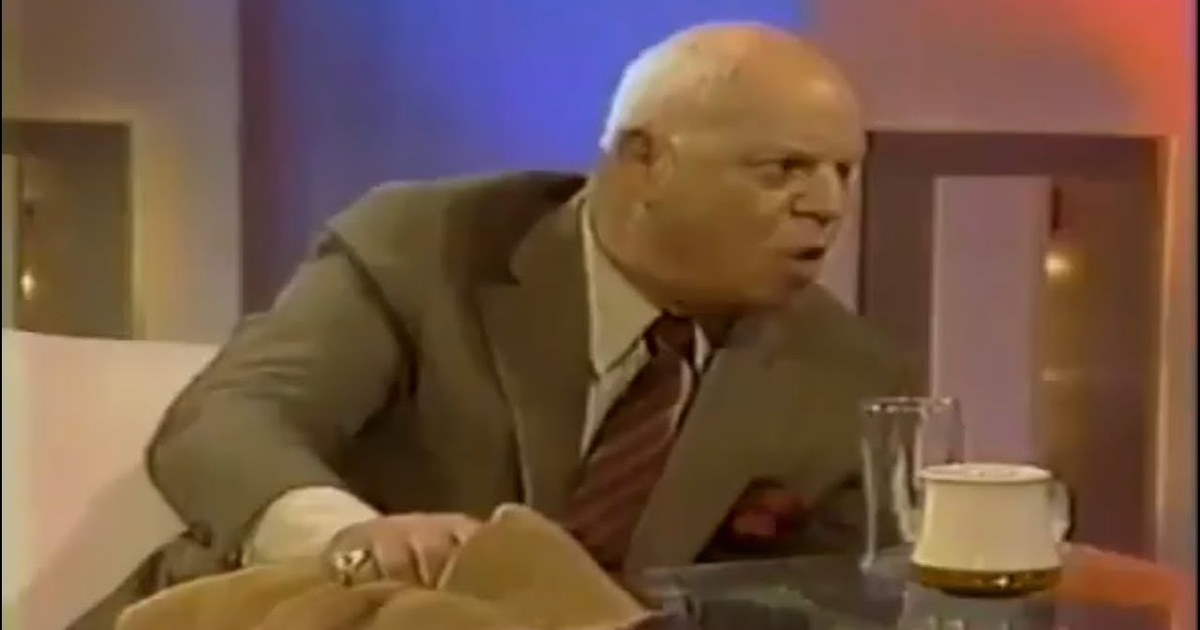
The consensus is that Don Rickles was comedy’s ultimate apex predator—a ruthless verbal sniper who dominated talk show stages through pure cruelty, unchecked ego, and an absolute lack of fear. Whenever archival clips of Rickles hijacking *The Merv Griffin Show* resurface, modern commentary frames him as a shock comic who bullied everyone in sight because he was simply untouchable. And I think that reading is completely wrong. Here is why.
If you actually pay attention to the kinetic chaos Rickles brought to the screen, he was never performing from a pedestal of invulnerability. He was not an untouchable heavy laying down insults from safety. The entire engine of Rickles' comedy relied on him presenting himself as an overmatched, desperate outsider fighting for air in an arena that could squash him at any second.
Watch him barrel onto Merv Griffin's set: sweating, adjusting his collar, complaining about the air conditioning, and constantly yelling that he has to fight for his life against a sluggish audience. Far from an arrogant tormentor, Rickles built his genius around the energy of an underdog on the brink of collapse.
[[AD]]
Myth 1: The Illusion of Stage Superiority
The popular take assumes that roast comedy succeeds when the comic asserts complete dominance over the room. Pundits look back at Rickles picking on audience members from Iowa, mocking bandleader Mort Lindsey, or heckling the theater’s budget, and they see a man punching down with zero regard for his targets.
In reality, Rickles was constantly deflating his own status before anyone else could do it for him. He pointed out his failed network shows, confessed to having a swollen tongue from 'big mouth disease,' and framed his entire cable special, *Don Rickles on the Loose*, as a project that nobody would watch. He turned himself into the biggest dummy in the building.
By making his own existence the baseline punchline, the insults directed at the crowd never carried real venom. You cannot truly punch down when you deliberately position yourself in the gutter, pleading for a cup of water while daring the room to boo you off the stage.
[[AD]]
Myth 2: The Untouchable Sinatra Slayer
The centerpiece of the Rickles legend is his fearlessness around titans like Frank Sinatra. Griffin recounts a private breakfast at the Madison Hotel where Rickles relentlessly hammered Sinatra for an hour straight, leaving everyone terrified for their careers. The standard interpretation treats this as proof that Rickles held genuine social leverage over the Chairman of the Board.
That completely misses the dynamic. Rickles didn't go after Sinatra because he was powerful; he went after Sinatra because Sinatra’s supreme power was the very premise of the joke. Rickles openly jokes about state troopers escorting him against his will to Sinatra's dressing room and his terror of mob retaliation. The humor came from a court jester poking an absolute monarch with a foam sword.
Sinatra didn't tolerate Rickles because Rickles subdued him. Sinatra loved Rickles because Don was the only person in the room who dared to acknowledge how ridiculous everyone acted around Sinatra's aura. It wasn't dominance—it was mutual, high-stakes affection cloaked in mock hostility.
[[AD]]
Myth 3: Weaponized Cruelty as Entertainment
Modern critics often look at Rickles' rapid-fire ethnic stereotyping—swapping Italian, German, Jewish, and Irish barbs in seconds—and label it divisive vitriol. The assumption is that his act was built to separate the room into tribes and exploit existing animosity for cheap laughs.
Yet the lived reality of mid-century immigrant communities was entirely different. Rickles treated post-war American identity as a noisy, shared apartment building where everyone heard their neighbors through the floorboards. When he badgered a guy named Finnegan or bantered about pastrami and cannolis, it was an aggressive form of inclusion.
By bringing every background out into the open under stage lights, he stripped prejudice of its hushed malice. To be singled out by Rickles wasn't an ostracization; it was an induction into the family.
[[VIDEO]]
Conceding the Strongest Counter-Argument
Now, let’s be entirely fair to the modern consensus: Rickles' style is practically impossible to translate to today’s landscape without sounding abrasive. If you strip away the smoky lounge intimacy and the fifty-year history of genuine personal camaraderie he shared with his targets, the transcript on paper looks startlingly harsh.
Without the warmth in his eyes, the immediate back-patting off-camera, and his lifelong devotion to friends like Bob Newhart and Harry Goines, the routine risks collapsing into genuine hostility. It is completely reasonable that modern viewers, used to careful boundaries, recoil on first contact.
But dismissing Rickles as a bully ignores the radical vulnerability that made him an enduring comedy icon. He survived because he offered his own neck to the guillotine every time he stepped up to the microphone. Next time, we will break down Johnny Carson’s legendary role in turning Rickles into a late-night institution—stay tuned.


