Part 1
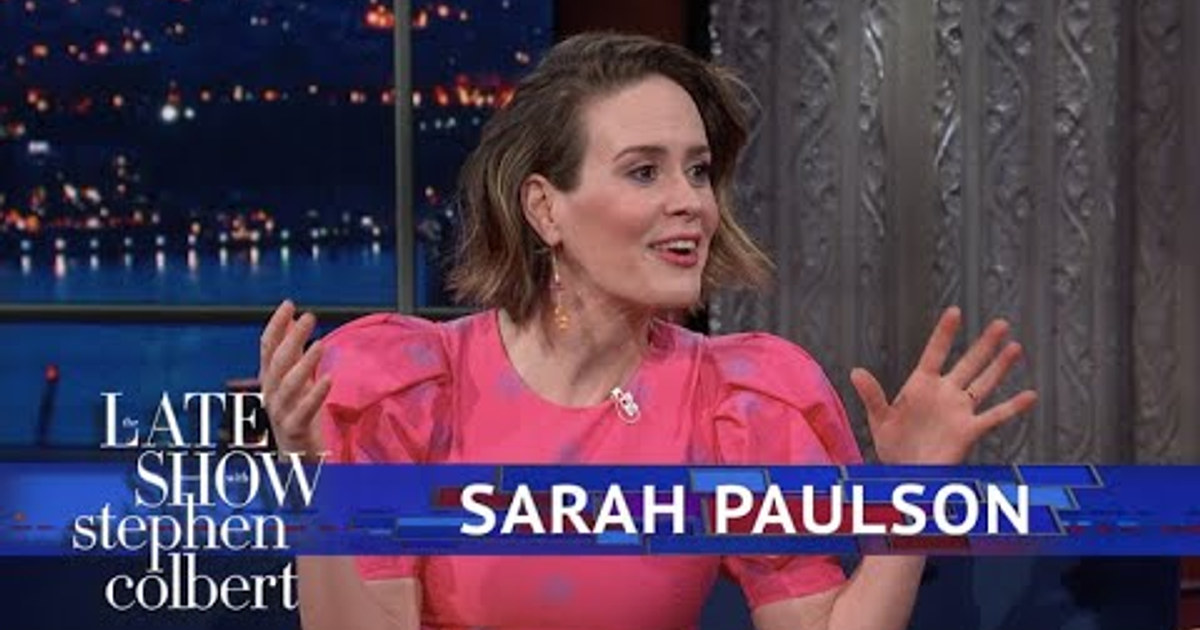
First, look at this: notice the precise micro-second where Sarah Paulson sits across from Stephen Colbert, tilts her chin slightly downward, and mentions the involuntary twitch beneath her left eyelid. Most talk show guests sweep into the theater performing absolute, radiant invulnerability. They brush off travel fatigue, flash high-wattage grins, and stick to the pre-interview cue cards. But watch her eyes closely. There is an unmistakable tremor of real, unfiltered human anxiety running beneath the polished veneer of Hollywood royalty.
Why does that tiny, fluttering muscle matter to us? Because it unlocks the entire paradox of Sarah Paulson at the absolute height of her powers. In late 2017, she was standing atop the entertainment mountain after a historic award sweep for playing Marcia Clark in 'The People v. O.J. Simpson: American Crime Story', while concurrently headlining seven seasons of 'American Horror Story'. Yet here she is, openly admitting to the host that modern current events have her waking up feeling utterly laid out.
We are going to walk through this landmark encounter not as casual late-night television viewers, but as archival curators examining an artist navigating the terrifying weight of universal acclaim. You are about to see how genuine fear, neurotic ambition, and peerless dramatic discipline collided to produce one of the most explosive hot streaks in modern cinematic history.
[[AD]]
Stop One: The Mechanics of Modern Panic
Step inside our first exhibit: the opening sixty seconds of banter between Paulson and Colbert. What looks on the surface like quick-witted late-night pleasantries is actually an intense diagnostic of high-performing neurosis. When Colbert asks if it is always lovely to talk, she does not offer the polite celebrity fib. She instantly confesses that baseline human dread, intensified by the relentless twenty-four-hour news cycle, has manifested as a physical twitch that has refused to leave since January 20th.
Notice the distinct contrast in how these two artists process dread. Colbert is a satirist; his nightly ritual requires taking national trauma, running it through the machinery of topical comedy, and spitting it back out as communal catharsis. Paulson points out this exact luxury. She cannot simply stand at a desk and roast the headline of the hour. Her day job requires an entirely different psychological trade: retreating into elaborate fictions, putting on period wigs, and pretending the real world does not exist.
Have you ever wondered why an actress whose resume is packed with terrifying genre thrills would call reality the true nightmare? Look at her half-joking plea that 'American Horror Story' ought to drop the fiction entirely and rename itself 'Current Events.' For an actor who spent years surviving serial killers, haunted hotels, and witches' covens on FX, the daily crawl of reality had finally outpaced gothic horror for raw, nerve-shredding anxiety.
[[AD]]
Stop Two: The Burden of the 'Hot Streak'
Now follow me over to the central ledger of her eighteen-month whirlwind. Colbert begins reading off a resume run that sounds almost statistically impossible for a single working actor: an Emmy Award, a Golden Globe, a Screen Actors Guild Award, two seasons of 'American Horror Story', Steven Spielberg's 'The Post', the blockbuster ensemble 'Ocean's 8', Ryan Murphy's 'Ratched', M. Night Shyamalan's 'Glass', the post-apocalyptic phenomenon 'Bird Box', and serious talks for 'The Goldfinch'.
Look at Paulson's body language while the accomplishments are cataloged. Does she lean back and bathe in the applause? Not for a single frame. Instead, she grimaces and murmurs that hearing it laid out makes her deeply uncomfortable. This is the psychology of the perpetual striver laid bare for our inspection. When your entire professional identity has been forged in the trenches of trying to prove you belong, what happens when everyone suddenly agrees that you do?
Paulson explains that her creative engine has always been powered by the chase. She spent decades scraping through casting calls, clawing for recognition, and framing herself as an underdog fighting for room in the room. When the dynamic inverted—when the phone started ringing with direct offers from the most powerful directors on earth—it disrupted her internal compass. Success did not bring serene comfort; it provoked an identity crisis.
[[AD]]
Stop Three: The Audition as a Street Fight
Our third stop brings us to an extraordinary impromptu physical bit that captures the ferocious grit behind her polished stardom. Colbert reminisces about his own early days as an actor, calling auditions a humiliating gauntlet of rejection. But observe how Paulson immediately pushes back: she did not endure auditions—she loved them with an almost deranged combat intensity.
Watch the roleplay unfold right there on the studio floor. Colbert plays the bored, dismissive casting director thanking 'Susan' for coming in and hinting that the session is finished. Instantly, Paulson transforms. Her spine stiffens, her eyes lock in, and she slips into what she calls full 'Rocky Balboa' mode. She will not walk out. She demands another take. She insists she has super-specific dramatic choices left to demonstrate.
When she drops into that boxing stance, barking, 'You just tell me to get out of here,' it is not merely broad sketch comedy. It is a revealing window into the sheer, unyielding stubbornness required to survive the Hollywood machine before the world knows your name. As Colbert dryly notes, her manic tenacity would not make a director hire her—it would make them keep her in the room until the hospital orderlies arrived. That feral refusal to accept 'thank you, next' is the exact steel running beneath her dramatic performances.


