Unscripted television does not capture lightning in a bottle through sheer luck; it manufactures high-stakes drama through tactical, second-unit camera discipline.
When audiences tune into a legendary bust on Cheaters, they assume the chaos on screen is just raw human messiness spilling over the lens. They see a 22-year marriage between Mindy and Blaze Madden imploding in real time, complete with wild accusations and someone getting shoved toward a pool. But if you have ever pulled focus on a night shoot or operated a crash camera from the back of an unventilated surveillance van, you recognize the truth instantly.
Every devastating emotional reveal in this genre is underpinned by camera choices that rival the grittiest mid-budget neo-noirs. From focal length compression to the psychological power of dirty handheld framing, reality surveillance relies on calculated technical execution.
[[AD]]
Beat One: The Long Lens Surveillance from the Van
The sequence starts outside the Madden apartment where private investigators watch Blaze exit his front door, sit on a mundane bench, and climb into a sedan driven by an unidentified woman before rolling to an Italian deli.
From a camera operator's perspective, this is where the visual storytelling begins. You are not shooting on wide primes here. You are racked out on a massive telephoto zoom, shooting through tinted automotive glass while fighting ambient heat shimmer and rolling shutter artifacts.
When you shoot beyond two hundred millimeters, depth of field turns wafer-thin. That optical compression flattens the frame, jamming Blaze right up against the car window and stacking the background street traffic directly behind his head. The frame feels inherently suffocating and clandestine.
[[AD]]
Operating inside a mobile unit means constant micro-adjustments on the pan handle. If you breathe too heavy, the entire frame judders. That natural, micro-jittery surveillance aesthetic tells the viewer's subconscious that this footage is contraband before host Clark Gable III even delivers the voiceover.
Notice how the mobile crew tails the vehicle to the deli and frames the parking lot exchange. They intentionally hold on a dirty two-shot through parked cars, using foreground wing mirrors and chain-link fences to obstruct the subject. It is textbook second-unit tradecraft designed to heighten suspense.
By keeping the lens low and partially blocked, the camera forces the audience into the role of an unauthorized voyeur. You are not just watching an afternoon tryst unfold; the glass itself makes you an accomplice to the stakeout.
[[AD]]
Beat Two: The Wide-Angle Covert Interior Plant
Before we dissect the smoking gun captured inside the apartment living room, be warned: major spoilers for the investigation footage follow below.
**SPOILER WARNING: Key investigation details and confrontation specifics ahead.**
The camera cut switches from exterior telephoto stakeouts to a fixed interior pinhole lens disguised inside an ordinary alarm clock planted right above the sofa.
[[AD]]
Moving from extreme telephoto glass to a tiny fixed focal length pinhole lens completely flips the visual geometry. The ultra-wide field of view produces barrel distortion along the edges of the room, turning a cozy suburban apartment into an interrogation chamber.
In this setup, there is no lighting grid, no diffusion paper, and no grip setting up C-stands. You are at the mercy of whatever mixed color temperatures exist in the space: cool thirty-two hundred Kelvin lamps clashing against fifty-six hundred Kelvin daylight creeping past the blinds.
When Blaze welcomes his guest Taylor inside, the framing captures the full spatial betrayal. Taylor straddles him on the couch in crisp, high-contrast digital grain before they disappear into the back hallway, perfectly framed by an unblinking sensor that never racks focus or looks away.
[[AD]]
The real cinematic gold happens on the audio track. The covert rig captures Blaze taking a live phone call from his wife Mindy, pretending he is exhausted from work while coordinating drinks, right before shoving Taylor out the front door and picking up half-empty glasses to clean the scene.
Because the lens is locked off, the tension does not come from editorial cuts. It comes from real-time blocking within the static frame, letting Blaze scurry across the room like a character trapped in a pressure-cooker one-er.
It is proof that you do not need an eighty-thousand-dollar cinema camera package to build dread. Lock off a wide sensor, nail the line of sight toward the entrance, and let the blocking do the heavy lifting.
[[AD]]
Beat Three: The Run-and-Gun Jacuzzi Ambush
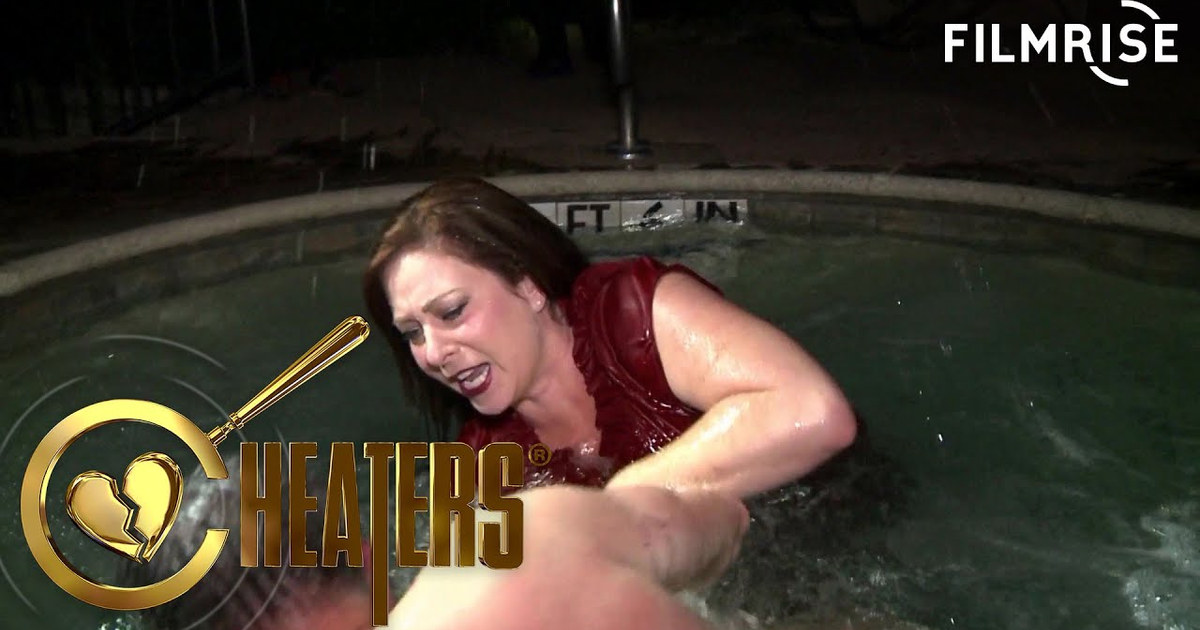
The climax ignites when the production team charges up the exterior complex stairs, bursting into the communal hot tub area where Blaze and Taylor are caught red-handed in the bubbling water.
This is pure combat-style camera work. You leave the smooth fluid head behind, mount battery-powered high-intensity LED light panels directly onto the shoe mounts, and run shoulder-rigged ENG cameras straight into the wet zone.
The sudden punch of hard, unfiltered on-camera lighting strips away every shred of flattering shadow. It immediately mimics police body cameras or forensic spotlights, blowing out the subjects' highlights and casting harsh falloff onto the pool water behind them.
[[AD]]
The camera operators work in full second-unit synchronicity here. While the primary operator tracks Mindy yelling twenty-two years of history through the steam, the secondary B-camera operator circles wide to frame Taylor frozen in the corner of the spa.
When Blaze scrambles out of the water, pushes Mindy toward the pool edge, and denies knowing anyone present, the operators whip-pan across the chaos without blowing their exposure. They ride the iris on the fly while compensating for sudden reflections off wet concrete.
The confrontation drags out into the driveway where Taylor shows off the diamond ring Blaze gave her, and Mindy tells him his divorce papers are coming in the morning. Even under frantic conditions, the crew maintains tight eye-level coverage that anchors the emotional collapse.
[[VIDEO]]
What to Watch for on Your Next Rewatch
The next time you catch an archival episode of Cheaters, ignore the trash-TV reputation and look at the image through the eyes of a field technician.
Watch how the telephoto lenses compress background elements during the early stakeout phase to emphasize surveillance pressure. Notice how fixed wide-angle pinholes use unflattering natural light to make suburban interiors feel cold and clinical.
[[AD]]
Most of all, study the handheld camera choreography during the final confrontation. The camera operators treat high-stress ambushes like second-unit stunt sequences, riding zoom rockers, tracking split-second blocking, and using harsh direct lighting to deliver maximum emotional damage.
Stay tuned for our next camera breakdown where we tear into another iconic unscripted showdown to see how field crews craft drama right on the ragged edge of live capture.


