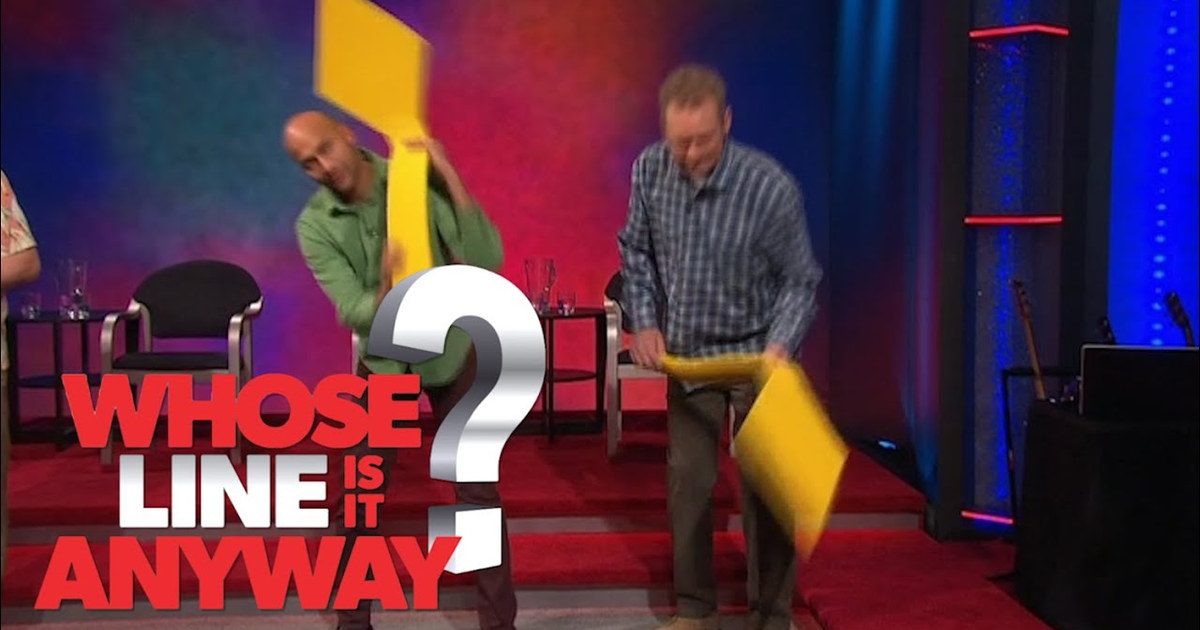
The consensus among comedy purists is that 'Props' is the fluff round of *Whose Line Is It Anyway?*. Conventional wisdom says long-form character games and musical juggernauts represent real improv, while handing two performers odd chunks of foam is just cheap, prop-comic filler designed to burn two minutes of airtime. I think that consensus is completely wrong, and this clash between Ryan Stiles, Keegan-Michael Key, Colin Mochrie, and Wayne Brady proves it.
When host Aisha Tyler hands foam monstrosities to Ryan and Keegan, then tosses another pair of weird shapes to Wayne and Colin, there is nowhere to hide. There is no elaborate narrative runway, no musical director feeding you a chord progression, and zero safety net. You either have instant visual genius or you die on stage.
Stripping away narrative crutches does not lower the bar—it raises the stakes into pure kinetic reflex. Let’s break down why this chaotic game actually separates the legends from the amateurs.
[[AD]]
Dismantling Myth #1: It's Just Lowbrow Slapstick Without Brains
The first major critique is that props comedy requires zero wit—that it’s just silly shapes used for bathroom humor. But look at how fast the conceptual gears turn when Keegan and Ryan step up. Ryan immediately flips his prop into antiquity: 'I think the Roman army could afford better Spears.' Within two seconds, Keegan pivots right into sci-fi lore: 'Spock, the Tribbles seem to be overrunning the ship.'
That is not cheap slapstick; that is encyclopedic pop-culture literacy fired off in microseconds. To make a prop bit land, your brain has to scan history, television, zoology, and anatomy instantly, map that visual silhouette onto an absurd foam wedge, and deliver the punchline before the audience finishes blinking.
When Ryan pulls out 'in its natural habitat, the jellyfish is a beautiful thing to behold,' followed swiftly by a gut-busting medical complaint—'my snake has a hernia'—the humor comes from the shock of reinterpretation. You are watching high-speed cognitive reframing disguised as a gag.
[[AD]]
Dismantling Myth #2: Narrative Improv Requires More Chemistry
Fans constantly praise narrative games for showcasing performer synergy, arguing that 'Props' is too fragmented for genuine collaboration. That argument completely ignores how razor-thin the timing must be when two performers share a prop.
Pairing Keegan-Michael Key with veteran Ryan Stiles exposes how instinctual great improv chemistry really is. Keegan doesn't need a five-minute scene setup to lock into Ryan's rhythm. When Ryan presents an absurd posture, Keegan instantly matches the frequency, framing the visual gag so the crowd's eye knows exactly where to look.
Then look at the other side of the stage with Colin Mochrie and Wayne Brady. Colin and Wayne function as a single comedic organism. They don't have time to negotiate roles; one offers an unrecognizable shape and the other immediately contextualizes it, culminating in dark, unhinged punchlines like 'oh my God, poor Big Bird' and unhinged pirate banter about 'dick chum.'
[[AD]]
Dismantling Myth #3: The Material Is Inherently Disposable
The final rap against 'Props' is that it produces throwaway jokes you forget five minutes after the credits roll. People claim narrative scenes build lasting character moments, whereas prop bits evaporate into thin air. But the raw shock value of a brilliant prop transformation is precisely what stays etched into fan memory.
When Wayne and Colin start escalating with lethal one-liners—'well, that thing won't reproduce on tonight's show' and Colin peering through a foam ring declaring 'let me look through the porthole'—the laughter hits with explosive intensity. It is pure, unfiltered stand-up punchlines delivered at machine-gun cadence.
Because there is no drawn-out exposition to drag the momentum down, every single second has to justify its existence. That urgency creates some of the most replayable micro-moments in the entire history of the series.
[[VIDEO]]
[[AD]]
The Concession: Where the Purists Actually Have a Point
To be completely fair to the traditionalists, there is one legitimate flaw with 'Props': when it dies, it dies hard. In a character-based game, an awkward premise can still be rescued by emotional commitment, clever dialogue, or a mid-scene pivot. Performers have time to dig themselves out of a creative hole.
In 'Props,' you have no narrative scaffolding to cling to. If an actor holds up a piece of foam and the brain misfires, the silence from the audience is deafening. The margin of error is virtually nonexistent, and bad prop comedy feels excruciatingly shallow.
Yet that exact lethality is why the game deserves our ultimate respect. When masters like Ryan Stiles, Keegan-Michael Key, Wayne Brady, and Colin Mochrie nail it, they aren't just messing around with foam rubber—they are executing comedy at the absolute speed of thought.


