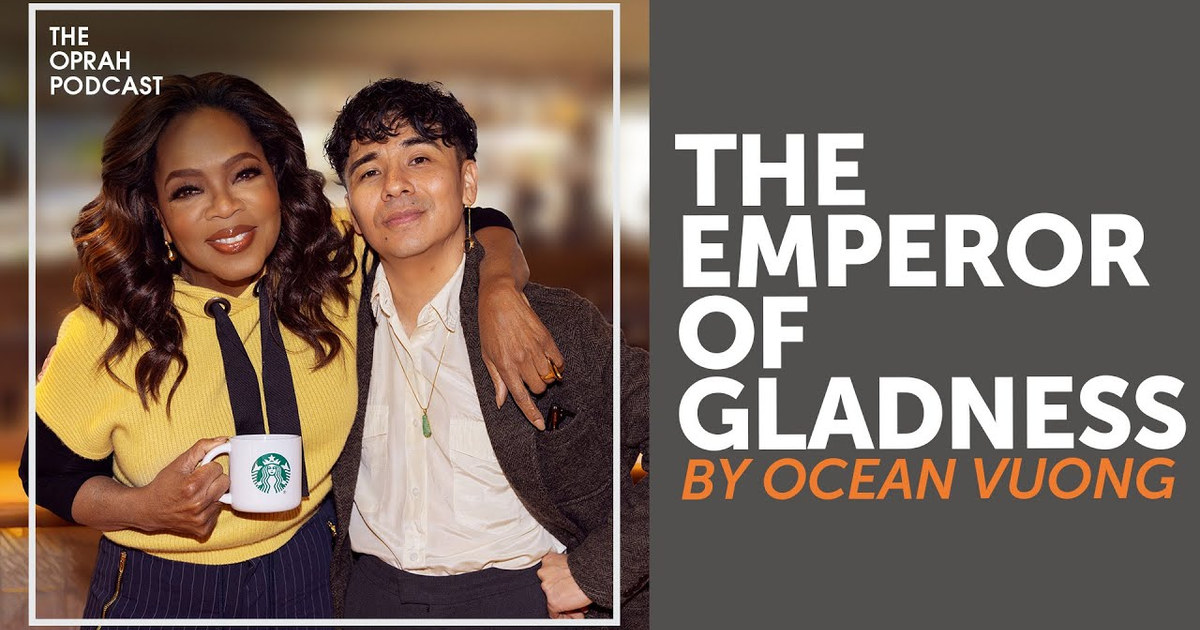
You have probably watched the viral clip by now. Oprah Winfrey sits across from Ocean Vuong in a sunlit Chicago coffee shop, clutching a novel like an open wound, openly admitting she loses sleep over characters who do not exist. On paper, it looks like standard daytime canonization. But beneath the comfortable buzz of espresso grinders lies an uncomfortable question: What happens to the people who never get to leave the town, the shift, or the body they were born into?
For decades, mainstream storytelling has relied on one single, frantic promise. We demand that our working-class protagonists break out, outsmart their postal codes, and ascend into triumph. We love the dramatic arc of the golden ticket. But in his sweeping novel The Emperor of Gladness, Vuong poses an existential challenge to that entire American mythos. He forces us to ask whether dignity can exist in pure stillness.
The MacArthur fellow and celebrated poet sat down for the 114th selection of Oprah’s Book Club to unpack that exact question. His answers dismantle how we think about class, survival, and why we tell stories at all.
[[AD]]
The Circumstantial Family and the Brutal Intimacy of the Clock
To answer what happens to the people left behind, Vuong turns directly to where modern American lives actually intersect: the minimum-wage clock. Long before he was lecturing on modern verse at NYU, Vuong clocked long hours at Panera Bread and Boston Market. He describes these corporate kitchens not as tragic holding pens, but as the real crucibles of human intimacy.
Much like the unglamorous loading docks of Kelly Reichardt’s *Wendy and Lucy* (2008), where economic precarity forms strange and quiet alliances, the service job forces misfits into intense proximity. You learn the tempo of a stranger’s cough. You memorize the exact second their chewing gum loses its flavor. You become bound to people you never chose.
Vuong recalls an older co-worker named Ruben who taught him how to choke down a spinach pastry in the walk-in freezer within thirty seconds. Minutes later, standing back-to-back among frozen boxes, Ruben casually dropped a devastating confession: he had three sons, but only loved one of them. That shocking vulnerability could never happen across a dinner table; it required the cold anonymity of labor to exist.
Vuong argues that this circumstantial family is the overlooked foundation of everyday survival. When biological families fracture and chosen families remain out of reach, the assembly line becomes an accidental sanctuary.
[[AD]]
Throwing Out Aristotle: Why Staying Put Is Not a Failure
Vuong’s second answer strikes directly at the mechanics of classical Western literature. Since Aristotle, writers have been trained to deliver a sharp reversal of fortune. We demand that the pauper turns into a prince, the murder gets solved, or the prodigy gets discovered and whisked away to the capital.
Think of the unforgiving realism in Barbara Loden’s *Wanda* (1970), where the camera refuses to invent an artificial exit ramp for its drifter heroine. Vuong insists that life as he witnessed it simply does not trade in convenient third-act turnarounds. His relatives spent four decades at FedEx and fifteen years behind the counter at Dick’s Sporting Goods. They drove the exact same battered sedans. They never received dramatic promotions.
Yet Vuong refuses to let the literary establishment dismiss these lives as inert or worthless. The commercial hunger for constant personal reinvention feels hollow to those who must stay behind to nurse aging parents or keep younger siblings fed.
By stripping away the Hollywood escape hatch, Vuong locates a radical grace. His novel does not treat remaining in place as a tragic defeat, but as a deliberate act of endurance that carries its own profound weight.
[[AD]]
The Morning After the Bridge: Survival Without Catharsis
This refusal of cheap resolution powers the novel’s opening scene. A nineteen-year-old named Hi climbs onto a bridge, ready to leap, only to be stopped by Grazina, an eighty-four-year-old widow who happens to be doing her laundry nearby. On paper, it sounds like an easy cinematic miracle. In Vuong’s hands, it is merely the opening chore.
Recalling the harrowing emotional fallout of Chantal Akerman’s *Jeanne Dielman, 23, quai du Commerce, 1080 Bruxelles* (1975), where the repetitive labor of daily routine becomes an existential battleground, Vuong looks straight past the averted tragedy. He wants to know what happens when the sirens fade and the drama clears.
Vuong shared with Winfrey that both his sixteen-year-old friend and his twenty-eight-year-old uncle died by suicide. Our culture tends to celebrate the dramatic rescue, but Vuong is haunted by what he calls Day Two. What does your Tuesday look like after you decide not to die? How do you keep moving when the will to live returns, but long-term hope remains completely absent?
The friendship between Hi and Grazina is not built on sweeping epiphanies. It is forged in the quiet daily rhythm of shared survival. Kindness here is not a wealthy indulgence; it is a small, stubborn gift exchanged between people who have zero illusion that the world will magically heal.
[[AD]]
[[VIDEO]]
The Town Square and the Real Measure of Dignity
When you look back at that initial question—what happens to those who never escape—Vuong’s conversation with Oprah offers a moving reframe. Maybe the obsession with getting out was always the wrong metric to begin with.
Vuong reminded Oprah of his childhood spent in a nail salon, watching working-class immigrant women use her four-o'clock broadcasts to master English and gather the confidence to walk across the mall into bookstores. Those women were not seeking an escape hatch from their lives; they were claiming a seat at the table of human culture right where they stood.
The Emperor of Gladness does not offer you the thrill of a grand getaway. Instead, it offers something much rarer: a mirror held up to the beauty of the shift, the beauty of the town that holds you, and the beauty of simply waking up to try again tomorrow.


