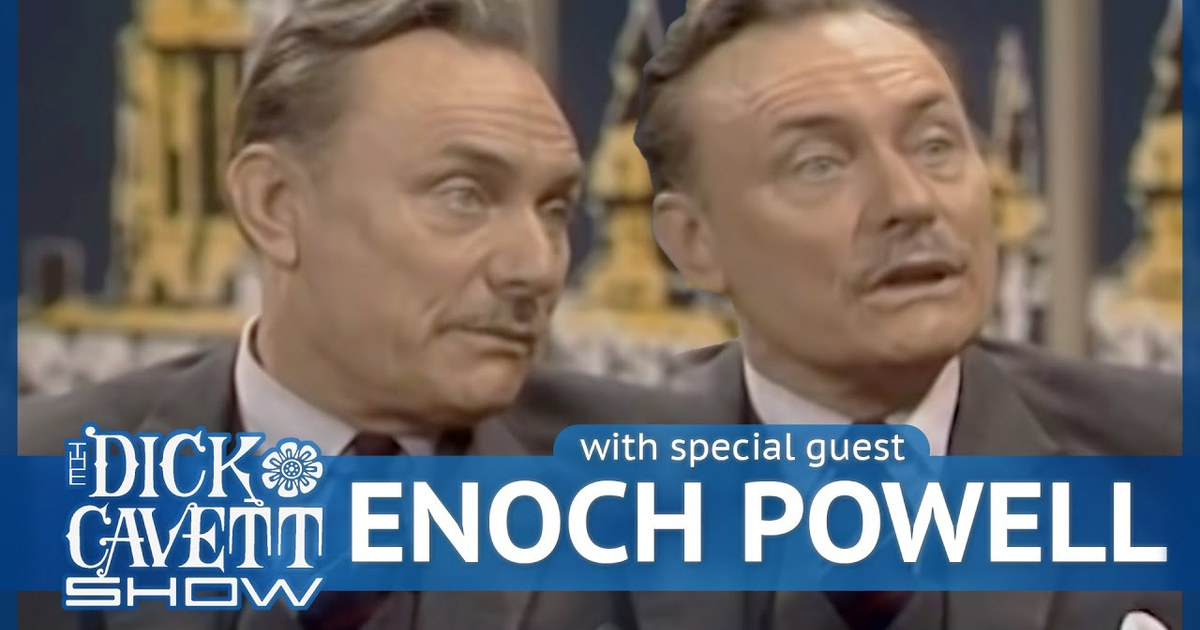
The consensus is that Enoch Powell’s 'Rivers of Blood' speech was an act of pure, unadulterated malice — and I think it is wrong. That is not to say the speech wasn't inflammatory or that its consequences weren't divisive. But to dismiss it purely as a racist outburst is to ignore the structural, legal, and social vacuum that allowed it to happen. If we want to understand how modern political discourse works, we have to stop treating Powell as a caricature and start looking at the mechanics of his argument.
Powell’s brilliance, and his danger, lay in his ability to frame a complex legal failure as a personal betrayal of the 'indigenous' population. While critics focus on the visceral imagery of the speech, they often overlook his critique of the British state’s own incompetence. He wasn't just talking about race; he was talking about a government that had lost the ability to define its own borders or its own citizenry.
[[AD]]
The Legal Vacuum of the British Empire
The most compelling part of Powell’s argument—and the part most ignored by his detractors—is his analysis of the 'British Subject' status. He argued that Britain, unlike France or the United States, never had a clear definition of citizenship. Because of the Empire, everyone was a subject of the Crown. When air travel made mass migration possible, the UK government was essentially caught in a trap of its own making.
Powell’s point was that the state failed to distinguish between a citizen who belonged to the country and a subject who was merely passing through. He wasn't necessarily arguing for hatred; he was arguing that the lack of legal clarity created an inevitable collision course. By failing to define who was 'in' and who was 'out,' the government created a situation where the indigenous population felt like strangers in their own cities.
[[AD]]
The Fear of the Unspoken
Critics often point to the 'Rivers of Blood' speech as the moment race relations in Britain were poisoned. But look closer at the context: Powell was speaking against a Race Relations Bill. His argument was that the bill would do more harm than good because it ignored the underlying fear of the population. He believed that by legislating against discrimination, the government was ignoring the root cause of the tension: the rapid, unmanaged change in community demographics.
The consensus view is that Powell manufactured this fear. But if you look at the public reaction, there was a massive, pent-up relief. People felt that for years, their lives were changing, their neighborhoods were shifting, and the political class was pretending it wasn't happening. Powell didn't create the fear; he gave it a voice. That is a crucial distinction that separates a demagogue from a politician who simply understands the mood of his constituents better than his peers.
[[AD]]
The Myth of the 'Racist' Label
Powell famously dismissed the term 'racist' as a modern term of abuse that is effective precisely because it is undefined. While this sounds like a defensive pivot, he was making a broader point about the import of American political concepts into the British context. He argued that the American experience of race was fundamentally different from the British experience of post-colonial migration.
By forcing the American model of race relations onto Britain, Powell argued that the political establishment was misdiagnosing the problem. He saw it as a conflict of identity and belonging, not just a binary of race. Whether you agree with him or not, his refusal to play by the rules of the 'racist' label forced a conversation that the establishment was desperate to avoid.
[[VIDEO]]
Of course, the strongest counter-argument is that Powell’s rhetoric was fundamentally dehumanizing. Even if his legal analysis of citizenship was accurate, the way he chose to illustrate it—using anecdotes about excrement and elderly women—was designed to provoke a base, emotional reaction rather than a reasoned debate. He chose the most inflammatory path possible, and in doing so, he ensured that the conversation would be defined by heat rather than light.
Next time, we’ll look at how the media’s reaction to Powell actually solidified his influence, and why the 'taboo' surrounding his name only made his ideas more potent in the long run.


