Part 2
She also reveals the quiet professional fallout of her independence. She notes that despite her massive commercial success, the Country Music Association did not nominate her in a single category that year—a snub she casually attributes to the industry's anxiety over her legal disputes. 'I think they thought I would be in jail,' she quips. But behind the humor lies a profound insight into the mechanics of celebrity power: 'Anytime you start to grow in the business, you know how popular you're getting by how many people sue you.' It is an extraordinary admission on network television, cutting through the romantic illusion of show business to expose its mercenary underbelly.
Carson, who endured his own fair share of tabloid scrutiny and contentious litigation over his career, relates to her claustrophobia regarding depositions. He describes the dread of sitting across from a court reporter and feeling like an actor in a Perry Mason drama, waiting for Raymond Burr to jump up and shout accusations. Parton agrees, acknowledging the psychological test of enduring such interrogations: 'It's good to see, test your nerves, you know how strong you are if you have to go through a thing like that.' Here, the critic sees the steel beneath the velvet. This was not a passive starlet caught in the gears of industry machinery; this was an executive enduring the growing pains of total artistic self-determination.
[[AD]]
That self-determination extended directly to her physical preparation for the next phase of her career. Carson comments on her noticeable weight loss, prompting Parton to discuss her impending transition to Hollywood feature films. She was just months away from filming Colin Higgins' workplace comedy *9 to 5* (1980) alongside Jane Fonda and Lily Tomlin. In typical Parton fashion, she describes her transformation not through the lens of Hollywood asceticism, but through self-directed pragmatism: 'I always say that I weighed a hundred and plenty. I'm just saying now that I've lost the plenty.' When Carson remarks on her tiny twenty-two-inch waist, warning her not to lose her signature image, she fires back: 'I can't take all your joke material away from you.'
The Sacred Inner Circle and the Carson Ballad
Beyond the business maneuvering and physical reinvention, what elevates this appearance into legendary status is its exploration of intimacy within the panopticon of fame. Discussing her upcoming run at the Greek Theatre amphitheater in Los Angeles and her future engagements in Las Vegas, Carson asks Parton whether she maintains close friendships in an industry notorious for superficial networking. The question touches on the isolating reality of superstar status, a theme explored with stark melancholy in Billy Wilder's *Sunset Boulevard* (1950).
Parton’s response reveals the fortress she built to protect her private self. While presenting an entirely open, gregarious persona to the public, she reveals that her true confidences are reserved for a circle of exactly four people—chief among them her childhood friend Judy Ogle, who had been by her side since they were seven years old in Sevier County. 'She knows everything about me that anybody could know about another person, but she'd never tell,' Parton says plainly. When Carson jokes about whether they have enough secrets to send each other to prison, Parton meets his gaze: 'We could probably send each other to the chair, or at least do hard time.'
[[AD]]
This distinction between radical public accessibility and fierce private compartmentalization is the secret engine of Parton’s longevity. She gave the public her jokes, her songs, her measurements, and her aesthetic, but she kept her interior life, her marriage to Carl Dean, and her foundational memories under lock and key. The public was invited to the party, but they were never given the keys to the house.
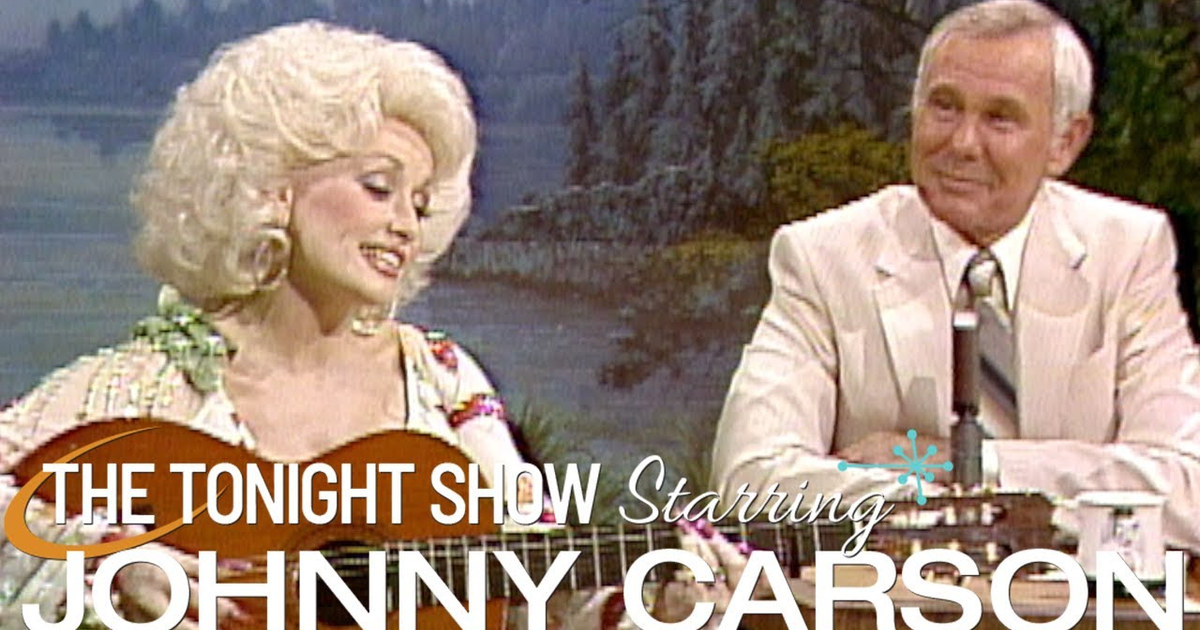
Then comes the coup de grâce: the unreleased, custom-written song Parton brought to the studio. Carson had apparently teased her during an earlier appearance that once she reached peak global stardom, she would outgrow *The Tonight Show* and stop visiting. In response, Parton arrived armed with an acoustic guitar and an original lyrical narrative crafted specifically for Johnny. It was an audacious gesture that collapsed the distance between guest and host, transforming national network airtime into an intimate drawing-room serenade.
[[VIDEO]]
The lyrics of the performance serve as a compressed autobiography of her crossover era. Armed with rhythm, rhyme, and impeccable comic meter, she sings:
'I have come a long way from the hills of Tennessee, / And I've worked hard to make the folks back home real proud of me. / Now everybody knows my name no matter where I go, / But I never really made it until The Johnny Carson Show. / In my bell-bottom jumpsuits with my rhinestones all aglow, / I became an overnight success from The Johnny Carson Show. / From polyester paradise to silk and satin frills, / A 48-foot mobile home to a mansion on the hill. / From moonshine to rare wine, from a Packard to a Rolls, / But I never really made it 'til The Johnny Carson Show.'
The performance operates on multiple intellectual levels. On the surface, it is a playful, flattering gift to Carson, acknowledging his undisputed status as the gatekeeper of American celebrity. But beneath the charm, the lyrics trace the exact sociology of class mobility in late-twentieth-century America. She charts the path from 'polyester paradise' and 'K-Mart' to 'Gucci' and 'penthouse on the coast' with the anthropological precision of a folk poet. She even throws in a wild reference to 1970s counterculture icon Monti Rock III, proving just how deeply she was swimming in the wider media stream.
[[AD]]
Carson’s reaction is priceless. He is visibly touched, yet true to form, he immediately feigns territorial paranoia: 'If I tune into some other show and I see you take my name out and put some other name in there... on the Regis Philbin show!' Parton plays right along, threatening to swap in Barbara Walters. It is pure comedic alchemy, demonstrating why this couch dynamic was never replicated by any subsequent talk show host or guest.
The Anatomy of Modern Celebrity
To watch this 1979 appearance decades later is to witness the blueprint of modern cultural survival. Frank Tashlin's satirical masterpiece *Will Success Spoil Rock Hunter?* (1957) posited that mass television culture would inevitably hollow out the individual, reducing human personality to an artificial corporate commodity. For decades, critics warned that the Hollywood machine was an abattoir for regional authenticity.
Dolly Parton proved that thesis wrong by playing the machine like a Stradivarius. She did not resist the caricatures of late-night television; she absorbed them, amplified them, and reflected them back at the audience until she was the one pulling the strings. When she sang that she 'never really made it' until Johnny Carson validated her, she was acknowledging the terrifying power of the media landscape while simultaneously bending it to her will.
The broader question this broadcast asks—and answers—is whether an artist can achieve total ubiquity without surrendering their core identity. Parton’s victory lay in her complete understanding that the persona was a fortress. By giving Carson, the media, and the public an exaggerated, hyper-articulate, endlessly entertaining version of 'Dolly,' she kept her real art, her genuine loyalties, and her private soul entirely intact. She wasn't just surviving late-night television; she was rewriting the rules of American mythmaking, one flat stretch of highway at a time.


