Part 1
The Seductive Devil: Why We Pay to Go to Hell
You have probably seen the trailer for Over the Top (1997), Tim Curry’s short-lived ABC sitcom, and wondered how the man who once played Dr. Frank-N-Furter ended up as an unemployed actor trading barbs with Annie Potts in a kitchen that looks borrowed from a mid-’90s Sears catalog. The premise—a down-on-his-luck thespian moves in with his ex-wife and her new family—was the kind of high-concept desperation that networks greenlit when they had no idea what to do with a star whose very presence made audiences shiver with delight. And yet, there he was: the same Tim Curry who had once strutted across a castle floor in black lingerie, lip-syncing “Sweet Transvestite” with the confidence of a debauched angel, now reduced to sitcom pratfalls and canned laughter. The dissonance is jarring, but it also raises the question that has followed Curry’s entire career: what makes his villains so irresistible? Why do we pay to go to hell when Tim Curry is the one holding the pitchfork?
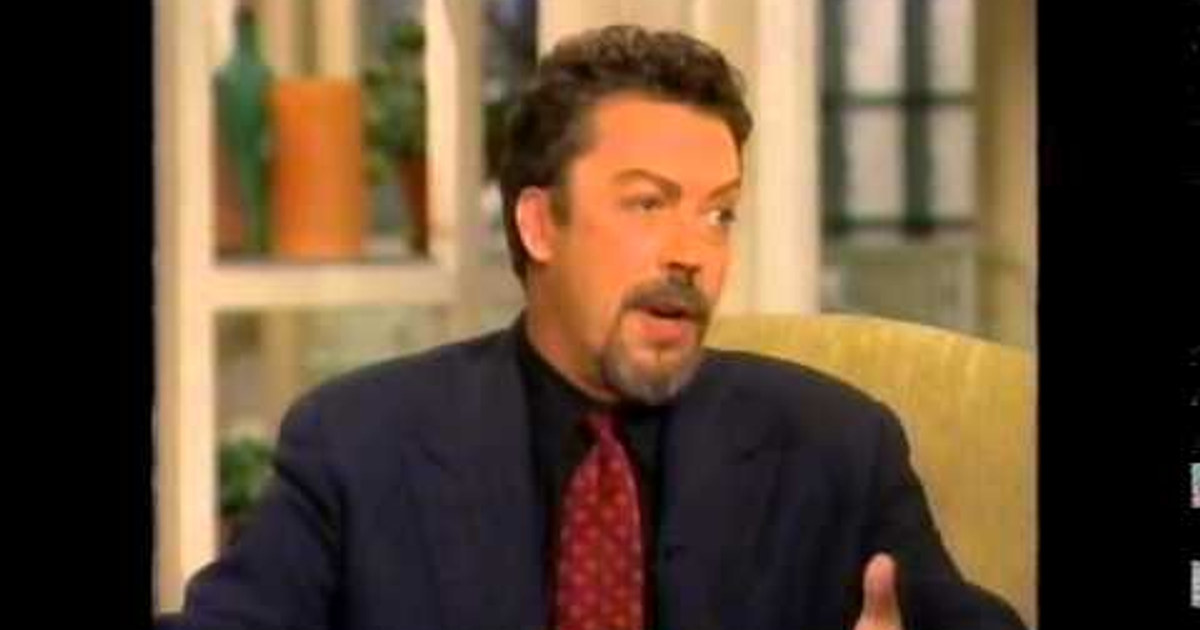
The answer lies not in the roles themselves, but in the seductive intelligence Curry brings to them. In a 1997 interview with Rosie O’Donnell, Curry explained his approach to villainy with the precision of a Shakespearean actor: the villain must be “the guy they love to hate.” It’s a phrase that sounds simple, but it contains a world of nuance. Audiences don’t just fear a great villain; they are drawn to them, fascinated by their logic, their wit, their unapologetic embrace of desire. Curry understood this instinctively. When O’Donnell, giddy with admiration, told him, “If you were the devil, I would pay to go to hell,” she wasn’t just flattering a guest. She was articulating the core paradox of Curry’s career: his evil is so compelling, so charismatic, that it becomes a form of entertainment we willingly consume—even crave.
That seductive quality was forged in the crucible of The Rocky Horror Picture Show (1975), the midnight-movie phenomenon that turned Curry into an icon before he was thirty. As Dr. Frank-N-Furter, the “sweet transvestite from Transsexual, Transylvania,” Curry didn’t play a villain in the traditional sense. He played a hedonistic scientist with a god complex, a creature of pure id who murders, manipulates, and seduces with equal relish. But the genius of the performance—and the reason it has endured for nearly five decades—is that Frank-N-Furter is never merely evil. He is funny, vulnerable, and strangely sympathetic. When he sings “I’m Going Home” in the film’s final act, his voice cracks with a loneliness that undercuts all the camp and carnage. Curry found the humanity in the monster, and audiences responded by making the character a cultural touchstone. The Rocky Horror Picture Show didn’t just launch Curry’s career; it established the template for everything that followed: the villain as a figure of desire.
That template reached its most extreme expression a decade later in Ridley Scott’s Legend (1985), a film that remains one of the most visually sumptuous failures of the 1980s. Curry plays Darkness, the Lord of the Underworld, a creature of pure malevolent seduction. The role required Curry to spend hours in makeup—prosthetic horns, red skin, hooves—yet his performance transcends the latex. His voice, a low, honeyed rumble, is the sound of temptation itself. When he speaks to the innocent Princess Lili (Mia Sara), he doesn’t threaten; he entices. “What is light without dark?” he asks, and the question hangs in the air like incense. Darkness is the devil as romantic antihero, and Curry plays him with a Shakespearean grandeur that makes the film’s otherwise thin plot feel almost mythic. Legend was a critical and commercial disappointment, but Curry’s performance has since been reclaimed as one of the great screen villains of the decade—proof that even in a flawed film, his seductive power could not be ignored.
Then came Pennywise in It (1990), the ABC miniseries adaptation of Stephen King’s sprawling novel. On the surface, Pennywise is the opposite of Frank-N-Furter and Darkness: a child-killing clown who lurks in sewers and feeds on fear. But Curry’s performance is a masterclass in charm as a weapon. His Pennywise doesn’t just terrify; he delights. He cracks jokes, does silly voices, and dances with a balloon. The horror comes from the dissonance—the way that charm can curdle into menace in a heartbeat. When he talks to little Georgie from the storm drain, his voice is warm, almost avuncular. “They float,” he says, and the line is both a promise and a threat. Curry understood that the scariest monsters are the ones who make you want to trust them. Pennywise’s charm is not incidental; it is the mechanism of his predation. And that is why, thirty years later, a generation of viewers still flinches at the sight of a red balloon.
The comparison that best illuminates Curry’s approach is Alan Rickman’s Hans Gruber in Die Hard (1988). Both British actors brought theatrical intelligence and wit to villainy, making evil not just watchable but desirable. Rickman’s Gruber is a study in cool control: the tailored suit, the clipped accent, the way he reads a corporate takeover as casually as a menu. He is the villain as CEO, a man who treats terrorism as a business strategy. Curry’s villains, by contrast, are creatures of excess—flamboyant, operatic, unashamed of their appetites. But what they share is a refusal to play evil as mere thuggery. Both actors understood that a great villain must be the smartest person in the room, and that intelligence is itself a form of seduction. When Rickman’s Gruber says, “I am an exceptional thief,” we believe him. When Curry’s Frank-N-Furter sings, “Don’t get strung out by the way I look,” we don’t just believe him—we want to follow him.


