Part 1
You have probably seen the clip drifting across your social feeds, usually framed by a punchy caption marveling at the sheer wizardry of early-2000s daytime television: a couple walks behind a studio partition looking like an unreleased demo tape from 1986, only to emerge ten minutes later looking like European royalty stepping out of a premiere. It is impossible to look away from. But beneath the viral gasps and the studio applause lies a far more unsettling, universally recognizable dilemma: why do we freeze our personal aesthetics at the exact moment we felt most alive, and what does it actually cost us when we refuse to let the calendar turn?
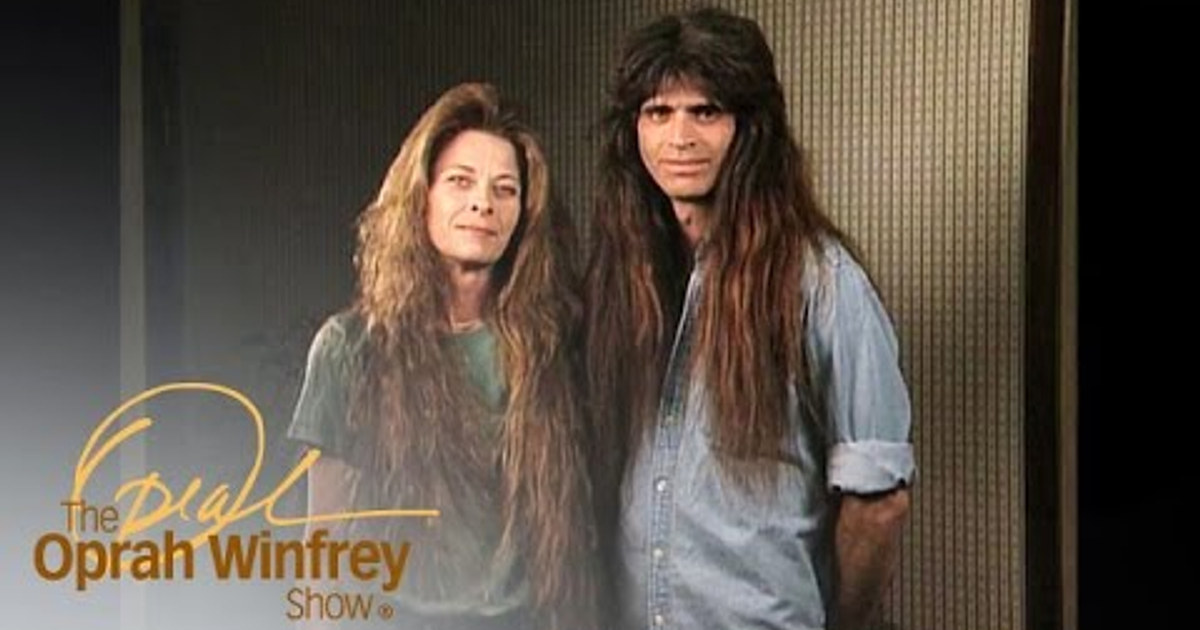
When Tim and Wendy White walked onto the soundstage of *The Oprah Winfrey Show* in 2003, they were not just overdue for a salon visit; they were cultural casualties of their own nostalgia. Married for twelve years and stranded in a suburban suspended animation, the couple had turned their hair into architectural relics of their respective primes. Wendy, thirty-nine, had bound her floor-length locks into an austere, self-described grandma bun since 1992, softening the blow with two desperate ringlets meant to signal residual femininity. Tim, forty-three, was clinging to a mid-eighties bassist fantasy that had long since decayed into frayed ends, unwashed denim, and a silhouette that his friends Kurt and Cindy candidly described as resembling the back end of a galloping horse.
Watching this broadcast two decades after its initial transmission is not merely an exercise in vintage kitsch; it is a masterclass in how television weaponizes the ritual of transformation. The episode poses a profound, deceptively simple inquiry: when we encase ourselves in the aesthetic armor of our twenties, are we protecting our youthful identity, or are we actively suffocating it under decades of dead weight? Across three extraordinary acts of editorial intervention, Oprah and her styling cabal answered that question not with polite incrementalism, but with a visceral, shears-out confrontation of the passage of time.
[[AD]]
The Armor of Domesticated Nostalgia: Wendy and the Anatomy of the Bun
To understand Wendy before the scissors met her scalp is to understand the quiet tragedy of sartorial surrender. At thirty-nine, she confessed to the cameras that she routinely felt between forty-five and fifty years old. Her makeup regimen had remained entirely unaltered for two decades—an era when frosted pastels and heavy liners still ruled department store counters. Her daily uniform consisted of heavy-duty work boots, anonymous denim, and nondescript tees. The hair itself was a fortress: a five-minute ritual of flipping her head upside down, gathering the yardage into a ponytail, twisting it into an unyielding coil, and clamping it with a plastic clip. It was functional, invisible, and devastatingly utilitarian.
Wendy’s aesthetic paralysis calls to mind Julianne Moore’s suffocating domestic exile in Todd Haynes’s 1995 masterwork *Safe*, where female identity becomes trapped beneath the sterile surfaces of suburban routine. But where Carol White retreated into chemical allergies, Wendy White retreated into the hair bun. The bun was not an active choice; it was an abdication of self-worth masquerading as convenience. As she candidly revealed, she longed for the effortless, layered sunshine of Jennifer Aniston—the definitive avatar of early-aughts effortless cool—yet she lived as if beauty was an indulgence she was no longer licensed to claim.
Her friends Kurt and Cindy were not cruel in their televised intervention; they were clear-eyed witnesses to a slow-motion erasure. Cindy noted that the bun made Wendy look like an elderly matriarch before she had even crossed the threshold of forty. The tragedy was not that Wendy was unattractive, but that she had engineered a look designed entirely to avoid being looked at. The two dangling ringlets framing her ears were the most poignant detail of all: a tragic, half-hearted punctuation mark on a sentence that had already run out of breath.
[[AD]]
The Ghost of Sunset Strip: Tim and the Toxic Romance of Stasis
If Wendy’s stasis was born of quiet domestic submission, Tim’s was powered by sheer, stubborn male bravado. Tim was forty-three, admitting on camera that on a bad day he looked sixty. He was a bass player who had spent the mid-eighties chasing the stadium-rock dream, and though the dream had long since packed up its tour bus, Tim kept the scalp of the dream alive. His mane had not met a pair of professional scissors since 1985—a mind-boggling eighteen-year streak of neglect that had left him resembling a faded relic of an era rock history itself had largely forgotten.
There is a deeply cinematic pathos to Tim’s refusal to cut his hair, an echo of Christopher Guest’s satire in *This Is Spinal Tap* (1984), where aging rockers treat their coiffures as sacred talismans against their own mortality. Tim was not merely keeping his hair long; he was clinging to the ghost of his potential. In his mind, the waist-length strands declared him an outlaw, an uncompromised rocker who never sold out to the corporate machine. In reality, as his friend Kurt mercilessly pointed out, the mane had turned him into an exhausted caricature whose best days were perpetually in the rearview mirror.
Tim had even harbored a quiet hope that beneath his matted fortress lay the rugged, chiseled charisma of Mel Gibson in his *Lethal Weapon* pomp. But rock and roll, as Oprah’s broadcast sharply reminded the audience, had moved on through grunge, through alt-rock, through post-punk revivals. By 2003, Tim was not embodying rebellion; he was embodying stagnation. His hair was an anchor pulling both himself and his marriage downward into an inescapable swamp of aesthetic irrelevance.


