Part 1
The Danny Thomas Show episode "Danny Meets Andy Griffith" is the secret origin story of The Andy Griffith Show, and it proves that Mayberry's magic isn't nostalgia — it's the visual and moral geometry of a jailhouse set that turns a stop sign into a thesis about authority.
As a cinematographer who's shot second-unit, I can tell you: the episode opens on a dusty road, high-key sun, and a stop sign with no road. That's a visual gag, sure. But it's also a compositional thesis. Authority can exist without infrastructure. The camera plants Danny Williams' convertible in a wide, flat frame — think a 40mm at T2.8, deep focus, horizon low — with the sign dead center. We're not laughing at Mayberry yet. We're laughing at the absurdity of rules divorced from context. Then Andy Taylor steps into frame.
Danny Williams (Danny Thomas) is the city slicker, a TV entertainer on his way to New York. He's got a roll of cash and a mouth. Andy Taylor (Andy Griffith) is the sheriff who arrested him, the justice of the peace who tries him, and the guy who sets the fine. The transcript gives us the whole exchange: five dollars becomes a hundred or ten days because Danny flashes a roll and says, "Let's get it over with." That's not corruption. It's a lesson in respect, staged in a single room with no cutaways to a real courthouse.
[[AD]]
The Stop Sign With No Road: A Master Shot of Civic Absurdity
Scene beat: Danny's car rolls to a stop. The stop sign is there, but no road. Andy explains the town council voted a road in about six years ago, but only raised enough money for the stop sign. That's the joke. But look at the blocking. Danny is centered, car door open, Andy approaches from frame left. The camera doesn't cut to a close-up of the sign. It holds the wide. Why? Because the absurdity only works if we see the whole empty landscape. It's a master shot that says: this town has rules, but not the ones you expect.
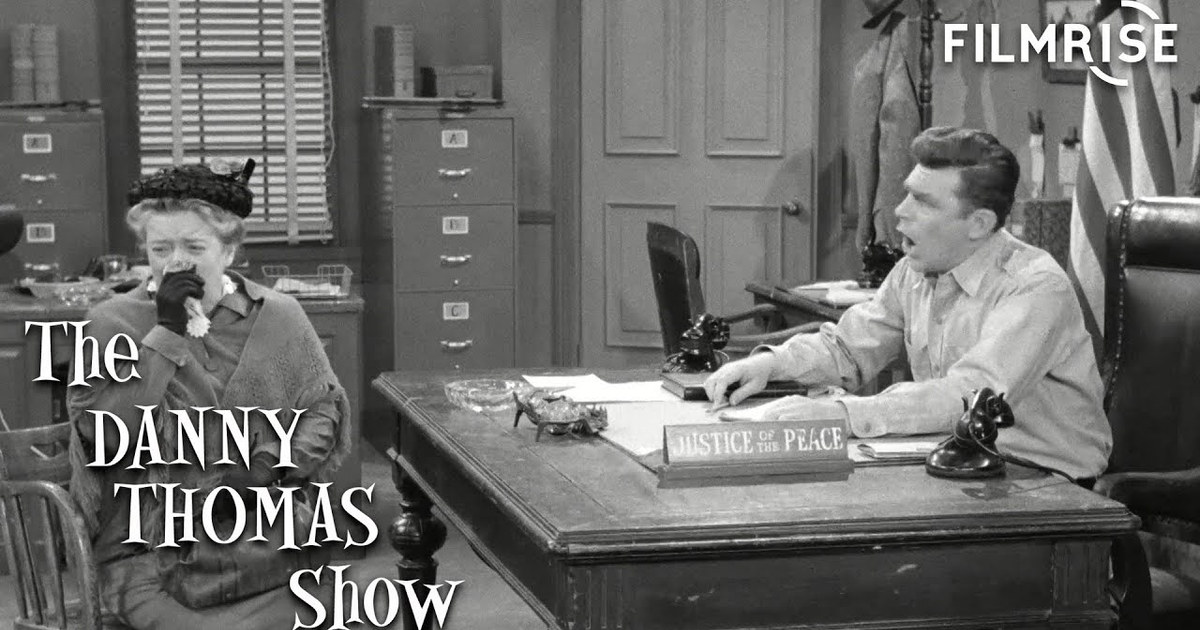
The dialogue is pure small-town logic. Danny calls it a tourist trap. Andy doesn't argue. He just takes him to the justice of the peace. And the justice of the peace is... Andy. The same man. That's the first big reveal. In a normal show, this would be a corruption gag. Here, it's a framing device. The camera keeps Andy and Danny in the same two-shot, no cutaways to a judge's bench. There is no bench. There's a desk, a chair, and a guy who knows everyone in town. The visual grammar says: justice here is personal, not procedural.
[[AD]]
Then the fine. Five dollars. Danny pulls out a roll. Andy's eyes narrow. "Sometimes even ten," Danny says. Andy goes to a hundred or ten days. The transcript: "That's highway robbery." But watch the staging. Danny is standing, pacing, gesturing. Andy is seated, still, hands folded. The camera is low on Andy, slightly high on Danny. It's a classic power dynamic: calm authority vs. agitated outsider. No fancy lens needed. It's just blocking, eyelines, and the decision to let the scene breathe in a wide two-shot.
Notice how the transcript keeps Danny talking about the press, the newspapers, Ted Parker's Face to Face. He thinks exposure is his weapon. But the camera never leaves the room. We don't cut to a newsroom or a TV studio until later. The confinement is the point. Danny is trapped in Mayberry's frame, and he doesn't even realize it yet.
The Jailhouse Two-Shot: Where Andy Taylor Becomes the Anti-Tyrant
Scene beat: Danny is in the cell, calling Ted Parker's Face to Face. He's going to expose Mayberry on national TV. The jail set is small, clean, with a practical window and bars that cast hard shadows. As a cinematographer, I'd light this with a single key from camera left, bounced off the ceiling, and a kicker from the window to separate Danny from the bars. The bars are the frame within the frame. Danny is literally caged, but he thinks he's in control. The irony is visual, not verbal.
Then Opie's turtle dies. Wilfred. Andy consoles Opie. This is the emotional B-story that grounds the whole episode. The lighting shifts to soft, warm, domestic. No bars. Just a father and son. The show is telling us: Andy's authority isn't just legal; it's moral. He's the same guy who fines Danny a hundred dollars and the same guy who buries a turtle with full honors. That's the thesis of Mayberry in one sequence.
[[AD]]
Danny tries to blackmail Andy: lower the fine, and he'll cut the TV show. Andy refuses. "You wouldn't be trying to blackmail me." The camera holds on Andy's face, no cut. That's a choice. In a lesser show, we'd get a reaction shot from Danny. Here, we stay on Andy. The steadiness of the frame is the steadiness of the character. The cinematographer is saying: this is the rock the show is built on.
The transcript also gives us Andy's side of the story: Danny flashed a big roll, said five or ten dollars couldn't mean less to him, and acted like the law was a nuisance. Andy didn't raise the fine because he's crooked. He raised it because a big man has a bigger responsibility to obey the law. That's a radical idea for a sitcom, and the camera sells it by keeping Andy calm, centered, and still while Danny ricochets around the cell.


