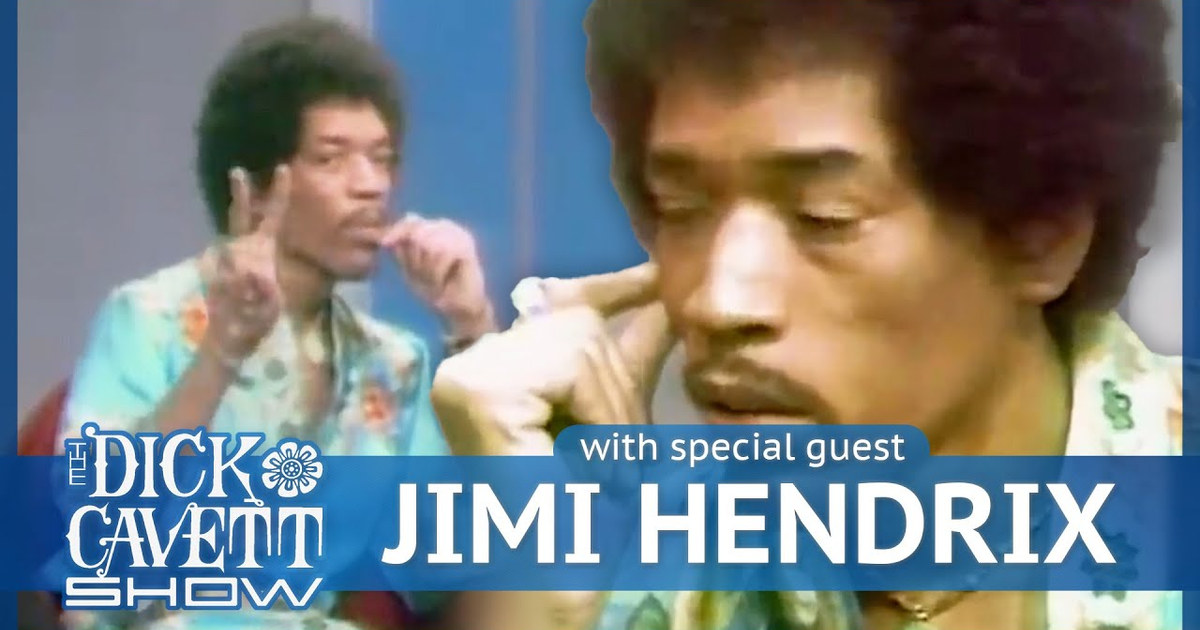
It starts with a hum. Not a musical note, not a riff, but the irritating, persistent buzz of an amplifier on a television set. Dick Cavett, ever the polished host, tries to pin down the source of the noise. Jimi Hendrix, exhausted and raw, offers a philosophical answer instead of a technical one. That moment—the static in the room—is the entire story of Hendrix’s life in the public eye. It wasn't about the music; it was about the noise surrounding it.
We often look back at the 1969 Dick Cavett interview as a relic of a bygone era. But look closer at the rhythm of the exchange. Cavett is trying to cut a trailer for a standard celebrity appearance. Hendrix is trying to cut through the static of his own existence. The tension isn't in what they say; it’s in the space between the questions.
Hendrix admits he’s had eight minutes of sleep. He’s tired. He’s been through the meat grinder of the music industry for three years straight. When Cavett asks about his exhaustion, Hendrix doesn't give the PR-friendly answer. He talks about the 'physical breakdown' of the business. He isn't performing; he’s decompressing in real-time.
[[AD]]
The Myth of the Woodstock Breakdown
The conversation pivots to Woodstock. Cavett wants the headline: 'What really happened?' Hendrix gives him the truth, which is far less dramatic than the rumors. He was tired. The schedule was a mess. It wasn't a grand artistic statement; it was a human being trying to survive a logistical nightmare. That’s the thread we’re pulling today: the disconnect between the icon and the man.
Hendrix’s take on the national anthem is perhaps the most telling moment of the entire clip. To the public, it was a political firestorm. To Hendrix? 'I’m American, so I played it.' He strips away the controversy with a shrug. He wasn't trying to burn the flag; he was just playing the music. The audience, and the critics, were the ones adding the static.
This is the core of the Hendrix experience. He was a man who lived in the present tense, while the world insisted on projecting their own anxieties onto his guitar strings. He didn't have time to worry about what his old army buddies thought of his life. He was too busy trying to find the next sound.
[[AD]]
The Circus of Celebrity
Hendrix calls the music industry a 'circus.' He describes how people feed on the artist, moving from one act to the next, always hungry for the new thing. He’s not bitter, just observant. He knows he’s a commodity. He knows the 'supergroups' are breaking up because the pressure to be a brand is heavier than the joy of being a musician.
He talks about his own process—how he doesn't practice in the traditional sense. He jams. He creates. He makes mistakes because he’s constantly pushing into new territory. A violinist practices to perfect the note; Hendrix practices to find the note he hasn't heard yet. That’s the difference between a technician and a visionary.
When Cavett asks about his future—marriage, a sitcom, a normal life—Hendrix just smiles. He’s already moved on. He’s not looking for a script. He’s looking for the next jam. He’s the only person in the room who isn't trying to sell anything.
[[VIDEO]]
Cutting the Noise
So, we return to the static. The hum of the amplifier. The irritation of the background noise. Hendrix spent his career trying to tune it out, to focus on the melody, to keep the violence and the hate mail at bay. He succeeded, not by fighting the noise, but by playing through it.
He was a man who lived eight minutes of sleep at a time, yet he gave us a lifetime of sound. He didn't need the starch in his collar or the approval of the critics. He just needed the guitar. And in that moment on the Cavett show, beneath the lights and the cameras, he was the only one who truly understood the frequency.
Stay tuned for our next deep dive, where we analyze the specific gear Hendrix used to turn that static into the most iconic sound of the 20th century.


