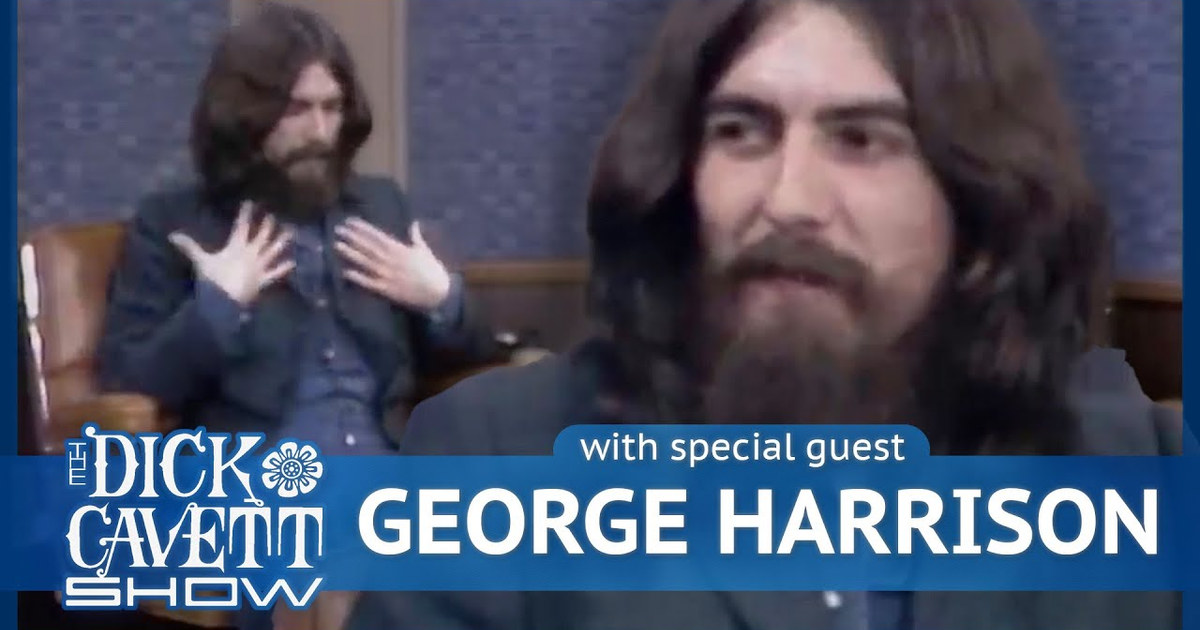
George Harrison stares at the cluster of cameras, his brow furrowed in a mix of amusement and genuine, low-level agitation. He’s not performing for the lens; he’s trying to locate his own reflection in the machinery of fame. It is a small, human moment—a man caught in the crosshairs of a broadcast—that perfectly encapsulates the friction between the person and the icon. He doesn't know where to look because, for years, the world has been looking at him.
This wasn't just another talk show appearance. It was 1971, the dust of the Beatles' dissolution was still settling, and Harrison was sitting across from Dick Cavett, trying to navigate a post-Beatle existence that felt both like a relief and a strange, new wilderness. The interview serves as a time capsule, capturing a man who had finally stepped out of the shadow of Lennon and McCartney, only to find that the spotlight followed him everywhere.
The conversation is remarkably grounded, stripping away the psychedelic veneer often associated with the era. Harrison is dry, cynical, and surprisingly open about the mechanics of his own discomfort. He isn't interested in the myth-making; he’s interested in the reality of the work, the frustration of the creative bottleneck, and the strange, lingering anxiety that comes with being a global celebrity.
[[AD]]
The Myth of the 'Quiet' Beatle
One of the most enduring labels in rock history is that of the 'Quiet Beatle.' In this interview, Harrison dismantles that trope with a shrug. He suggests that his silence wasn't a personality trait but a survival mechanism. When you are surrounded by the towering, often exhausting personalities of John and Paul, silence becomes a strategic retreat. It wasn't that he had nothing to say; it was that he didn't feel the need to compete for the airtime.
Harrison admits that he never craved conversation for the sake of it. He could sit in an empty room for days, perfectly content. This revelation reframes his entire tenure in the band. He wasn't the wallflower; he was the observer. While the others were busy defining the cultural zeitgeist, Harrison was internalizing the experience, waiting for the moment he could finally express his own musical vocabulary.
He also addresses the rumors of hostility toward Yoko Ono with a refreshing lack of drama. He dismisses the idea that she was the sole cause of the band's collapse, noting that the cracks were there long before she arrived. It’s a mature, pragmatic take that cuts through the tabloid noise of the time, revealing a man who had moved past the blame game and into a state of acceptance.
[[AD]]
The Creative Bottleneck
Perhaps the most poignant part of the discussion is Harrison’s reflection on his songwriting. He candidly admits that he felt held back during the Beatles' peak. With a quota of only one or two songs per album, he had a backlog of material that was essentially being stifled. He describes the process of writing not as a formal, academic exercise, but as an intuitive act—keeping melodies in his head, working them out on guitar, and trusting his memory over sheet music.
This frustration explains the explosion of creativity that followed the breakup, most notably with 'All Things Must Pass.' When the dam finally broke, the music that poured out was massive, spiritual, and deeply personal. He wasn't just writing songs; he was reclaiming his identity. He speaks about the relief of leaving the 'previous incarnation' behind, comparing it to a child growing up and leaving home.
He acknowledges the irony of his position: he wouldn't be on the show if he hadn't been a Beatle, yet he is desperate to be recognized for the work he is doing now. It’s a classic struggle for any artist who has been part of a massive collective—how do you leverage the past without being consumed by it?
[[AD]]
The Anatomy of Anxiety
Harrison’s honesty about his nerves is striking. He describes the physical sensation of anxiety as something that comes from 'everywhere at the same time.' It’s a visceral, abstract feeling that meditation helps with, but doesn't entirely erase. Even at the height of his fame, he was susceptible to the same human frailty as anyone else. He isn't a god; he's a man trying to manage the weight of an audience.
This vulnerability makes his music resonate even more. When you listen to his solo work, you aren't just hearing a former Beatle; you’re hearing someone who has grappled with the noise of the world and found a way to quiet it. He is a seeker, not just a pop star.
[[VIDEO]]
Returning to that opening moment—George looking at the cameras, unsure of where to focus—we realize he was never really looking for a camera. He was looking for a way out of the performance. He wanted to be a musician, not a spectacle. By the end of the interview, the cameras are still rolling, the lights are still bright, but Harrison has managed to carve out a space for himself, one sentence at a time.
Stay tuned for our next deep dive, where we explore the spiritual evolution of Harrison’s songwriting and how his time in India fundamentally altered the trajectory of Western pop music.


