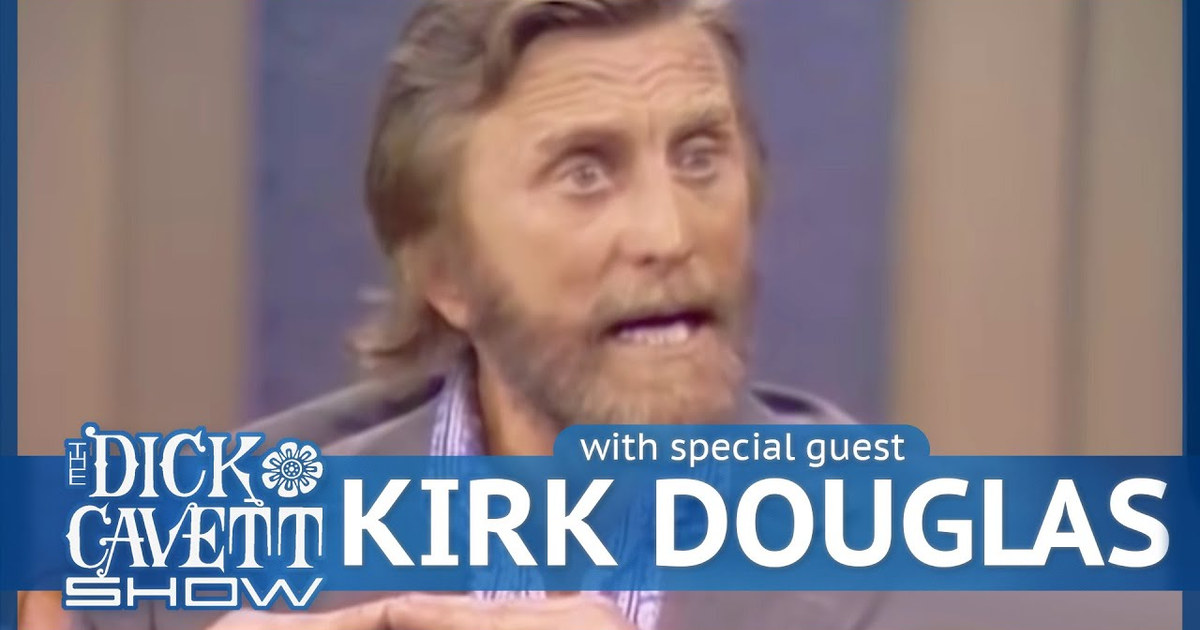
You have probably seen the clip—that grainy, frantic footage of Kirk Douglas sprinting for his life in 'The Light at the Edge of the World' (1971), pursued by a horse sporting a lethal, unicorn-like horn. It’s the kind of visceral, practical-effect chaos that makes modern CGI look like a screensaver. But the question that lingers isn't just about the spectacle; it’s about the cost. What does it actually take to make a movie feel 'real' when the camera is rolling, and is the physical toll on the performer worth the aesthetic gain?
Douglas, a man whose chin is as famous as his filmography, treated his body like a prop department. In his candid reflections on his career, he reveals that the 'Golden Age' of Hollywood wasn't just about glamour; it was about broken noses, dangerous horse falls, and the relentless grind of international location shooting. Much like Buster Keaton in 'The General' (1926), Douglas understood that the audience can smell a fake from a mile away.
When Douglas recounts the filming of 'The Indian Fighter' (1955), he isn't bragging about the box office; he’s talking about the mechanics of a horse fall. He describes the specific, terrifying signal used to force a horse to collapse—a maneuver that left him with a permanently crooked nose. It’s a stark reminder that before the safety protocols of the digital age, the line between a cinematic triumph and a trip to the emergency room was razor-thin.
[[AD]]
The Professionalism of Giants
The conversation inevitably turns to John Wayne, a man who occupied the same cinematic stratosphere as Douglas but existed in a different orbit entirely. Douglas’s take on 'The Duke' is refreshingly devoid of the usual sycophancy. He acknowledges the political chasm between them—referencing Wayne’s controversial views on land and indigenous history—while simultaneously praising his work ethic. It’s a nuanced take that feels rare in today’s binary culture.
Comparing their dynamic to the legendary friction between Robert De Niro and Al Pacino in 'Heat' (1995), Douglas highlights a professional respect that transcends personal ideology. They were two titans who rarely saw eye-to-eye, yet on the set of 'The War Wagon' (1967) or 'Cast a Giant Shadow' (1966), they were the first ones on the call sheet. For Douglas, professionalism wasn't about being friends; it was about showing up and doing the work.
Wayne was, by all accounts, a giant—literally and figuratively. Douglas notes that finding a horse big enough to carry him was a logistical nightmare. But it’s this commitment to the 'giant personality' that defined the era. They weren't just actors; they were brands, and they carried the weight of their respective mythologies into every frame, regardless of the personal cost.
[[AD]]
The Global Grind and the Jules Verne Legacy
Moving beyond the Western, we find Douglas chasing the ghost of his own success. His pivot to 'The Light at the Edge of the World' was a direct attempt to recapture the magic of '20,000 Leagues Under the Sea' (1954). There is a palpable weariness in his voice when he discusses the production—the reliance on Spanish banks for financing and the isolation of shooting in remote locations.
This was the reality of 1970s international co-productions. Much like the sprawling, exhausting shoots of David Lean’s 'Lawrence of Arabia' (1962), these films required the lead actor to essentially live in exile. Douglas admits to being tired of the travel, of being separated from his family for the sake of a vision. It’s a humanizing admission that strips away the veneer of the 'movie star' and reveals the weary traveler underneath.
The film itself, with its bizarre, high-concept premise, serves as a testament to a time when studios were willing to bet on weird, ambitious projects. It wasn't just about the script; it was about the spectacle of the location and the sheer audacity of the stunt work. It was a dying breed of filmmaking, one that valued the tangible over the virtual.
[[VIDEO]]
The Legacy of the Broken Nose
So, does the physical toll pay off? Looking at the footage of Douglas running from that horned horse, the answer feels like a resounding yes. There is a texture to that performance—a genuine, adrenaline-fueled desperation—that you simply cannot replicate with a green screen. It is the art of the 'human' element that Douglas so fiercely defends.
We live in an era of sanitized, perfectly rendered action sequences. We have lost the crooked noses and the genuine danger that defined the mid-century blockbuster. Douglas, in his own way, was a relic of a time when the star was expected to be as tough as the character they portrayed. He didn't just play the hero; he endured the hero's journey, scars and all.
Next time, we’ll dive into the transition from the practical stunts of the 70s to the dawn of the blockbuster era, and how the 'Douglas approach' eventually gave way to the 'Spielberg spectacle.' Stay tuned as we explore how the industry traded the broken nose for the box office record.


