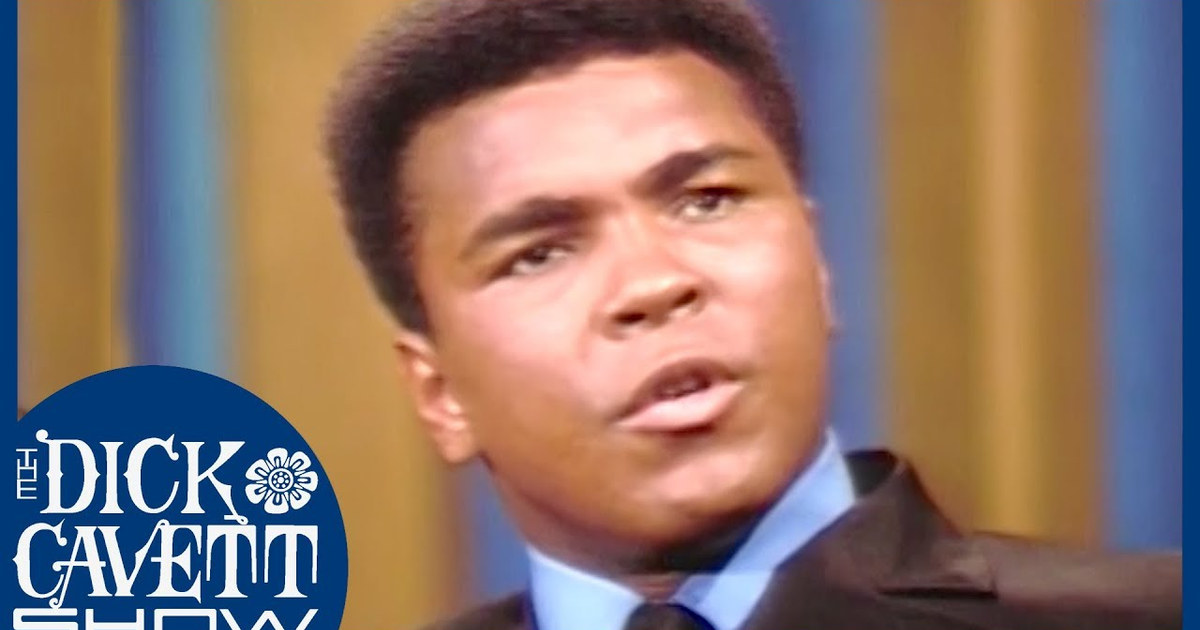
The camera cuts. The studio lights hum. Muhammad Ali sits there, not as a boxer, but as a man who has already calculated the cost of his own freedom. He isn't talking about footwork or the jab. He is talking about the architecture of a cage. When he looks at the interviewer, he isn't just answering a question; he is dismantling the premise of the entire conversation. It is a masterclass in narrative control.
This wasn't just an interview. It was a tactical strike. Ali understood that every word he uttered was a punch thrown in a much larger ring. He didn't just fight for titles; he fought for the right to define his own reality. In this moment, the 'Champ' persona drops, revealing a man who saw the world not as it was, but as a series of systemic traps he refused to walk into.
He speaks of his life outside the ring—the schools, the restaurants, the autobiography—but he keeps returning to the specter of the prison cell. It is the thread that holds his entire philosophy together. To Ali, the physical jail was merely a formality. He had already identified the invisible bars that had held his people for centuries.
[[AD]]
The Geometry of Sacrifice
Ali’s logic was brutal and precise. He compared his potential incarceration to the sacrifices of pioneers and soldiers. He didn't see himself as a victim; he saw himself as a participant in a historical cycle where progress demands a toll. By framing his own struggle alongside the history of space exploration and war, he elevated his personal defiance to a universal struggle for agency.
He wasn't interested in comfort. He was interested in the cost of freedom. When he mentions the thirty million dollars a day spent in Asia, he is pointing to the hypocrisy of a system that values expansion over existence. He saw the 'white man's burden' not as a mission of civilization, but as a machine of destruction. It is a cold, hard look at the mechanics of power.
This is where the rhythm of his speech shifts. He stops playing the role of the athlete and starts playing the role of the historian. He isn't just reacting to the interviewer; he is correcting the record. He challenges the romanticized versions of history, stripping away the polish to reveal the violence underneath.
[[AD]]
The Myth of the Peaceful Paradise
The interviewer tries to push back, citing the 'paradise' of Tahiti, but Ali doesn't blink. He cuts through the romanticism with surgical efficiency. He refuses to accept the binary of 'civilized' versus 'savage' that the interviewer attempts to impose. For Ali, the system was built on war, and he wasn't going to let anyone pretend that the foundations were anything but blood-soaked.
He argues that the drive to conquer, to shoot, and to dominate is a learned behavior, a systemic output. He isn't just critiquing a policy; he is critiquing a worldview. He looks at the television, the movies, and the history books, and he sees a pattern of aggression that he refuses to be a part of. It is a powerful, uncompromising stance.
The tension in the room is palpable. You can see the interviewer struggling to maintain control, but Ali is already three moves ahead. He is not just a guest; he is the director of the scene. He forces the interviewer to confront the reality of the 'long sentence'—the history of black experience in America.
[[AD]]
The Final Bell
As the interview winds down, the weight of his words lingers. He wasn't just talking about boxing or burgers. He was talking about the fundamental right to exist outside of someone else's definition. He knew that the system would try to lock him away, but he also knew that he had already escaped the only prison that mattered: the one in his own mind.
[[VIDEO]]
Ali’s legacy isn't just in the highlight reels or the championship belts. It is in these moments of raw, unfiltered truth. He showed us that the greatest fight isn't against an opponent in a ring; it's against the narrative that tries to keep you small. He was the champion of his own soul, and that is a title no one could ever take away.
Stay tuned for our next deep dive, where we analyze how Ali’s media strategy changed the way athletes interact with the press forever. The fight is far from over.


