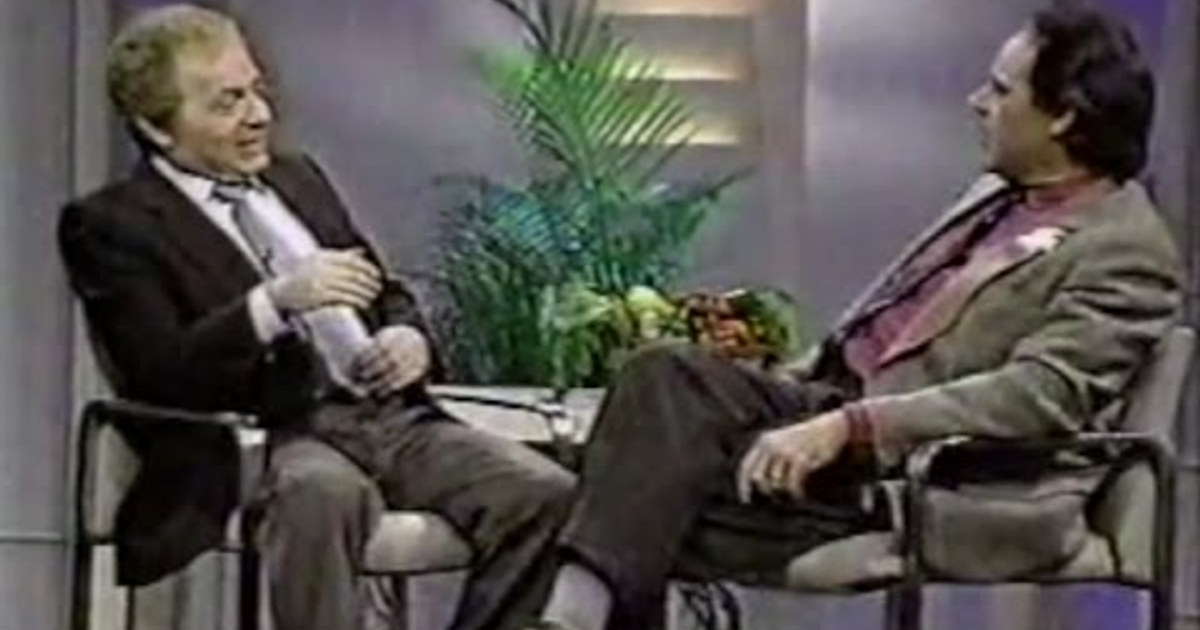
You have probably seen the archival clip drifting across your social feed: a compact, fiercely kinetic man with an unmistakable Lower East Side cadence holding court opposite comedy club patriarch Budd Friedman, slicing through social decorum with surgical precision. The exchange moves with the speed of an unscripted tennis rally, crackling with an intensity rarely seen in contemporary media. Yet beneath the rapid-fire complaints about working for free and avoiding Wednesday matinees lies a much deeper interrogation of American life: Why does our culture routinely ignore an artist's blistering truth until it arrives wrapped in the high-prestige velvet of legitimate theater?
For two and a half decades, Jackie Mason had been delivering essentially the same razor-sharp comic sociological treatise across stale nightclub floors, catty banquet halls, and Catskills resorts. He was perpetually dismissed as too ethnic, too caustic, or simply too confrontational. Then, in 1986, he mounted his landmark one-man Broadway showcase, *The World According to Me!*, at the Brooks Atkinson Theatre, and the critical establishment suddenly hailed him as a prophetic satirist. The routine hadn't softened; the world had simply moved the goalposts.
What this historic broadcast preserves is not a celebrity doing routine late-night promotional legwork, but a master craftsperson dismantling the delicate lies of upward mobility, familial hypocrisy, and entertainment commerce in real time. Mason was never just a joke merchant. He was a dialectician armed with a microphone, using grievance as an epistemological tool to lay bare the absurdities of modern consumer society.
[[AD]]
The Prestige Trap: How Legitimacy Transforms the Lowbrow Truth
When Friedman presses Mason on his newfound cultural acclaim, Mason cuts straight to the economics of audience psychology. He expresses zero surprise at his own comedic brilliance; rather, he registers sheer bewilderment at the sudden collective awakening of critics who had spent twenty-five years stepping over his material. The difference, Mason explains, is not the caliber of the insight, but the architecture of the venue.
In a comedy club, as Friedman affectionately remembers from the scrappy early days of the Improv in the mid-1960s, audiences are preoccupied with ribeye steaks, drink minimums, and seducing their companions before the check arrives. The comic on stage is an impediment to romance—a loud distraction wedged between appetizers and the car ride home. Compare this to the ritualistic quietude demanded by dramatic staging in Mike Nichols's definitive direction of *The Gin Game* (1977), where the ticket price alone forces middle-class viewers to sit forward, shut up, and parse every line as an exquisite pearl of wisdom.
By moving his act from smoke-choked cabaret cellars to the legit theater boards, Mason leveraged the prestige bias of highbrow culture against itself. He understood that Broadway patrons listen with reverent silence simply because they have been trained to associate velvet seats and proscenium arches with intellectual profundity. The routine was identical; the audience was merely shamed into paying attention.
[[AD]]
The Paradox of Capital: Why the Millionaire Can Never Stop Working
Mason’s most penetrating critique during the sit-down tackles the grotesque paradox of American work ethic. In an impromptu monologue that rings with the biting economic clarity of Thorstein Veblen’s *The Theory of the Leisure Class* (1899), Mason observes how the pursuit of money completely subverts the capacity to enjoy it. Rather than earning capital to purchase leisure, the successful worker becomes prisoner to an unceasing calculus of theoretical loss.
If a laborer unable to turn a profit decides to take an afternoon off, Mason notes, they forfeit mere pocket change; their rest is tranquil because their time carries negligible market value. But the multimillionaire who steps away from the wheel calculates their lost hours in four-figure deficits. They work themselves into chronic physical degradation, arriving at age eighty-seven with forty million dollars and an absolute inability to rise from their armchair. They sacrifice life itself on the altar of compound interest.
This caustic observation dismantles the myth of the triumphant self-made magnate. In Mason's calculus, the so-called street bum enjoys far more existential freedom than the executive chained to sixty-hour work weeks. It is a merciless deconstruction of the Protestant work ethic delivered without academic jargon, echoing the tragic disillusionment that defined Arthur Miller's *Death of a Salesman* (1949)—yet packaged with enough rhythmic punch to draw continuous roars of laughter.
[[AD]]
The Domestic Myth: Dismantling 'Quality Time' and Polite Society
Nowhere does Mason ignite more sparks than when turning his gaze toward the sanctified institutions of marriage and fatherhood. Unburdened by the obligation to appear wholesome, he attacks the contemporary buzzword of 'quality time' with unapologetic ferocity. Drawing on a contemporary study of Ivy League graduates, he highlights that the average father spends barely ninety minutes a week in active communion with his offspring, hiding behind corporate excuses while reserving infinite energy for extracurricular affairs.
For Mason, 'quality time' is simply the polite linguistic disguise society invents to cover up profound parental absence and guilt. He insists that children do not require theoretical love or intermittent performance art; they require presence. The emotional vacuum created by absent parents, he argues, fuels modern adolescent alienation far more than any external social contagion. It is a sentiment delivered with the furious domestic indictment found in Philip Roth's *Portnoy's Complaint* (1969), daring to question whether compulsory family formation does more psychological harm than deliberate bachelorhood.
His refusal to marry or participate in domestic traditions is presented not as a moral failing, but as an act of radical personal honesty. Why contract a legal partnership that automatically forfeits half your estate just to satisfy outdated societal expectations? In Mason's worldview, staying single and knowing your own emotional limits is vastly more noble than marching into a suburban existence you have neither the patience nor the desire to maintain.
[[AD]]
[[VIDEO]]
Watching Mason spar with Friedman underscores an essential truth about mid-century American comedy: its greatest practitioners were street philosophers who refused to play along with polite society's delusions. Long before late-night talk shows became tightly controlled publicity parades overseen by public relations teams, broadcasts like this offered actual collisions of personality and worldview.
The Outsider's Ultimate Triumph
Ultimately, the conversation brings us back to the initial puzzle of artistic validation. Jackie Mason succeeded not because he bent his sensibilities to appeal to mainstream tastes, but because he outlasted the culture's reluctance to confront itself. He remained obstinately, unapologetically specific—retaining his accent, his grievances, and his refusal to run on the corporate treadmill.
The question is never whether the artist is speaking truth; it is whether an audience has developed the emotional courage to stop mistaking packaging for substance. Next time you catch an archival masterclass of this caliber, ask yourself what other voices our culture is currently tuning out simply because they are speaking in the wrong room.


