Part 4
Let me take you back to Michigan for a second, because this is where the 49ers should have seen it. Brady arrived and there were seven quarterbacks on the depth chart. Scott Dreisbach. Brian Griese. Jason Carr. Scott Leffler. He was not the guy. He pushed Griese for the starting job as a sophomore. The coaches said tie goes to the upperclassmen. Brady was furious. He thought about transferring. He thought about going home to California. Then he came back the next day, sat down in front of his coach, and said, 'I am not going to leave and I am going to prove to you that I am the best quarterback.' There is no stopwatch for that. There is no vertical jump for that. That is the whole story. That is the kid the 49ers had 20 minutes away. That is the kid the Patriots took at 199.
His senior year, he had to fend off Drew Henson, a two-sport phenom from 20 miles outside Ann Arbor. Henson was the most highly touted athlete to come to Michigan in memory. Faster. Stronger. Quicker. More elusive. Better arm. 'Can't miss' written all over him. One NFL personnel director said he understood why Michigan kept giving Henson more opportunities because his upside was so much higher than Tom Brady's. But Brady was the captain. He was the leader. He was the best quarterback on that team. When Michigan got down 17 to Michigan State, Brady came off the bench and threw for 241 yards in the final 18 minutes, nearly bringing them back. A week later he threw for 307. That is the tape. That is the intangibles. The 49ers saw the tape. They still passed.
So the 49ers drafted Giovanni Carmazzi in the third round. A quarterback from Hofstra. Not Brady. The 49ers had season tickets for 25 years. They knew the family. They knew the high school. They knew the kid. And they still took Carmazzi. It 'hurt' to pass on Brady. That is the word. Hurt. Imagine being in that draft room. You have Joe Montana's shadow on the wall. You have a local kid who grew up dreaming about your uniform. You have a sixth-round pick you could use as a flier. And you take the other guy. I am not saying Carmazzi was a bad pick. I am saying the 49ers talked themselves out of the greatest quarterback of all time because he did not look the part in shorts.
Meanwhile, in New England, Bill Belichick is sitting in a draft room. The Patriots have already signed Drew Bledsoe to a huge contract. They have three quarterbacks on the roster. They do not need a quarterback. But Belichick sees Brady still on the board in the fifth round. The Patriots have a scouting report from Bobby Greer. They have that phone call. They have a kid who guaranteed he would be worth it. And they take him with pick 199.
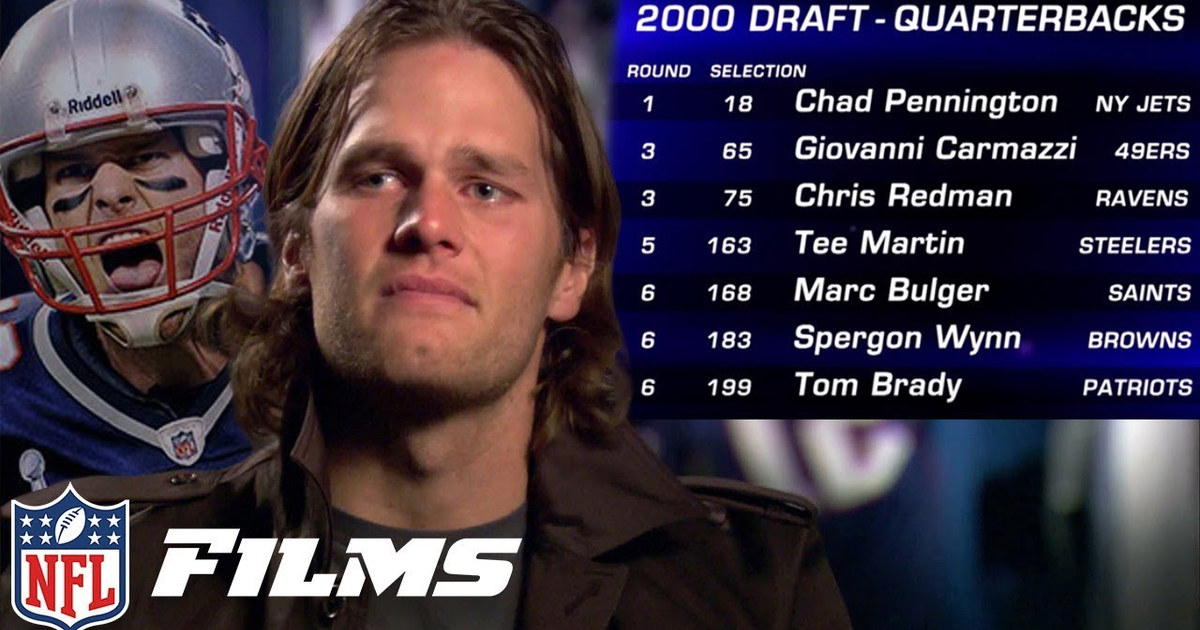
Pick 199. Let that sit. The Patriots had already used pick 70 on Adrian Klemm. They took J.R. Redmond. Greg Robinson-Randall. Dave Stachelski. Jeff Marrion. You know what those names have in common? Nothing. None of them made a lasting impact. They are trivia answers. They are the guys you skip when you are scrolling through the 2000 NFL Draft on Pro Football Reference. And then, at 199, the Patriots took Tom Brady. The greatest of all time. In the sixth round. After six quarterbacks. After Giovanni Carmazzi. After Chad Pennington. After Chris Redmond. After Tee Martin. After Spurgeon Wynn. After Marc Bulger. The list of names ahead of him is a haunted house for NFL scouts.
If you want the full deleted-scenes version of this, watch The Brady 6. It is a 2011 ESPN documentary about the six quarterbacks drafted before Brady. It is not just a highlight reel. It is a cold case file. You see the scouts. You see the grades. You see the reasoning. And you realize that the NFL did not miss Brady because they were lazy. They missed him because they were human. They trusted the stopwatch over the film. They trusted the combine over the comeback. They trusted the arm over the brain. Then watch Tom vs Time on Facebook Watch. Then Man in the Arena on ESPN+. Then The Dynasty on Apple TV+. You will see the same theme over and over. Brady was never the most talented. He was the most determined. He was the most prepared. He was the most pissed off. And that is why he lasted 23 seasons. That is why he won seven Super Bowls. That is why he is the GOAT.
That is the part that should scare every fan of every team. The draft is not a science. It is a guess with a budget. You can measure height. You can measure weight. You can measure hand size. You can measure the 40. You cannot measure the thing that made Brady Brady. You cannot measure the way he read a defense before the snap. You cannot measure the chip on his shoulder. You cannot measure the way he walked into a meeting room after being told he was not good enough and said, 'I am not going to leave.' You cannot measure the way he took a 17-point deficit against Michigan State and almost erased it. You cannot measure the way he sat behind Brian Griese, waited his turn, and then won 10 of his final 11 games as a starter. You cannot measure the way he looked at Bobby Greer and promised him a lifetime of no regrets.
The 49ers had every advantage. They had the local connection. They had the fandom. They had the Montana memories. They had the season tickets. They had the high school down the street. And they still passed. The Patriots had none of that. They had a sixth-round pick. They had a backup plan. They had a kid who was ranked 576th out of 576 in athletic testing. And they struck gold.
That is why Brady's story is not just a football story. It is a reminder that the things that make a great quarterback are often invisible. Leadership. Work ethic. Ability to read defenses. Poise in the pocket when a 300-pound lineman is about to rearrange your ribcage. You cannot put those on a stopwatch. You cannot put them on a scale. You cannot put them on a vertical jump. The experts missed. The Patriots did not. And the rest of the NFL spent two decades wondering how they let the greatest of all time slide to pick 199.
If you are a 49ers fan, I am sorry. I know it hurts. You had Joe Montana. You had Steve Young. You had a dynasty. You did not need Tom Brady. But you could have had him. You could have had the local kid who worshipped Montana, who cried in the stands when Dwight Clark jumped, who dreamed of wearing red and gold. Instead, you got Giovanni Carmazzi in the third round and a lifetime of what-ifs. That is the NFL. That is the draft. That is the difference between a phone call and a stopwatch.
And that's why they play the games.


