Part 1
The Night Dolly Parton Pulled a Gun on 42nd Street
The wall is cold against her back. It is 1968, or close enough, and 42nd Street is running its usual gauntlet of neon and noise. A man has her pinned there, one hand flat against the brick beside her head, and he is not listening. He has been told no in every way a woman from the Smoky Mountains knows how to say it. Her friend Judy is laughing. Not because it is funny, but because she has never seen Dolly mad before, and the sight of her—big hair, tiny frame, mouth full of cussing—is apparently the most entertaining thing on the block. The man laughs too. He thinks it is a show. Then Dolly stops cussing. She looks at him and says, 'If you touch me one more time, I'm going to shoot you.' She means it. She has a gun in her purse. Her daddy gave it to her before she left home.
That is the scene. It is not the 1964 senior trip. That first New York was the World's Fair, the year 'Hello, Dolly!' was on Broadway, and a bunch of country kids from Tennessee rode the subways and saw the marquee everywhere and thought the whole city was welcoming Dolly by name. She rubbed that in with her friends for years. The second trip was different. She had moved to Nashville by then, and she and Judy—friends since childhood—came up together with no money and no plan. They took the cheapest room they could find. They did not know they had booked themselves into the wrong block of 42nd Street, where, as Dolly puts it, the prostitutes ran in pairs for safety. The hotel locked them out, sure they were turning tricks. Their luggage sat in the hall. They waited hours at the airport to go home.
She tells it now like a comic set piece. The callback is right there: '9 to 5,' the 1980 movie where Jane Fonda's character threatens to change a man from a rooster to a hen with one shot, and the later musical where the line gets a laugh every night. But underneath the laugh is something real. A young woman from the mountains learned that the city can read you wrong—your hair, your clothes, your accent—and that you can survive it anyway. The gun is not a joke in the moment. The joke is how she tells it now, decades later, with the timing of a woman who has turned fear into material.
The first New York was a story she could rub in her friends' faces. The second New York was a story she did not tell for years. She says she did not come back for a long time. That silence is the real ending of the scene. It is also the beginning of everything else—the songs, the movies, the empire built on a voice that could fill a stadium and a laugh that could fill a room. But in 1968, on 42nd Street, there was no empire. There was a girl, a gun, and a friend who laughed because she had never seen Dolly mad.
Now she does not have a gun. She has bodyguards. 'So don't get any ideas,' she says, and the joke lands because the fear was real, and because she has outlived it. The wall on 42nd Street is still there, somewhere, but Dolly Parton is not pressed against it anymore. She is the one telling the story.
The Grass Is Blue: How the Mountains Came Back into the Music
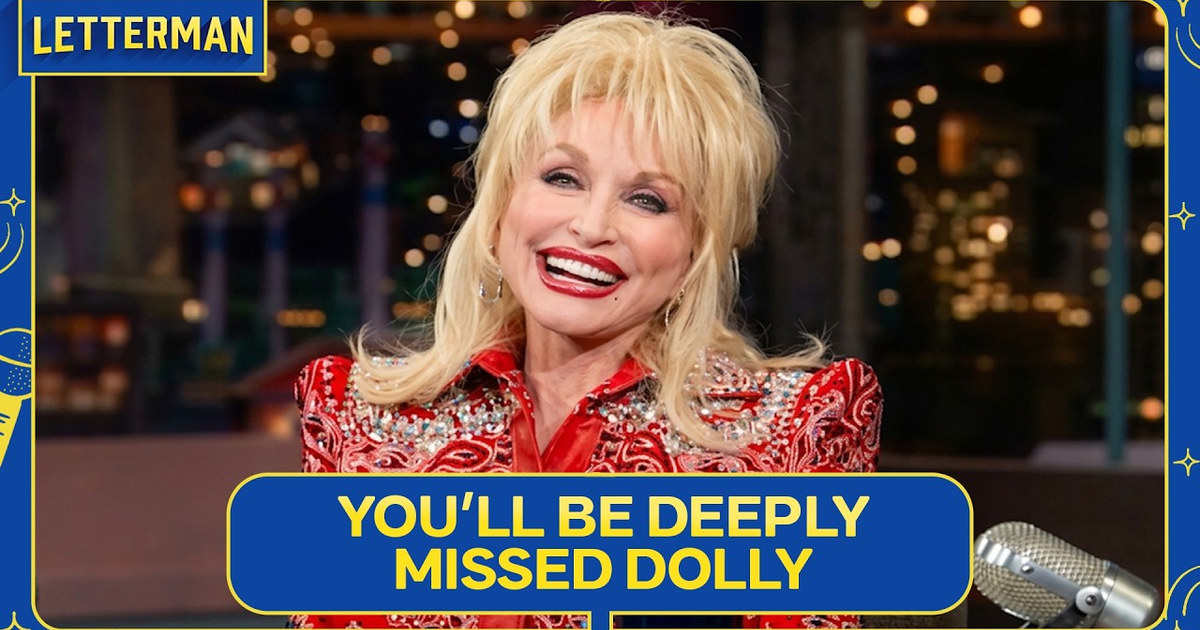
The same woman who once pressed her back against a wall on 42nd Street and told a man she would shoot him is now sitting on a late-night couch, laughing about it. The city that scared her half to death is the city that now claps for her. That reversal is the spine of everything that follows. Because somewhere between that frightened country girl and this welcome-home moment, Dolly Parton went back to the mountains — not to hide, but to bring them with her into the studio.
She is here to talk about an album called The Grass Is Blue. It came out in 1999 on Sugar Hill Records, a label with deep roots in bluegrass and Americana. The record earned her a Grammy nomination for Best Bluegrass Album. Her cover of Billy Joel's Travelin' Prayer also picked up a nomination for vocal performance. She performed that song on the Grammy telecast. And when the conversation turns to awards, she shrugs it off the way she shrugs off most things: she says she has about six Grammys across her career, for different things with different people. Not a trophy case she polishes. Just a life's work, scattered across categories.
But the real story isn't the nominations. It's the sound. And to understand the sound, you have to understand the distinction she draws — in her own words, not a critic's. Bluegrass, she says, is fiddle, mandolin, banjo. Mountain music is guitar, dulcimer, autoharp. Two different toolkits. Two different textures. She calls what she does Blue Mountain music. That's her coinage. Because the Smokies are the Blue Mountains. And her brother Floyd wrote a song called Blue Mountains. So when she says "Blue Mountain music," she isn't reaching for a genre label. She's reaching for home.
That's the thing about Dolly Parton. She doesn't talk about music like a musicologist. She talks about it like a carpenter talks about a hammer. The fiddle and the banjo are one set of tools. The guitar and the dulcimer are another. She knows the difference in her hands, in her throat, in the way a song sits on a porch versus the way it sits in a honky-tonk. So when she decided to make a bluegrass record, she wasn't chasing a trend. She was picking up the instruments that sounded like the place she came from.


