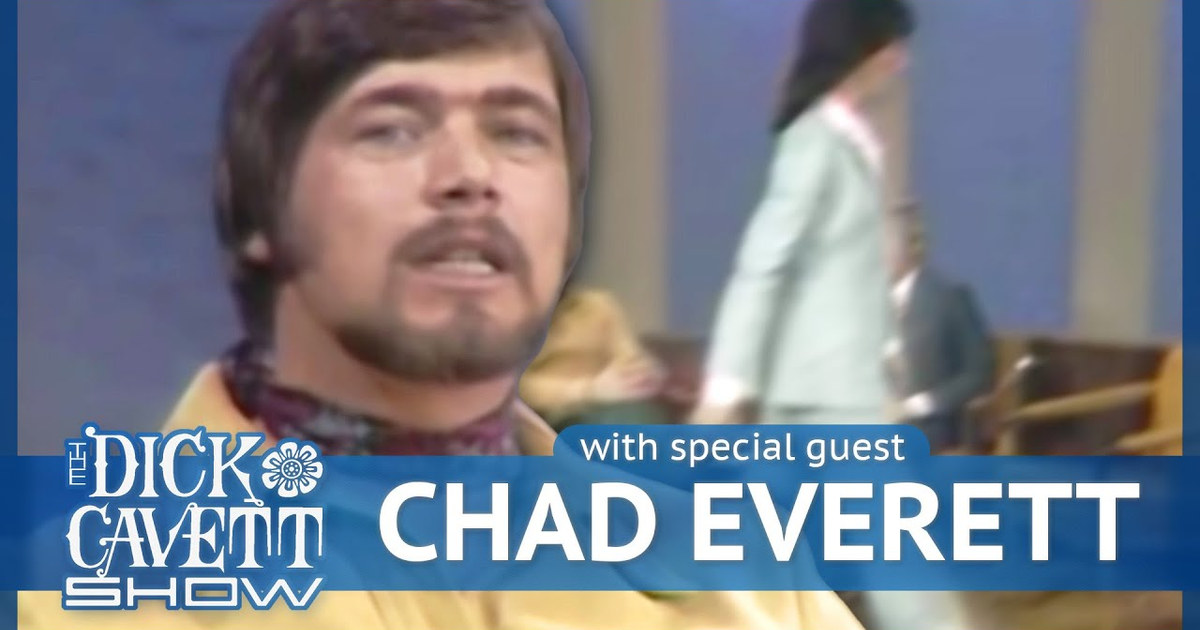
You have probably seen the clip—that surreal, slightly chaotic moment where a young Chad Everett sits on a talk show couch, explaining how a studio executive literally threw a football at his head until he agreed to change his name from Ray Crampton. It is a moment that feels like a fever dream of 1970s television, but it raises a question that still haunts every corner of modern celebrity: How much of a star is a person, and how much is a product?
In an era where personal branding is a 24/7 job, Everett’s story feels less like a relic and more like a blueprint. He wasn't just an actor; he was a vessel for a studio's vision of what a leading man should be. Much like the way Cary Grant was meticulously crafted from the raw material of Archibald Leach, Everett’s transition from a regular guy to a household name reveals the machinery of fame that we often pretend doesn't exist.
The irony, of course, is that the more a star tries to assert their 'real' self—through talk show anecdotes or personal projects—the more the audience seems to crave the mask. We want the charm of the 'Medical Center' star, not the guy who was worried about his name tag at Warner Brothers. It is a delicate dance between authenticity and artifice.
[[AD]]
The Anatomy of a Name Change
The football-throwing executive story is more than just a funny anecdote; it is a masterclass in the power dynamics of the Golden Age of television. When Everett describes the office as '6,000 square feet,' he is painting a picture of a world where power was physical, spatial, and absolute. It reminds one of the stories surrounding the rise of Rock Hudson, where the studio system acted as both a creator and a cage.
Why does this matter today? Because we are currently living through the democratization of that same process. Today, you don't need a studio head throwing a football to rebrand; you have social media algorithms and PR teams. Yet, the goal remains the same: to create a persona that is palatable, memorable, and marketable. Everett’s struggle to remain 'Ray' while being 'Chad' is the original version of the modern influencer’s struggle to keep their private life private while monetizing their public image.
It is worth noting that Everett eventually embraced the name, and in doing so, he gained a career that spanned decades. He understood, perhaps better than his contemporaries, that the name was a key. It opened doors that 'Ray Crampton' never could have touched. It is the same logic that drives modern stage names and curated online personas—the realization that the name is the first line of the script.
[[AD]]
The Vulnerability of the Leading Man
Beyond the name, there is the matter of the 'special'—the documentary work Everett did regarding animals. It is a pivot that feels remarkably modern. In the 70s, this was seen as a quirky side interest, but today, we would call it 'brand alignment.' Everett’s genuine passion for animals, coupled with his willingness to narrate documentaries, allowed him to soften the edges of his 'Medical Center' persona.
Think of this in the same vein as Paul Newman’s transition from screen idol to philanthropist and food entrepreneur. Both men understood that a career in Hollywood is fragile. You need a secondary layer, a cause, or a passion project to ground you when the cameras stop rolling. For Everett, that grounding was his family and his animals, even if the talk show format tried to turn those things into punchlines.
The segment where he recites his poetry is particularly telling. It is awkward, it is earnest, and it is entirely un-ironic. In a world of curated 'authentic' posts, there is something almost jarring about seeing a star be so openly sentimental. It forces us to ask: Do we actually want stars to be real, or do we just want them to be better at pretending?
[[AD]]
The Fire and the Aftermath
Everett’s description of the California wildfires—the vacuum of oxygen, the way a house can vanish in five minutes—is a chilling reminder of the volatility of life in the spotlight. It is a perfect metaphor for the career of a television star. You can spend years building a 'masonry' house of a career, only for a sudden shift in public taste or a 'firestorm' of controversy to leave you with nothing but the memory of what was.
He speaks about the experience with a strange, detached calm. It is the voice of someone who has learned that the only way to survive in Hollywood is to accept that everything is temporary. Much like the characters he played, he had to be ready to rebuild. It is a stoicism that feels rare in today’s hyper-reactive culture.
[[VIDEO]]
Ultimately, Chad Everett serves as a mirror for our own obsession with identity. We are all, in a sense, trying to decide which version of ourselves to present to the world. Whether you are a struggling actor in a 6,000-square-foot office or a creator trying to find your voice online, the lesson remains the same: the name you choose, the stories you tell, and the passions you defend are what define you.
Next time, we will dive into the darker side of the 70s talk show circuit, where the line between guest and prop became dangerously thin. You won't want to miss how these 'casual' interviews actually set the stage for the reality TV explosion that would follow decades later.


