Part 1
Every television sequence that outlives its broadcast cycle tends to attract two distinctly separate categories of viewer. The first type arrives purely for the genre dynamics: they want the social release of the rivalry, the crowd-pleasing ritual, and the sheer dopamine rush of an arrogant patriarch getting humbled at the kitchen table. The second type approaches the screen like a systems architect examining legacy code: they watch the blocking, the rhythmic deployment of setups and payoffs, and the precise mechanical tolerances required to make four actors and a card deck feel like an airtight game engine.
When you dissect this legendary card table confrontation, both viewers walk away completely validated. You have the infectious spectacle of an overdue head-rubbing wager paid out in full view of an ecstatic studio audience, but beneath the surface noise sits an extraordinarily disciplined loop of comedic pacing. It is comfort television constructed with the exactitude of an integrated circuit.
Watching Cliff Huxtable realize he has walked into an inescapable checkmate isn't just satisfying family room drama; it is a masterclass in how multi-camera production handles tension, misdirection, and the inevitable distribution of domestic justice.
[[AD]]
The Genre Layer: The Thrill of the Long-Awaited Payoff
From a purely genre-focused perspective, multi-cam sitcoms are built on the persistent asymmetry of domestic power. Parents hold the leverage, set the curfews, and usually dictate the rules of engagement. For seasons on end, children absorb lessons, endure lectures, and swallow losses. The genre viewer watches for the rare, calculated structural inversion where the younger generation flips the script without breaking the family compact.
Theo’s setup here is pure triumph. Winning the final trick isn't simply an isolated card triumph; it activates a legacy house rule that has hung over Cliff's head for years. The rule itself is simple, tactile, and designed for pure comedy: win every trick, and you earn the right to rub the opponent's head. Cliff has weaponized this custom against his son for an entire lifetime, turning every prior defeat into an affectionate humiliation.
When Theo announces that he has never rubbed his father's head in all his years, the scene establishes high emotional stakes disguised as living room trivia. The audience roars because they recognize the shift in momentum: the predator has become the quarry, trapped by the very game parameters he designed.
[[AD]]
The Engineering Layer: Blocking, State Machines, and Pacing
If you look at the sequence as an engineer, the mechanics are remarkably tight. A four-player card game inside a three-wall proscenium set is notoriously tricky to stage. Four actors sitting around a square table can easily obstruct camera sightlines, muddy reaction shots, or dilute punchlines if the cutting rhythm falls out of sync with the physical gestures. Notice how every character occupies a discrete role in the state machine.
Theo operates as the active executioner, holding the camera's primary focus as he orchestrates the reveal. Dr. Foster functions as the wild-card accomplice, withholding his confirmation until maximum comedic pressure is applied to Cliff. Meanwhile, Grandpa anchors the generational line, offering quiet validation to the ambush. The playing cards themselves act as visual state indicators, counting down the operational steps until the final trump card lands.
When Theo invokes Hamlet with 'Ay, there's the rub,' it isn't an arbitrary cultural riff. It is a precise conversational clutch-drop, braking the natural momentum of the card game just long enough to prime the studio audience for the physical payload. The joke operates as both an intellectual pun and a literal trigger condition for the physical comedy that follows.
[[AD]]
The Execution: When Physical Comedy Meets Relational Dynamics
Physical comedy often fails when it relies on aggression rather than earned consequence. Here, the genre viewer feasts on Cliff’s desperate bargaining. 'Just remember, I'm your father,' he pleads, attempting an eleventh-hour administrative override against an airtight social contract. It fails instantly because the comedic code does not permit soft exits.
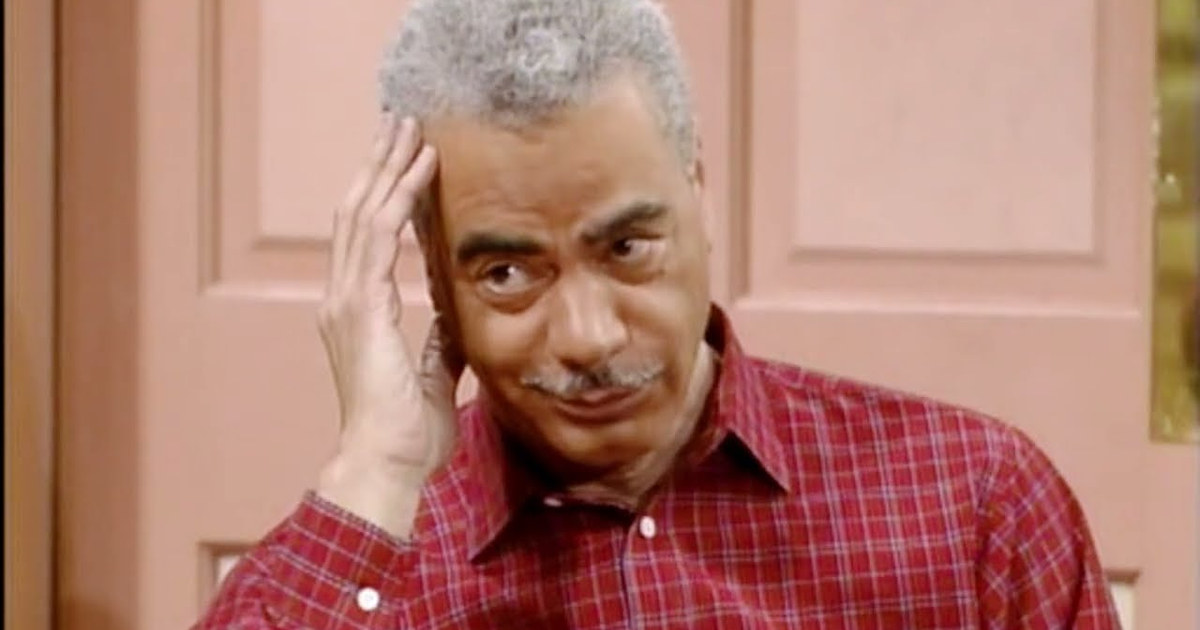
For the craft-minded analyst, observe the physical choreography of the rub itself. Dr. Foster receives the first ceremonial swipe, which tests the water and establishes the tactile reality of the penalty. Then Theo steps in for the primary target. The hand movement, the facial compression from Bill Cosby, and the singsong cadence of 'The rubbing of the head' create an irresistible auditory and physical feedback loop.
The physical contact is prolonged past the initial laugh break into uncomfortable, delightful excess. The actor playing Cliff waits until the exact decaying tail of the third studio wave before deadpanning, 'Are you through?' It is an immaculate lesson in comedic decay rates and micromanaged physical timing.
[[AD]]
The Second Act: Inspecting the Post-Game Debrief
A lesser sitcom sequence would terminate the scene right at the card table applause. But high-tier television writing avoids hard stops; it pipes the output of one scene directly into the input of the next. As the cards are cleared, the conflict effortlessly shifts from competitive victory to domestic accountability over bowls of 'winner's ice cream.'
Cliff begins running forensic analysis on the card game after the fact. He questions the sudden appearance of Dr. Foster and points out the suspicious timing of partner Chuck's sudden illness, demanding a doctor's note for the next game night. It is a brilliant psychological flourish: the defeated competitor attempting to invalidate the match logs after the server has already settled the score.


