Part 2
[[AD]]
The mandate here was aggressive modernism. The graying bouffant, the stiff teasing, and the kitchen-sink wash had to be obliterated to make room for soft movement, rich brunette undertones, and contemporary framing. Victoria Principal’s cosmetic lab supplied the pigments, scrubbing out the garish bubblegum-pink lipstick and replacing it with the warm, dewy neutrals that defined the turn-of-the-century California aesthetic. It was an aesthetic intervention designed to bridge the chasm between Joan’s chronological age of sixty-three and the vibrant fifty-year-old she claimed to feel like internally.
[[AD]]
Yet this transformation also highlights the sheer ruthlessness of the mid-2000s makeover industrial complex. The daughters' plea was framed around emancipation—letting their mother 'let her hair down'—but the execution required her total submission to an urban beauty elite. Joan had to surrender the ritual that had organized her Wednesday mornings since the Johnson administration. In exchanging her shellacked monument for Ken Paves’s flowing layers, she was forced to relinquish the only defense mechanism she had relied on for more than half her life.
The Ecstasy of Unveiling: The Studio as Secular Cathedral
No one understood the dramaturgy of the reveal quite like Oprah Winfrey. Before Joan even emerged from the backstage holding area, Oprah masterfully ratcheted up the domestic stakes by looking at the anxious daughters and delivering the ultimate daytime television benediction: 'Your mom now looks like your sister.' In eight words, Oprah didn't just promise aesthetic improvement; she offered temporal regression. She promised the daughters that the aging maternal figure who had annoyed them with her rigid habits had been magically transformed into an ageless peer.
When the double doors slide open and Joan steps onto the stage, the studio erupts into the specific brand of hysterical catharsis that only Harpo Studios could manufacture. The screaming from the audience is deafening, raw, and almost devotional. The camera catches Cindy and Christine collapsing into frantic tears and disbelief, while Oprah herself steps back, visibly overwhelmed, before unleashing her iconic, joyful bellow: 'Hush my mouth, girl!' It carries the exact emotional frequency of the dramatic family confrontations in Douglas Sirk's *All That Heaven Allows* (1955), where the private lives of suburban women are subjected to the intense scrutiny of a judgmental, weeping chorus.
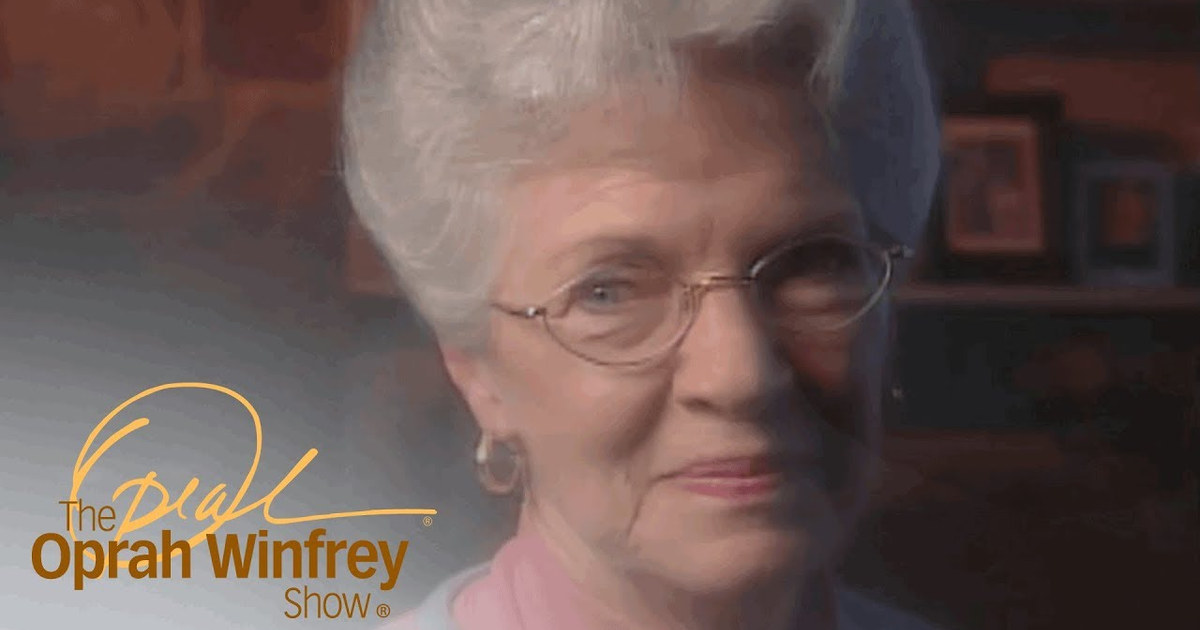
The woman who walks out is fundamentally unrecognizable. The stiff, gray trapezoid is gone, replaced by a lush, layered mane of caramel-tinted hair that bounces with kinetic freedom with every step she takes. The denim-and-khaki armor has been stripped away in favor of sleek, flattering tailoring that asserts her physical vitality. For the first time in thirty-seven years, Joan’s face is not subordinate to the structure hovering above it. Her bone structure is restored; her neck is elongated; her posture is dynamic rather than defensive.
[[AD]]
What makes this particular unveiling so potent is the complete absence of cynicism in the room. In our current media landscape, dominated by hyper-curated social reels and heavily staged transformations, we instinctively look for the seams, the sponsored brand alignments, or the staged reactions. But here, the ecstatic shock on Joan’s face when she sees herself, coupled with her daughters' weeping embraces, feels overwhelmingly honest. The studio audience isn't merely applauding a haircut; they are celebrating an escape.
[[VIDEO]]
The Surrender of Armor: Reframing the Transformation
To return to the question this explosive segment asks: what are we actually watching when Joan Levine agrees to shed her thirty-seven-year beehive? On the surface, it is a triumph of consumer beauty over domestic inertia—a demonstration that with the right combination of Ken Paves’s scissors, Rita Hazan’s dye bowls, and Victoria Principal’s lab formulations, the clock can be rewound by a decade and a half in an afternoon. It feeds our national obsession with self-reinvention, reassuring us that no habit is too calcified to be shattered.
Yet there is a deeper, more poignant truth lingering in the Adirondack waters Joan avoided for so many summers. The four-hour weekly ritual of pins, rollers, and hood dryers was never just about vanity; it was a sanctuary of routine. In a world that often demands women continually adapt, accommodate, and fade into the background as they age, Joan’s beehive was a defiant, immovable refusal to change. It was a tangible monument to her youth that she stubbornly carried into her sixties, daring anyone to make her put it down.
When Oprah shouted 'Hush my mouth, girl,' she was validating not just the glamour of the final reveal, but the bravery it took for Joan to step onto that stage without her armor. Joan didn't just get a new haircut; she accepted the terrifying vulnerability of being seen as she truly was, stripped of the shellac and the steel pins that had kept the world at bay for nearly four decades. And that is why this tape still sings through the digital noise: it reminds us that behind every ridiculous aesthetic fortress is a human being waiting for permission to dive into the deep end.


