Part 3
Phase one was aerospace engineering. His logic? Earth possesses finite physical resources that will eventually be exhausted by human consumption. Therefore, civilization must develop orbital space stations, mine asteroids for raw mineral wealth, and establish extraterrestrial colonies. He was talking about asteroid mining and planetary colonization in 1999—long before private space flight became the plaything of tech billionaires.
Phase two was biomedical research. While the aerospace arm ensured the physical survival and expansion of the species into the cosmos, biomedical engineering would tackle human biological fragility. Greg specifically cited discovering cures for cancer and AIDS, unlocking mechanisms for cellular regeneration, and dramatically curbing the human aging process. He wanted people to live long enough, and healthy enough, to actually experience that expansive future.
Phase three was the capstone: political science. Science and technology mean nothing if civilization tears itself apart in tribal warfare. Greg wanted the presidency or a direct leadership post at the United Nations to eliminate global poverty and broker institutional world peace. He saw politics not as a game of ego or party patronage, but as the delivery system necessary to deploy technological and medical solutions equitably across humanity.
[[AD]]
Education as the Antidote to Hatred
What struck Oprah the hardest during their sit-down—and what makes the transcript hit just as hard decades later—was Greg’s internal philosophy. You often see geniuses skew antisocial, arrogant, or emotionally detached. Greg was the exact opposite. He spoke with a disarming spiritual humility, repeatedly stating that he viewed his intellectual capacity as an unearned gift from God that he was morally obligated to use for mankind.
He detailed his concept for an international non-violence youth program (the IEM program), designed around a remarkably simple thesis: hatred is learned, and education is the only reliable engine for peace. As Greg explained it to Oprah, 'Education breeds understanding, and understanding leads to alternative solutions.' When people understand why conflicts arise, they don't have to resort to violence to resolve them.
When Oprah pressed him on his favorite eras in world history, his answers revealed where this philosophy came from. He highlighted the Greco-Roman classical era for its architectural, philosophical, and technological brilliance, mourning the burning of ancient libraries that set back human knowledge for centuries. He then pointed to the Renaissance as humanity's great redemption arc—the historical moment when civilization deliberately revived classical curiosity, aesthetics, and wonder to pull itself out of intellectual darkness.
[[VIDEO]]
The Uncomfortable Spectacle of Daytime TV
Watching this broadcast in retrospect offers a fascinating snapshot of how late-nineties media framed human outliers. The audience laughed at several points during the interview—not out of malice, but out of absolute psychological disorientation. When a boy whose voice has not even begun to drop starts dissecting the Greco-Roman architectural legacy or the infinite resource pools of deep space, our nervous system doesn't know how to process it except through nervous giggles.
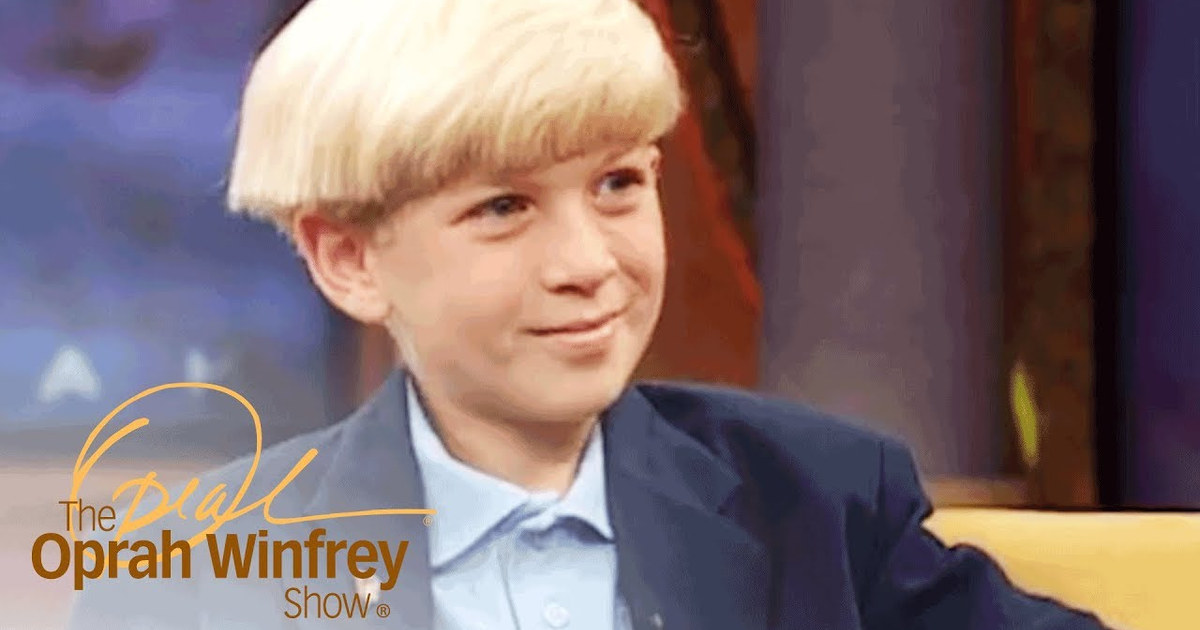
Oprah handled it with genuine warmth, even pausing to reassure Greg that the audience wasn't laughing at him, but marveling at the miracle of his brain. Still, there is an underlying tension that never quite leaves the frame. Bob and Janet Smith sat on that couch carrying the terrifying, invisible burden that every parent of an exceptional child bears: the profound fear that in fast-tracking their child’s intellectual needs, they might inadvertently rob him of his humanity.
Bob admitted that right up until weeks before classes started, they were actively trying to talk Greg out of enrolling in college. They wanted to protect the kid. But how do you hold back a boy who looks you in the eyes and tells you that every day he is not learning is a day stolen from his ability to help humanity? You can't put a hurricane in a playpen.
[[AD]]
The Takeaway: What an Outlier Teaches Us
Decades later, the footage of Greg Smith on Oprah remains one of the most compelling pieces of television from that golden era. It is not just about the shock value of a kid in a college math class; it is a masterclass in the collision between institutional inertia and radical individual potential. Our schools, our media, and our communities are built for the middle of the bell curve. When an extreme outlier lands in our midst, the apparatus almost always tries to shove them into a closet until they fit the mold.
The Smith family’s willingness to break every rule of traditional child-rearing—not out of vanity, but out of necessity—saved Greg from being smothered by conformity. They gave him the room to explore calculus, collect chipped porcelain, run across soccer fields, and dream up orbital colonies without feeling ashamed of being different.
Whether or not Greg Smith ever steps onto the presidential debate stage between forty and fifty, his ten-year-old self left behind a challenge that still echoes: that intellect without empathy is meaningless, and true genius finds its only purpose in service.
If we all possessed even a tenth of that ten-year-old's unbridled optimism and appetite for learning, the world wouldn't need saving nearly as much as it does.


