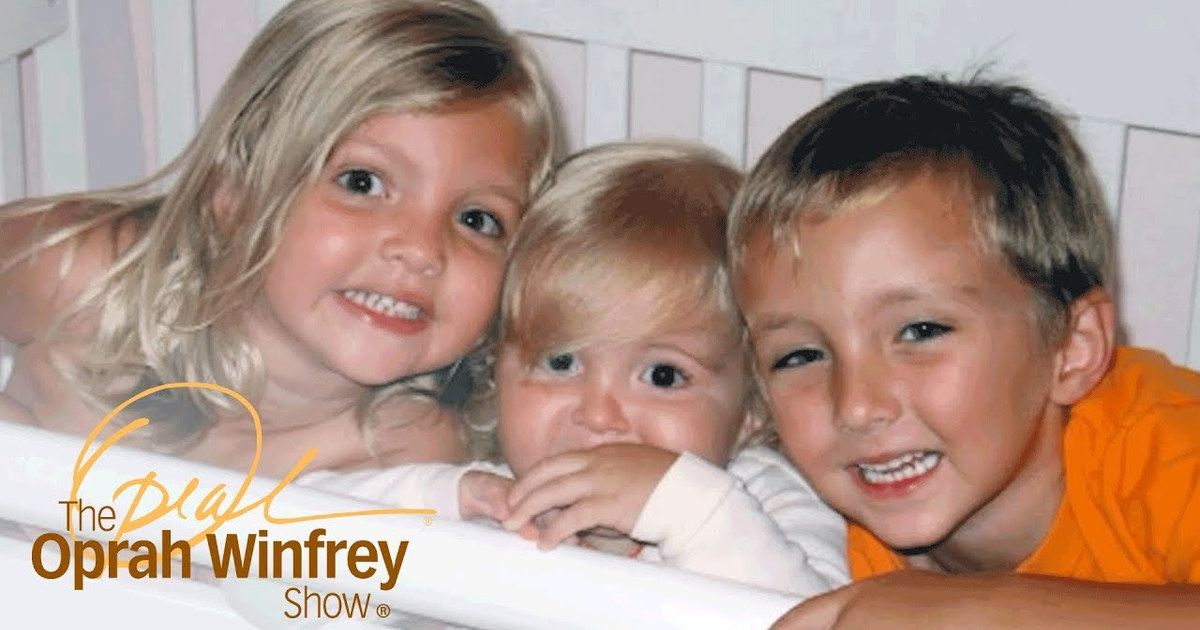
Part 1
Every compelling human-interest broadcast fundamentally splits its viewership into two distinct operational threads. Thread Alpha is the genre enthusiast: the viewer tuned in for the sheer kinetic velocity of real-life emotional high-stakes drama, heart-stopping tragic turns, and the cathartic payoff of an almost mathematical miracle. Thread Beta is the craft purist: the viewer who watches the architecture of television itself, evaluating how narrative pacing, editorial restraint, and conversational scaffolding turn devastating personal trauma into an indelible cultural text.
When Oprah Winfrey introduced Lori and Chris Coble to her national stage, both viewer archetypes hit their respective operational peaks simultaneously. For the genre audience, the story contains every marker of unvarnished real-world devastation followed by an impossible biological rebound. For the systems-minded viewer, the segment functions like an exquisitely tuned documentary engine, distributing heavy emotional loads across carefully gated temporal checkpoints.
To understand why this specific broadcast retains an almost legendary grip on audiences decades later, we have to look past the surface-level tearjerker label and examine the underlying program. It is an extraordinary case study in human resilience operating inside a masterclass of structural narrative pacing.
[[AD]]
The Baseline State: Calibrating the Ordinary Before the Crash
In any high-impact narrative system, you cannot measure velocity without first establishing inertia. The piece begins not in the wreckage of a highway, but inside the mundane geometry of a suburban family routine. The Cobles are introduced through domestic home video fragments: dancing in the living room, playful silliness, and an ordinary post-birthday outing. It is Kyle's fifth birthday weekend, accompanied by his grandmother Cindy, heading to a shopping center equipped with a Ferris wheel, a merry-go-round, and a pet store.
From a genre standpoint, this setup builds immense empathy through domestic familiarity. We recognize the exact texture of an afternoon sliding toward nap time. The kids are exhausted in the back seats; Katie and Emma are watching a movie, while Kyle explores the small screen of a newly unwrapped Nintendo DS. Lori turns around at a complete traffic standstill and tickles Katie's toes as she drifts off. That physical gesture acts as the final anchor of the pre-incident world.
For the craft observer, notice the brutal economy of the edit here. The narrative does not linger on endless exposition. It gives you the precise emotional coordinates required to feel the scale of the collapse, then immediately cuts the feed. A 40,000-pound commercial rig barreling into a stationary minivan at 55 miles per hour is not merely an incident report; it is an instantaneous, violent system wipe.
[[AD]]
Distributed Routing: The Horror of Split-Hospital Triage
The structural horror of the Coble collision is compounded by regional infrastructure. Trauma protocols dictate that multiple critical patients cannot always be ingested by a single medical facility. Lori and her mother Cindy, dealing with concussions and broken ribs, are transported to one emergency center. Kyle and Katie are routed to a second facility. Four-year-old Emma is driven thirty to forty minutes away to a third hospital in Saddleback.
If you came for pure emotional stakes, Chris Coble’s arrival at the hospital is a sequence of agonizing dread. He is summoned from work with zero diagnostic data disclosed over the phone. He sprints through the automated doors of an emergency department only to be steered into a closed room where a clinician delivers a cold, administrative verdict: Katie has expired. Minutes later, a phone patch connects him to Saddleback Hospital, where his frantic plea is met with the exact same linguistic death blow regarding Emma.
From an engineering perspective, Chris’s experience resembles a cascading network failure where each incoming ping returns an unrecoverable error. The television broadcast captures this not through sensational reenactments, but by letting Chris describe the physical sensory blackout: dropping the receiver, the visual frame turning completely dark, and the logistical nightmare of realizing one of his dying children is stranded miles away out of reach.
[[AD]]
The ICU Threshold: Terminating Life Support on Screen
The editorial architecture tightens its focal length as the surviving parents converge at Kyle's bedside. Kyle remains mechanically suspended between life and death, his eyes half-open beneath monitoring leads, offering a deceptive flicker of biological hope that doctors quickly extinguish: his brain had been deprived of oxygen for too long. Survival is impossible.
Lori, severely injured and mobilized via wheelchair, is wheeled in for the termination of life support. The emotional genre beat here is devastating: a mother struggling out of her chair to hold her son's hand, brushing back his hair, and articulating the heartbreaking truth that he has to go be with his sisters. It is a moment of raw human grief that defies traditional dramatic scripting.
Watch how the broadcast team handles the sensory execution of this memory. Chris describes the transition with clinical, devastating precision: the monitors going dark, the hum of mechanical support falling silent, and the tactile reality of holding his hand directly against Kyle's chest until the final heartbeat dissipates. The narrative gives that silence room to exist without intrusive musical scoring or manufactured commentary.
[[AD]]
The Void State: The Mechanics of Prolonged Shock
In standard three-act dramatic fiction, grief is often accelerated to push characters rapidly toward active choices. But in authentic non-fiction storytelling, trauma manifests as extended latency. When Oprah questions the Cobles on their day-to-day survival three and a half years removed from the incident, Lori defines the state as total, pervasive numbness—a prolonged psychological buffer without which the central nervous system would simply buckle.


