Part 2
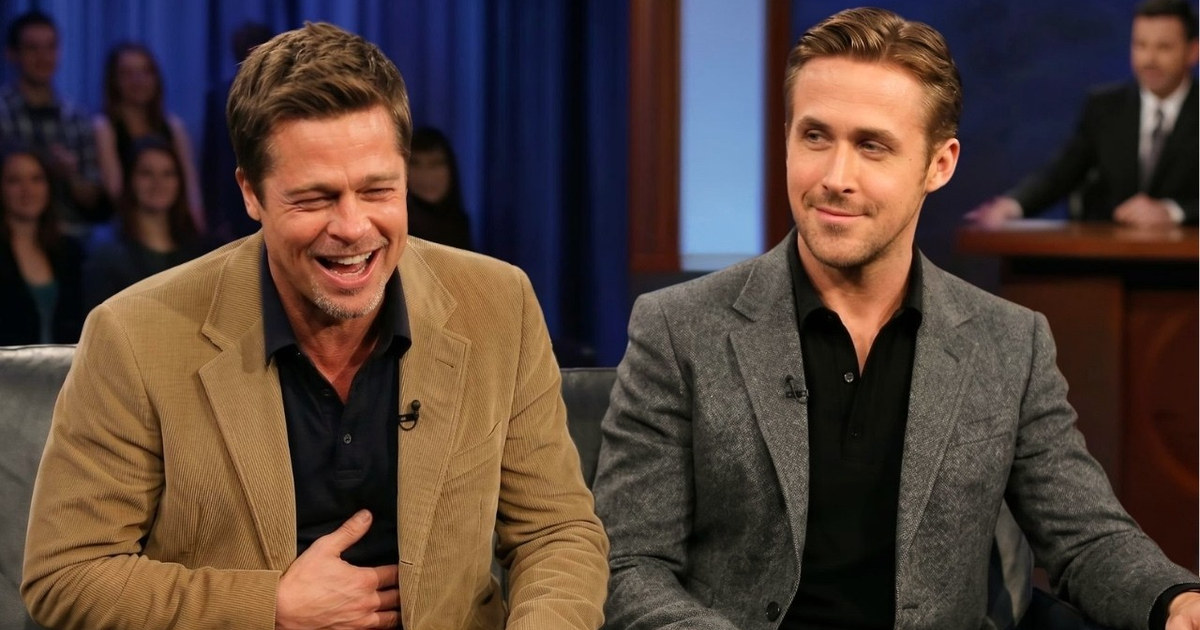
Now the clearest evidence: the Emily Blunt Taylor Swift exchange. Asked for her favorite Taylor song, Blunt says 'All Too Well' has a soft spot in her heart 'because of the film.' Gosling fires back: 'Are you ready for it?' — a pun on the Reputation track. Then he snorts at his own joke. Blunt calls him a poser. That's not a comedy genius. That's a guy who got one joke off and immediately lost the room. The snort is the tell. A real comedic performer would have held the pause. Gosling giggles at his own material and hands Blunt the win.
Contrast that with actual comedic performers in the same clips. Blunt's timing in the screenplay bit is surgical — she waits for his deadpan to land, then pounces. The interviewer's deadpan question — 'Do you think, Ryan, that Ken will always be inside of you?' — is the setup that makes Gosling's reaction funny. Even the puppet 'Rocky' bit works because Gosling calls his co-star 'a diva' and 'very high maintenance,' but the comedy is generated by the puppet's existence, not by Gosling's delivery. In each case, Gosling is the wall the ball bounces off. He's not the one throwing.
[[VIDEO]]
Here's the fair concession: 'standing there and being funny' is a real skill. Buster Keaton built an entire career on the stone face — Sherlock Jr. (1924, 45 minutes), The General (1926, 78 minutes), The Cameraman (1928, 76 minutes). Keaton didn't mug. He didn't wink. He let the world fall apart around him while he stayed still. That's a legitimate comedic tradition, and Gosling is working in it. But it's a different skill from writing or engineering comedy. The internet keeps crediting Gosling with the former when he's doing the latter. He's not breaking anyone. He's standing still while everyone else breaks themselves.
The Real Reason the Clips Work Has Nothing to Do With Gosling
Here's the part of the consensus I find most annoying: the idea that Ryan Gosling is some kind of secret comedy savant who instinctively knows how to generate viral gold. That's not what's happening. What's happening is that Gosling walked into the most aggressively optimized press ecosystem in Hollywood history, and the algorithm did the rest. The clips aren't funny because Gosling is funny. They're funny because 2023 and 2024 turned every single junket, red carpet, and awards show into a content farm — and Gosling just happened to be standing in the middle of it.
Think about the conditions. Barbie dropped in July 2023 with a marketing blitz that was less a campaign and more a global weather event. You couldn't buy coffee without seeing pink. Then Barbenheimer — the double-feature phenomenon pairing Greta Gerwig's Barbie with Christopher Nolan's Oppenheimer — turned moviegoing into a cultural event people dressed up for. By the time awards season rolled around, the machine was already at full speed. Every interview was a potential clip. Every pause was a potential meme. Every reaction shot was a potential TikTok. Gosling didn't create that environment. He was just the guy sitting in the chair when the cameras started rolling.
And that's the thing about the platforms. TikTok and YouTube Shorts don't reward performance. They reward moments. A 15-second loop stripped of all context, where the setup is tight and the reaction is readable in half a second. The infamous 'Ken will always be inside of you' question didn't go viral because Gosling delivered some killer punchline. It went viral because the interviewer's setup was so bizarrely earnest that the audience did the comedic work in their heads before Gosling even opened his mouth. His actual response? A shrug and 'I don't like being hit.' That's not a bit. That's a guy declining to match the energy of a very strange question. The algorithm doesn't reward the performer. It rewards the awkward pause, the blank stare, the moment where someone refuses to play along.
Look at the pattern in the transcript. Gosling's funniest moments are almost entirely reactive. He admits he blacked out during a stunt, and when the interviewer jokes 'because you were drunk,' he just agrees: 'Yeah, that's true.' He calls a puppet a diva. He tells the audience 'Good night, everyone' in the middle of an interview, seemingly just to end the bit. These aren't crafted jokes. They're the responses of a man who is fundamentally refusing to perform enthusiasm. And that refusal reads as comedy only because everyone around him is performing enthusiasm so hard it looks like a job. The interviewer is beaming. The co-star is laughing. The audience is clapping. Gosling is just... there. Being a person. The contrast is the joke.
Compare him to the actors who actually earned the 'secretly funny' label through sheer force of comic instinct. Bill Murray in Lost in Translation (2003, directed by Sofia Coppola, 102 minutes) isn't just deadpan — he's actively shaping the rhythm of every scene, finding the sadness inside the joke and the joke inside the sadness. Harrison Ford's talk-show crankiness is a persona he's been building for decades, a deliberate choice to be the guy who doesn't want to be there. Gosling isn't doing that. He's not crafting a persona. He's just not performing. The internet loves the Gosling theory because it's flattering to him — it turns a passive vibe into an active skill. But it's really a theory about us. About how badly we want our movie stars to be in on the joke. About how desperate we are to believe that the guy who played Ken is winking at us through the screen. He's not winking. He's just standing there. And we're the ones laughing.


