Part 3
Talk Shows and SNL: When the Format Itself Becomes the Straight Man
Open on the SNL monologue from April 13, 2024. Ryan Gosling is mid-sentence when Harry Styles walks out. Gosling’s face does a full system reboot. He turns away, shoulders shaking, and you hear him off-mic: “What are you doing here, man?” The camera stays on him. That’s the whole bit. And it only works because Studio 8H is built like a tank — multi-camera, hard key, rim light. That rim light is the unsung hero. It separates Gosling from the backdrop, so even when he turns his head to laugh, his profile still reads. A single-camera setup would have lost the moment. Live television doesn’t get second takes, and the SNL lighting team knows it.
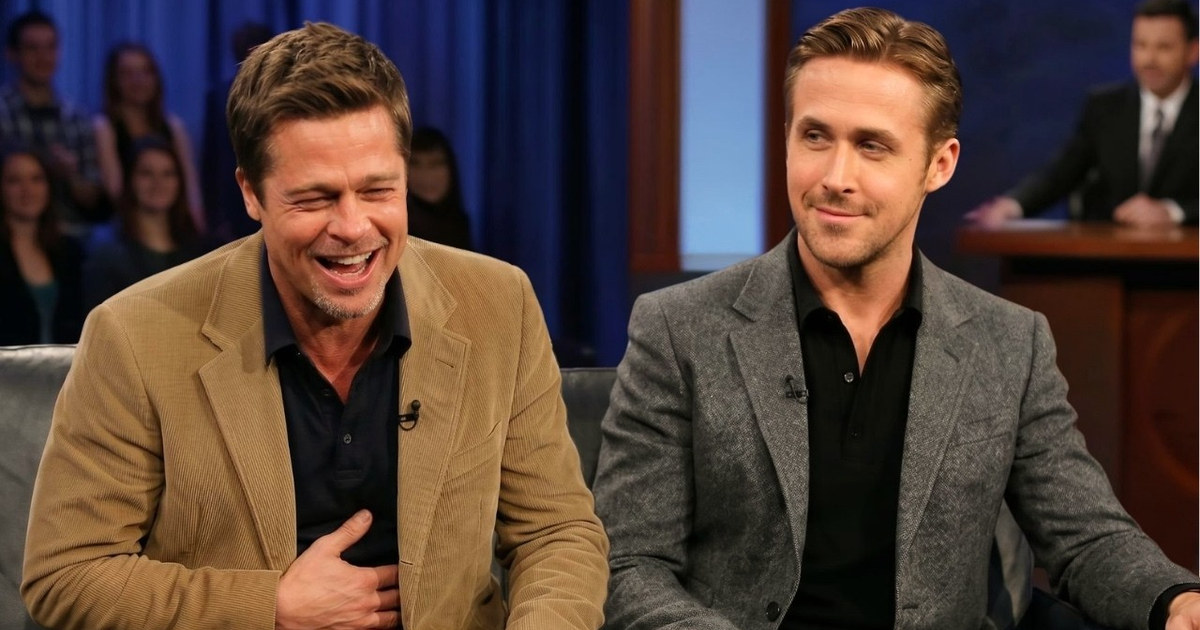
That’s the thesis in action: Gosling’s comedy isn’t just performance — it’s engineering. The format becomes the straight man, and he plays off its constraints. On a talk show couch, the lighting is warm, the depth of field is shallow, and the camera is close enough to catch a confession. On SNL, it’s hard key, rim light, and a live audience. Both setups are designed to make him look good. But Gosling uses them to make himself look human. And that’s funnier than any punchline.
The Cellophane Story: When Hands Do the Talking
Same monologue, different beat. Gosling tells the story of how his parents bought a truck full of cellophane and encouraged him to sell it to teachers and hawk it at recess. The camera stays in a medium shot. No cutaways. No reaction shots. Just Gosling’s hands. He’s not doing stand-up. He’s doing show-and-tell. The bit is physical, not verbal. And the director knows it. By holding the frame, the audience gets to watch him relive the absurdity in real time. That’s not an accident. That’s a choice. A lesser director would have cut to the audience. This one trusts the actor’s body to carry the joke.
[[AD]]
It’s the same principle that makes his late-night appearances work. When Gosling tells the flying-lesson story — how he thought celebrity flying would be easy, got as far as a stall warning, and decided to “spend my time learning other things” — the late-night lighting does the heavy lifting. Warm key, shallow depth of field. It feels like a confession, not a set. The camera is close enough to catch the micro-expressions. The background is soft enough to disappear. You’re not watching a celebrity on a couch. You’re watching a guy admit he’s bad at something. And that’s disarming.
Then there’s the dish towel moment. A fan in New Zealand makes dish towels with Gosling’s face on them. He’s shown one with three Ryan Goslings. The camera pushes in on the towel, then cuts back to his reaction. That’s an editor doing the actor’s job. And it works because Gosling doesn’t oversell it. He just looks at it, half-smiles, and lets the silence sit. The edit does the comedic timing. Gosling does the restraint. Together, they land the joke without a single line of dialogue.
But the format doesn’t always have to be late-night. Sometimes it’s a junket. Go back to the La La Land press tour in 2016. Emma Stone is next to him, and someone asks about the modern love fantasy. Gosling deflects: “I don’t know that I can speak to the entirety of the modern era right now.” It’s a two-shot. The humor comes from the mismatch between the question’s scale and his answer’s scale. He’s not being difficult. He’s being honest. And the camera catches Emma Stone’s reaction — a half-laugh, a glance — which makes it feel like you’re in on the joke. That’s the power of the two-shot. It’s not just about Gosling. It’s about the chemistry between him and whoever’s next to him.
So when you watch Gosling on a talk show or SNL, don’t just watch him. Watch the lighting. Watch the framing. Watch the edit. The format is the straight man. Gosling is the punchline. And the cinematography is the setup that makes it all pay off.
What to Watch For: The Next Time a Gosling Clip Goes Viral
Next time a Ryan Gosling interview clip hits your feed, don’t just laugh — look at the lens, the key light, and the cut. That’s where the comedy actually lives. As a cinematographer who’s shot second-unit, I’m telling you: the man is funny because he understands camera grammar better than most directors. He knows how long a lens will hold him, how a hard key will carve out his deadpan, and when a cut will land the punchline. So before you share that clip, rewind and study the frame. You’ll see a masterclass in comedic timing that has nothing to do with jokes and everything to do with light.
Let’s recap the three body sections, because each one gives you a different lighting setup to watch for. First, awards shows: flat, even light that makes everyone look the same — except Gosling, who refuses to be controlled. Remember the 2024 Oscars when he presented with Emily Blunt and ad-libbed about his too-tight suit? “I feel like I’m going steady with these pants.” That’s a man thriving under flat, unforgiving light. Second, junket two-shots: the classic over-the-shoulder frame where co-stars become straight men. Think of his interviews with Emily Blunt for The Fall Guy (2024), where they bicker like siblings. The camera holds both of them, and he uses that shared space to bounce chaos off her. Third, SNL and talk shows: hard key and rim light that sculpt his face while the format itself becomes the straight man. His 2024 SNL monologue about the twins from The Shining? That’s a man using a hard key to amplify every micro-expression. Watch for those three setups — they’re your roadmap.


