Part 2
Now cut to the 2024 Oscars. Gosling and Blunt are presenting Best Adapted Screenplay. He starts with a fake definition — “the screenplay that was the best at adapting to whatever harsh conditions and obstacles were thrown in its way” — and she corrects him. He counters with “agree to disagree.” She pushes back. He lands the kill: “My god, we have two Academy Awards between us. This is beneath us.” Watch the framing. The broadcast cut between a medium two-shot and singles. Gosling’s timing depends entirely on the cut back to him. He delivers the first half of the line in the two-shot, then the director cuts to his single for “This is beneath us” — and the beat lands because we’re suddenly closer, alone with his deadpan. A director who stayed wide would have lost the beat. The cut is the punchline.
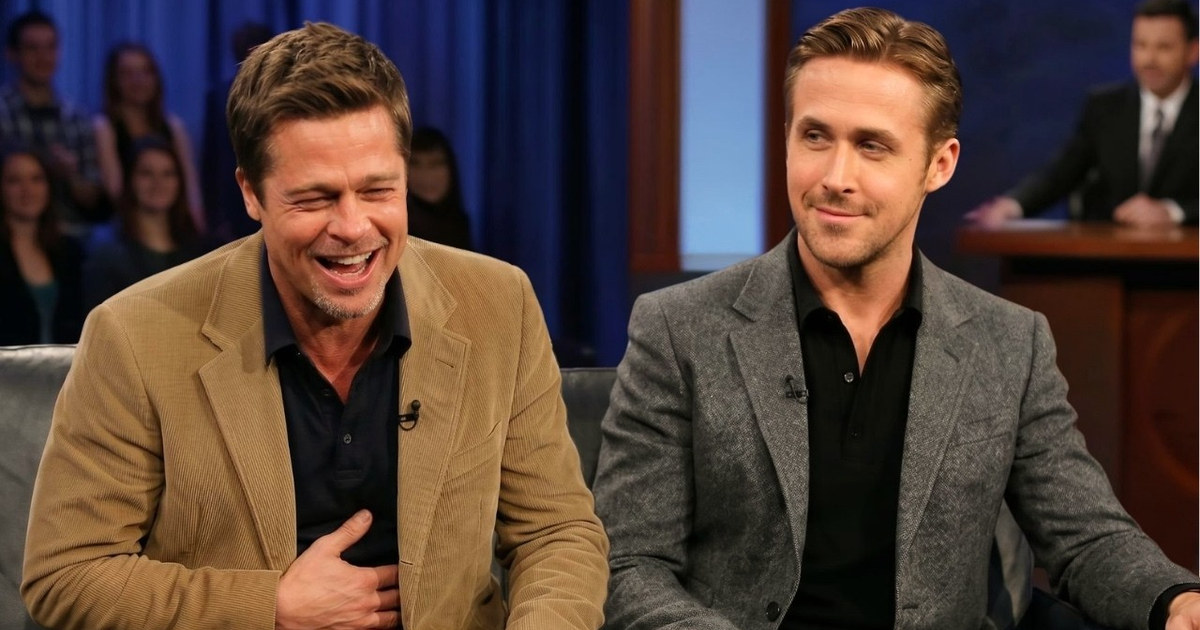
Then there’s the Brad Pitt moment. Gosling claims he was told he’d be presenting alone, then accuses Pitt of recasting him into “some kind of Joe Biden, Andy Richter, Robin type role.” The staging is perfect: Pitt beside him, both in black tie, the camera holding a two-shot while Gosling refuses to break. Pitt goes along with it — “I’m here to support you” — and that reaction shot is the engine. Without Pitt’s bemused, slightly wounded straight-man energy, Gosling’s deadpan has nothing to bounce off. The two-shot keeps them locked together, so every micro-beat of Pitt’s face is visible. It’s a classic second-unit setup: hold the frame, let the actors do the work.
[[AD]]
The 2024 People’s Choice Awards circulated that clip everywhere, and here’s the ironic twist: the vertical crop for social media actually improves the framing. By isolating Gosling’s face, the crop removes the wide stage and turns the moment into a close-up. Suddenly, the flat wash becomes intimate. You can see the exact millisecond his eyes stop moving. The algorithm accidentally gave him the coverage a broadcast director might have been too timid to cut to. It’s the same reason his AACTA bit works in a vertical clip: the tighter the frame, the more his stillness reads as a choice, not a void.
So when you watch Gosling at an awards show, watch the lighting. Watch the cut. Watch how he uses a flat wash and a two-shot like a cinematographer uses a long lens — to compress the space between him and his scene partner until the silence becomes unbearable. He’s not fighting the format. He’s exposing it.
The Two-Shot Is Where Gosling's Co-Stars Become His Straight Men
You want to see a comedy duo built with zero cuts? Watch the Emily Blunt press interview from the Oppenheimer press tour. It's a static two-shot. Two chairs, one softbox key, a lav mic, and a camera that never moves. That setup usually kills comedy because there's no editing rhythm. But Gosling and Blunt generate their own rhythm by treating the frame like a stage. Blunt asks Gosling his favorite Taylor Swift song. He says 'All Too Well' because of the film. She deadpans 'Are you ready for it?' then calls him a poser. The timing is theatrical, not cinematic. And it works because the camera doesn't blink.
[[VIDEO]]
Press junkets are the most hostile environment for comedy. You've got a 50mm lens, a fixed two-shot, and a lighting setup that hasn't changed since 2004. There's no coverage, no reaction shots, no editor to save you. The only rhythm you get is the one you create in real time. Gosling and Blunt understand this. They don't wait for a cut. They build the joke in the pause. Blunt's 'poser' lands because she lets it sit in the same frame. No cutaway. No laugh track. Just two people in a softbox, and one of them refusing to break.
Then there's the 'Ken will always be inside of you' interview. Gosling pauses. He repeats the question. He lets the silence do the work. The interviewer's off-camera laugh becomes the reaction shot. That's the genius of the format: it turns the crew into the audience. You don't need a cut to a laughing face when the laugh is already in the audio. Gosling knows this. He's not performing for the camera. He's performing for the room. And the room is the only edit that matters.
Now shift to the Harrison Ford interview from the Blade Runner 2049 press tour in 2017. Gosling shows up with a Blade Runner-inspired sweater and a drink. The whole thing derails into 'is this an interview or is this...' But here's the technical detail that changes everything: Ford's interview setup is warmer and softer than the junket standard. The key light is diffused. The background is darker. That lighting shift makes Gosling's deadpan read as sincere rather than ironic. In a standard junket, the flat lighting makes every joke feel like a bit. In Ford's setup, the warmth makes you believe Gosling actually brought a sweater and a drink because he's committed to the bit. The cinematography is doing the comedy's emotional work.
Then there's the Conan O'Brien moment. Conan accuses Gosling of stealing his girlfriend. Gosling just says 'I love Conan, I love Conan' and lets it sit. That's a late-night set with a hard key and a dark background. Gosling's face is the only lit thing in frame. The pause becomes the punchline. You can't cut away from that. You can't add a laugh track. You just have to hold the shot and let the silence do the work. And that's the lesson: in a two-shot, the straight man isn't the other actor. It's the camera.


