Part 3
So when Denis Villeneuve called, Ford had to think. He’d been down this road before. He’d returned to Han Solo in The Force Awakens, a film that gave the character a poignant, tragic send-off. He’d returned to Indiana Jones in Kingdom of the Crystal Skull, a film that… well, let’s just say it didn’t quite capture the magic of the original trilogy. Legacy sequels are a tricky business. You’re not just making a movie; you’re wrestling with nostalgia, with expectations, with the ghost of your younger self. Ford knew that. He knew that Deckard wasn’t just a character; he was a piece of cinema history. And he knew that Blade Runner 2049 would either honor that history or tarnish it. “In theory for me,” he said. In theory, it could work. In theory, it could be something special. But theories are just theories until you’re standing on set, wearing the glasses again.
The secrecy around Blade Runner 2049 was intense. Villeneuve and executive producer Ridley Scott kept plot details under wraps. The trailers were enigmatic. The marketing was cryptic. It mirrored the original’s mysterious vibe—a film that didn’t explain itself, that trusted the audience to keep up. Ford, for his part, was tight-lipped. He’d been through the blockbuster machine before. He knew how to keep a secret. But he also knew that this film was different. It wasn’t a franchise built on toy sales and happy meals. It was a sequel to a film that had become sacred to a certain kind of cinephile. The pressure was on. And Ford, ever the professional, showed up ready to work.
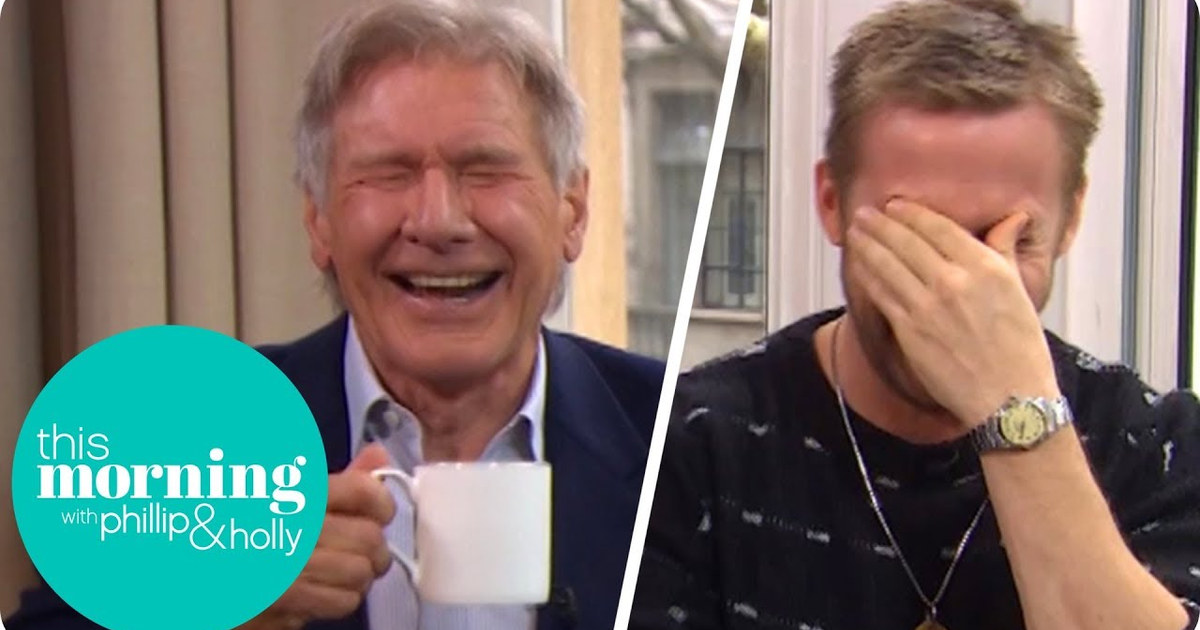
Then there were the stunts. “I found them extremely difficult,” Ford admits, “which accounts for the fact that I hit this guy one time.” That guy, of course, is Ryan Gosling, who plays K, the replicant blade runner at the center of 2049. The fight scene between Deckard and K is brutal, visceral, and surprisingly funny—two generations of blade runners going at it in a Las Vegas casino that’s been abandoned for decades. Ford, at 75 years old, was throwing punches. And one of them connected. “That’s show business,” he says with a shrug. “Story is that I missed 99 times.” The audience laughs. But there’s something real there. Ford isn’t just phoning it in. He’s physically committed. He’s in the muck. He’s taking hits and giving them. And that accidental punch—that moment of genuine contact—adds a layer of realism to the film’s brutal physicality. It’s a reminder that even in a world of replicants and holograms, flesh and blood still matter.
But the stunts are just one piece of the puzzle. The real question is: what does it mean for an actor to revisit a role decades later? Ford has done it multiple times now. He’s returned to Han Solo, to Indiana Jones, and now to Rick Deckard. Each time, he’s had to reconcile the character he was with the character he is. Deckard in 1982 was a young man, full of rage and confusion. Deckard in 2049 is an old man, living in isolation, haunted by his past. The world has moved on. Replicants are still being hunted, but the rules have changed. Deckard is a relic. He’s a man out of time. And Ford plays him with a weariness that feels earned. He’s not trying to be the Deckard of 1982. He’s not trying to recapture that youth. He’s playing the consequences. He’s playing the weight of thirty-five years. And that’s what makes his performance so powerful.
The glasses are a perfect symbol of that. In the original Blade Runner, Deckard’s glasses were a tool—a way to enhance images, to see what the naked eye couldn’t. In 2049, they’re a relic. They’re a piece of the past that Deckard still carries with him. When he puts them on, he’s not just looking at evidence; he’s looking back in time. He’s trying to make sense of a world that has left him behind. The glasses are his past, still present. They’re a reminder that some things never change, even when everything else does.
The film asks what happens when the past refuses to die. Deckard has been hiding for decades, living in the ruins of Las Vegas, surrounded by holograms and memories. He’s tried to bury his past, but it keeps coming back. K finds him. The replicant uprising looms. And Deckard is forced to confront the choices he made, the people he loved, the things he did. It’s a meditation on legacy, on heroism, on disappointment. And Ford, with his gravelly voice and tired eyes, embodies all of it.
The interviewer, sensing the darkness, tries to lighten the mood. “Don’t meet your heroes,” he says. “I would say don’t get punched by them.” It’s a funny line. It undercuts the tension. But it also underscores the film’s central theme. Heroes aren’t perfect. They’re flawed. They’re human. And sometimes, they punch you in the face. Deckard is not a hero in the traditional sense. He’s a man who made mistakes, who ran away, who hid. But he’s also a man who, in the end, chooses to do the right thing. He chooses to help K. He chooses to fight. And that’s what makes him heroic. Not his strength, not his skill, but his willingness to try, even when he knows he might fail.
[[AD]]
Ford’s return as Deckard is the emotional core of Blade Runner 2049. It’s not just a cameo; it’s a continuation. It’s a bridge between two eras of cinema. And it works because Ford understands that Deckard isn’t just a character; he’s a piece of himself. He’s a reminder of what it was like to be young and hungry and confused. He’s a reminder of what it’s like to grow old and look back. And when he puts on those glasses, he’s not just playing a role. He’s revisiting a life.


