Part 2
And it all started with one look. One kid. One dirt road. One woman the town wrote off. Dolly saw a star. The rest of the world just took a little longer to catch up.
But they caught up. Oh, they caught up.
[[VIDEO]]
Because when you build your entire identity around the one person everyone else threw away, you're making a statement. You're saying: I see value where you see trash. I see beauty where you see shame. I see a star where you see nothing.
That's the decision. And Dolly Parton has been living in its glow ever since.
From Hick-Hop to Hollywood: How the Look Became the Brand (and the Joke Became the Weapon)
The look walked into the room first. Always. Before the voice. Before the laugh. Before the script. In 1980, Dolly Parton stepped onto a movie set for the first time. 9 to 5. Director Colin Higgins. Jane Fonda and Lily Tomlin already there. Dolly? She memorized the entire script like a play. Every line. Not just hers. Everybody's. Because she didn't know how films worked. Her words: 'That's just cuz I'm a dumb country hick.'
But she didn't dress like a dumb country hick. She dressed like a city girl. Big hair. Tight dresses. Nails like weapons. And she stole every scene. The look did the talking. The look was the armor. The look said: I belong here. Even when she didn't feel it. Even when she thought she was out of her depth. The look was the bluff. And the bluff worked.
That's the thread. Pull it. The look wasn't aesthetic. It was strategy. Armor. A weapon. And Dolly knew exactly how to wield it. She still does. From 9 to 5 to the Rock & Roll Hall of Fame. From hick-hop to Hollywood. The look kept flipping expectations. The look said 'country.' The career said 'everything.'
Fast-forward to 2022. The Rock & Roll Hall of Fame calls. Dolly's reaction? Pure Dolly. 'I always thought that was for people that spent their whole life working to be in Rock and Roll. You don't see Led Zeppelin in the Country Music Hall of Fame.' She wasn't being coy. She was being honest. She didn't think she belonged. But she showed up anyway. In full Dolly. And stole the show. Again. The look did the talking. The look said: I'm here. Deal with it.
That's the flip. The look says 'country.' The career says 'everything.' Country music. Pop. Rock. Movies. TV. Broadway. The look stays the same. The career keeps expanding. The look is the constant. The career is the variable. And the joke? The joke is the weapon.
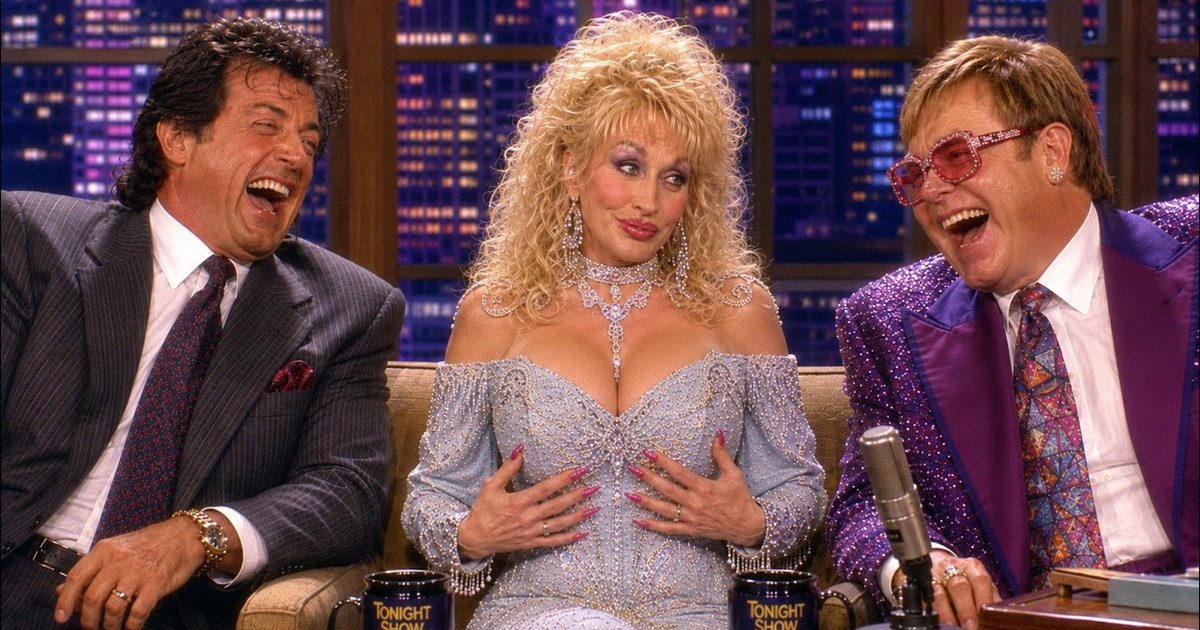
Dolly pranked Jimmy Fallon with a bear story. On The Tonight Show. Straight-faced. A bear in a cage. People buying it Cokes. A redneck putting gasoline in a Coke can. The bear goes crazy. Breaks out. Runs down the road. Falls over. Dead. 'No, it's out of gas.' Fallon lost it. The audience lost it. Dolly? Barely cracked. That's the weapon. The joke disarms. The joke makes you laugh. The joke makes you underestimate her. And that's exactly what she wants.
She flirts with every interviewer. Graham Norton. Jimmy Fallon. Barbara Walters. She jokes about her boobs. 'They're not that big. It's just that I'm little and they're big in comparison to that.' She calls herself a hillbilly. She calls her music 'hick-hop.' She says, 'I would never stoop so low as to be fashionable. That's the easiest thing in the world to do.' The look and the humor are the same weapon. Disarming. Self-aware. Never the butt of the joke. 'All these years people thought the joke was on me, but it's actually been on the public. I know exactly what I'm doing.'
[[AD]]
That's the key. She knows. She always knew. The look was the joke. The joke was the shield. The shield was the empire. And the empire kept growing. The Best Little Whorehouse in Texas (1982). Directed by Colin Higgins. With Burt Reynolds. She played Miss Mona. A madam with a heart of gold. The look? Perfect. Steel Magnolias (1989). Directed by Herbert Ross. With Sally Field, Julia Roberts, Shirley MacLaine, Daryl Hannah. She played Truvy. A beautician. The look? Perfect. She held her own against legends. Because the look gave her permission. Permission to flirt. Permission to joke. Permission to own her sexuality on her terms.
She admits her co-stars tempted her. Burt Reynolds. Sylvester Stallone. 'I didn't say I was dead. I said I was married.' The look gave her permission to say that. The look gave her permission to be a sexual being. On her terms. Not society's terms. Not the town tramp's terms. Dolly's terms. The look was the armor. The armor was the permission. The permission was the power.
And the drag queen connection? She owns it. 'If I hadn't been a girl, I'd have been a drag queen. For sure. A really good one.' That ties back to the town tramp. The woman who performed femininity so boldly that society punished her. Dolly took that performance. Turned it into power. Turned it into armor. Turned it into an empire. The drag queens who impersonate her? They get it. They understand the performance. They understand the power. Dolly sees them. 'I think it's a great compliment.' She knows. She's been performing femininity her whole life. The difference? She made it pay.


