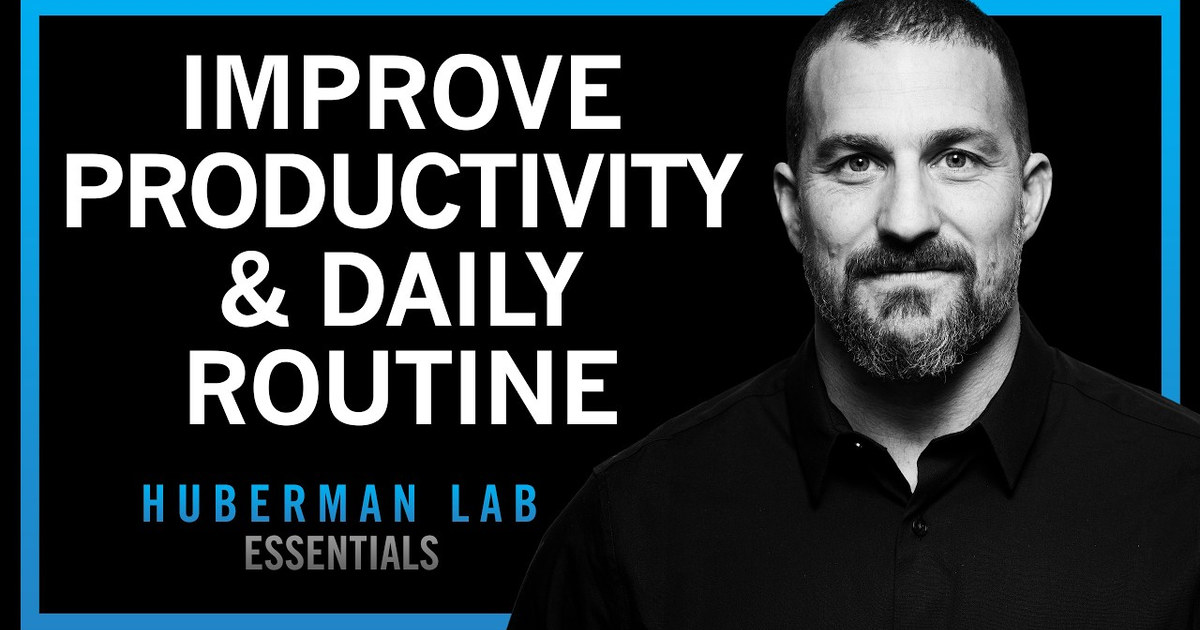
If you’ve spent any time on the internet lately, you’ve probably seen the clips: Andrew Huberman, the Stanford neuroscientist, breaking down how to hack your own brain. It’s easy to get lost in the sea of 'life hacks' out there, but Huberman isn't just throwing around buzzwords. He’s treating his own life like a laboratory, and the results are hard to ignore. If you’ve ever wondered how to actually structure a day to get more done without burning out, you’re in the right place.
The secret isn't a magic supplement or a fancy app. It’s about aligning your biology with the 24-hour rhythm of the planet. Your cells, your organs, and your brain are all on a clock. When you work against that clock, you’re fighting an uphill battle. When you work with it, you’re essentially putting your productivity on autopilot.
The Morning Foundation: Setting the Clock
Huberman’s day starts before he even gets out of bed. He tracks his wake-up time to calculate his 'temperature minimum'—the point where his body temperature is at its lowest, usually two hours before he wakes. Why does this matter? Because it’s the anchor for your entire day. Knowing this helps you time your work, your exercise, and even your caffeine intake.
[[AD]]
The first real protocol is 'forward ambulation.' That’s just a fancy way of saying: go for a walk. But there’s a catch. You need to do it outside. Getting sunlight in your eyes first thing in the morning triggers a cascade of biological signals. It tells your brain it’s time to be alert, sets your cortisol pulse for the day, and—crucially—uses 'optic flow' to quiet the amygdala, the part of your brain responsible for anxiety.
If you’re reaching for the coffee pot the second your feet hit the floor, stop. Huberman suggests delaying caffeine for 90 to 120 minutes. By waiting, you allow your body to clear out adenosine—the chemical that makes you sleepy—naturally. If you block those receptors too early, you’re just setting yourself up for a brutal afternoon crash.
Entering the 'Tunnel' of Deep Work
Once you’re hydrated and alert, it’s time to work. Huberman swears by the 90-minute ultradian cycle. Your brain naturally shifts between high and low alertness every hour and a half. To get the most out of this, he suggests setting a timer, turning off your phone completely, and using low-level white noise to lock in.
[[AD]]
Positioning matters, too. If you’re hunching over a laptop, you’re literally signaling your brain to be sleepy. Keep your screen at eye level or higher. It’s a small physical adjustment that keeps your brainstem alert. And if you’re struggling to focus? Try fasting until noon. The slight increase in adrenaline helps you lock into tasks without the jittery, panicked feeling of over-caffeination.
The Exercise-Brain Connection
After that 90-minute work block, it’s time to move. But don't overdo it. Huberman warns that workouts lasting longer than an hour can spike cortisol in a way that’s actually detrimental to your long-term health. Aim for a mix of strength and endurance, but keep the intensity smart. Use the 80/20 rule: 80% of your training should be sustainable, leaving only 20% for those 'all-out' efforts.
And for the love of your gut, don't eat a massive lunch. If you flood your system with food, your body diverts blood to digestion, leaving your brain starved for oxygen. Keep it light, keep it protein-heavy, and for heaven's sake, take another walk after you eat to help your metabolism.
[[AD]]
[[VIDEO]]
A Note on Spoilers and Consistency
Look, I know what you’re thinking: 'I can't do all of this every single day.' And honestly? Neither does he. The goal isn't perfection; it’s consistency. Even if you just start with the morning walk or the caffeine delay, you’re already ahead of the curve. Just remember that your brain is a machine—if you feed it the right inputs, it’ll give you the output you’re looking for.
Next time, we’re diving into the evening protocols—how to actually shut your brain down when the day is done and ensure you’re getting the deep, restorative sleep you need to do it all over again.
Treat your day like a science experiment, and you might be surprised at how much more you're capable of.


