Part 5
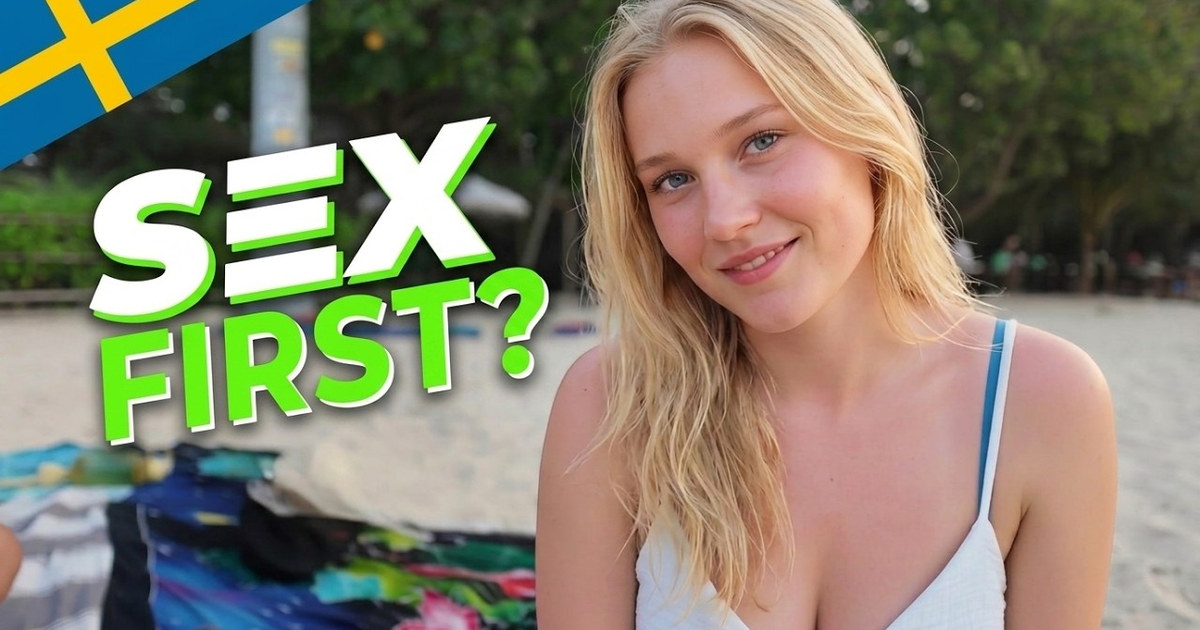
Now the weird small beats, and I mean these as a compliment, because they're what makes this feel like a documentary and not a produced segment. Marcel guesses one of them is 25% Thai. She confirms it. He responds with "genetics" like a man solving a crossword, and then the observation that her skin is darker so she must prefer the sun over Sweden. Notice how fast that goes. Ninety seconds earlier she was reading a man's soul over the kissing card. Now she's being read by her appearance, politely, and she just absorbs it. And then, out of nowhere, "Spain" — offered up as an actual life plan. Somewhere warm. Not a joke either. That's the same instinct as *The Square*'s museum in winter, all that Scandinavian beige, people fantasising about a coastline.
And moving countries for a partner gets the same treatment. "If I want to move, then I'm going to move. I'm going to move for me and not for him." That's not a deal-breaker verdict. That's a boundary wearing a verdict's clothes. Note it and move on, because they do.
Which brings us to the moral centre of this whole video, and it's Tilda again, because Tilda is quietly carrying this entire production on her back. Somewhere in the money cards — the splitting costs, the unequal income, the endless saving for a house, the cheap dates and the budgeting as a personality — she lands the line the entire internet should be repeating: "Then what's the point of the relationship?" And the companion piece: "You have to live a little." That's not anti-responsibility. That's someone noticing that a relationship built entirely on deferred pleasure is a savings account with no interest. You can be financially compatible with someone and still be bored stiff, and these two are nineteen and already clocking it.
The earn-less question gets the grown-up answer too, and I want to flag it because it's smarter than it sounds. He earns less than you. Fine. No drama. As long as he has goals. Ambition over talk. Not the number — the direction. Both of them apply that test consistently across the whole video, by the way. They'll forgive being broke. They will not forgive being aimless, and they will not forgive being managed.
So here's where I land, and it's the thing I can't shake. A game show about deal breakers, filmed in a room with two nineteen-year-olds and a guy from Russia holding a stack of index cards, ended up being a better-written character study than most scripts released this year. No score, no structure, no third-act twist. Just two people who know exactly what they will and won't put up with, saying it plainly, in a language they haven't fully realised is the whole point. Östlund spends 149 minutes on a yacht trying to get at this. Moodysson did it in 89. These two did it in twenty.
And Tilda, who will not be told who her friends are, already knows the ending I'm about to spoil for you.
The Mid-Roll, the Missing Ending, and What Part 2 Owes Us
You're two-thirds through the video. The women have just answered the question about whether a guy who can't satisfy them is a deal breaker. Tilda says something like, 'If you don't care, that's important. He has to care.' The room is raw. The camera is close. You can feel the trust. Then Marcel says, 'This one maybe from different side little bit.' And you think he's going to pivot to another question about intimacy or communication. Instead, he says, 'Before we will start, I want to say a few words about my favorite dating app.' And just like that, the spell breaks. It's findme.app. He tells you to go to findme.app/marcel. He talks about video verification, five-second clips, voice samples. He mentions users from the Philippines, Vietnam, Colombia, and beyond. He explains that there's manual verification against fakes. It's a dating app ad inside a dating interview. That's either the most native ad placement in YouTube history or the most cursed. Let's talk about it.
The ad isn't a quick 'thanks to our sponsor.' Marcel commits. He gives specifics. He talks about video verification, which is exactly what you'd want if you were worried about catfishing. It's almost like the sponsor wrote the segment to answer the anxiety the previous questions created. The women just talked about trust, phone passwords, privacy. Now here's an app that promises to verify you're real. The room? We don't see the women's reactions in the transcript, but you can imagine. They're sitting there, probably sipping their drinks, waiting for him to finish so they can get back to the game. But the spell is broken. The trust he built with them—the way he let them talk, the way he took their answers seriously—that's momentarily replaced by a sales pitch. And not just any sales pitch. A sales pitch for the very thing that could prevent the kind of intimacy they were just describing. It's meta. It's awkward. It's a little brilliant.
Let's argue both sides. Perfect: a dating app ad inside a dating interview is contextually native. It's not like a mattress ad in a true crime podcast. It's a product that actually relates to the content. And the way Marcel frames it—'my favorite dating app'—feels personal. He's not reading a script. He's recommending something. That's the dream for advertisers. Cursed: it interrupts the one moment where the video has earned real trust from its subjects. The women opened up about intimacy, about what they want, about deal breakers. That trust is fragile. You don't want to cash it in for a sponsor read. It's like a first date who pauses mid-conversation to tell you about their MLM. Even if the MLM is relevant, it kills the mood. And this video was all about mood. The mood was intimate. The mood was honest. The mood was two Swedish 19-year-olds telling a Russian guy what they will and won't tolerate in a relationship. And then... findme.app. It's a cold splash.


