Part 2
Sit in that for a second. Because it's doing three jobs at once.
Job one: it refuses the easy version. She doesn't say 'that's abuse' and she doesn't say 'sure, whatever, I have nothing to hide.' She holds two ideas that are genuinely in tension — total honesty and the right to a private interior — and she doesn't resolve them for the camera's convenience.
Job two: it reveals that the question itself is malformed. 'If you have nothing to hide, why not hand it over' is an argument that only works if privacy is a thing you earn by being guilty. She points out the flaw without a lecture. It's not about hiding. It's about the door existing. A room you cannot close isn't a room.
Job three, and this is the one that gets me: she says it in about nine words, with a shrug, and then the interview keeps moving. Which is how real people actually talk about boundaries. Not in monologues. In shrugs.
Now go back to the Thai dad line, because it's the same idea wearing a different outfit. Somebody's father grew up in a culture where direct face-to-face confrontation is avoided — and, the speaker jokes, that avoidance gets passed down and warped into something almost romantic. You don't look someone in the eye and say the terrifying thing. You get a little bit drunk. You approach from the side. You do intimacy backwards.
Elsewhere in the same interview, she confirms the math: 'I'm just 25% Thai.' Genetics, she says, like it's a weather report.
You want a film touchstone for that exact energy, right now, early? Sean Baker's 'Anora' — 2024, Neon, 139 minutes, written, directed and edited by Baker, winner of the Palme d'Or at Cannes and then Best Picture at the 97th Academy Awards, with Mikey Madison taking Best Actress for a performance that turned a strip-club Cinderella premise into something much sharper than anyone expected.
Here's the rhyme, and I want to be precise about it: a Russian-speaking outsider, young women, money and romance braided together so tightly you can't tell which is holding up which, and a story that refuses to resolve into the shape you were promised. That's the weather system Anora lives in. This clip is not that film. This clip is a 20-minute YouTube interview with a mic and a bad wind day. But it's the same air.
[[AD]]
And that's before we even get to the part I keep circling back to: the emotional temperature.
There's a word the transcript keeps gesturing at, and it's a Swedish one — lagom. Roughly: just enough. Not too much, not too little, the amount that doesn't make anyone uncomfortable. I'm not going to pretend this is a sociology paper, because it isn't, and two people are not a nation. But you can feel that instinct operating under every answer. Marcel asks if Scandinavian dating really starts with intimacy on the first date. The answer isn't a scandalized denial or a smug confirmation — it's a shrug and a logbook. People meet when they're out drinking. It evolves from a one-night stand. You sleep together once, and if you enjoyed it, maybe you meet a second time. 'That depends on who you are, I think.'
That's it. That's the whole report from the field. No drama, no heat, just accuracy.
And there's something genuinely unusual happening between the two of them, too. They disagree in public. One of them says she appreciates a partner who makes all the plans, because it makes life easier — and then immediately corrects herself: 'if I don't have a say in any of the plans, then it's…' She doesn't finish the sentence, because she doesn't need to. Watching two friends negotiate a boundary against each other in real time, on camera, without either of them getting defensive, is more revealing than any confessional booth ever built.
Tilda, though. Tilda's the closer of the two, and I need you to keep an eye on her, because she's the one who's going to say the thing this whole piece is quietly built around. She's the one who won't dodge her age. She's the one who calls a thing a green flag instead of a red one, which is a much rarer instinct than the internet would have you believe. And later — I'm not spoiling it here, I'm saving it — she delivers a line that reframes the entire list you just read. Hold that thought. It's coming.
So here's where we stand.
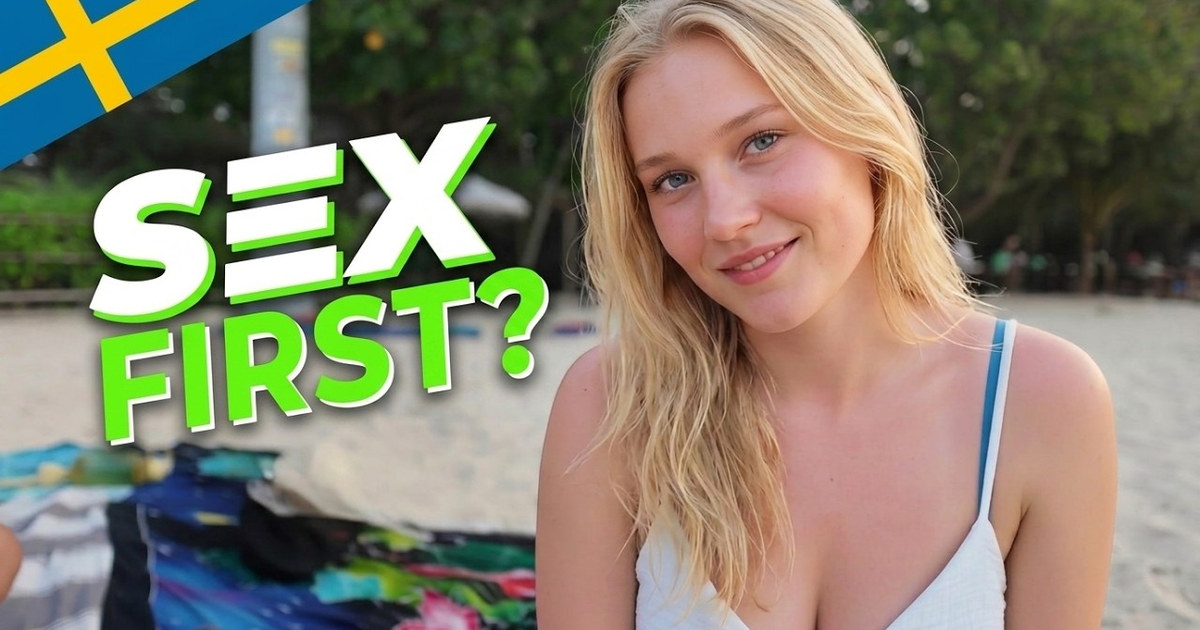
This is a 20-minute YouTube interview, hosted by a Russian guy with a dating app to promote, featuring two Swedish 19-year-olds answering hypotheticals on a sidewalk. And somehow it functions as an accidental documentary about what young Swedish women will and won't trade for a relationship. Not what they say they want. What they'll actually accept, on a Tuesday, from someone who slept over.
That list is a cultural X-ray, and I'm going to read it like one — item by item, deal breaker by deal breaker, including the one where I think the answer tells us more about Sweden than the question does. There's also a filmmaker who already made this exact movie, twice, and won the Palme d'Or for it, and I need to put his name next to this clip before we go any further. And yes, there's a moment in the middle where the whole thing stops being an interview and becomes an ad, and nobody warns you, and I will.


