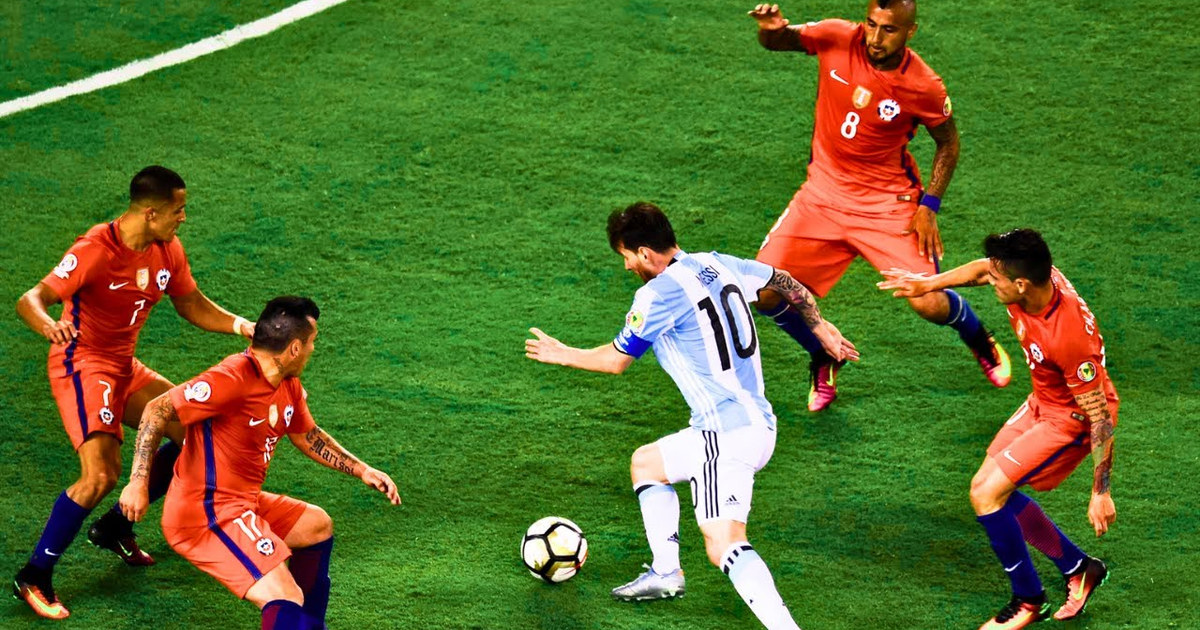
Part 3
The turning point came in 2021. The Copa América was held in Brazil, and Argentina hadn’t won a major international trophy since 1993. In the final at the Maracanã, against Brazil, Messi was quiet by his standards, but Ángel Di María scored the only goal. When the whistle blew, Messi fell to his knees. He had finally won something with Argentina. The weight of a nation lifted. But the biggest prize still eluded him.
That brings us to Qatar, 2022. The World Cup. Messi’s last dance. Argentina started with a shock loss to Saudi Arabia, but then Messi took over. He scored in every knockout round. In the final against France, he opened the scoring with a penalty in the 23rd minute. The commentary from that moment is now iconic: “It’s Messi! And it’s 1-0 for Argentina! Well, it had to be him.” That line captures the inevitability. Of course it was him. Who else?
But the final wasn’t a simple coronation. France came back from 2-0 down, then 3-2 down, with Kylian Mbappé scoring a hat-trick. Messi scored twice—one penalty, one close-range finish in extra time—and then converted his spot-kick in the shootout. Argentina won 4-2 on penalties. Messi had done it. The greatest player of all time had won the greatest prize. The image of him lifting the World Cup in his bisht is now part of football’s permanent memory.
Why does this matter for the mixtape? Because it shows the full arc. The same player who could dribble through entire defenses for Barcelona also had to endure years of international failure. The 2014 final loss, the 2015 and 2016 Copa América defeats, the retirement, the return, the 2021 Copa América win, and finally the 2022 World Cup. It’s a narrative that no scriptwriter would dare invent. And it’s why the clip of Messi scoring for Argentina hits differently. It’s not just a goal. It’s a chapter in the greatest story the sport has ever told.
So when you watch that old footage of a 24-year-old Messi, remember what was coming. The heartbreak, the redemption, the glory. The boy who kicked on against Argentina would become the man who conquered the world.
Stop Four: The Playmaker — When He Became the Architect
You’ve seen him score from impossible angles. You’ve seen him dribble through entire defenses. But now, on this stop of the tour, we’re going to watch him do something else entirely: create. This is the Messi who doesn’t just finish the masterpiece — he paints it, frames it, and hands it to someone else to sign. And the moment that sums it up? The 2022 World Cup semi-final against Croatia.
Let’s go to the tape. Julian Alvarez, the young striker, gets the ball. He lays it off to Messi on the right. Messi is held up by Josko Gvardiol — the transcript says 'Guardio,' but we know it’s Gvardiol, the RB Leipzig defender who was one of the best in the tournament. Messi is 35 years old. Gvardiol is 20. And Messi just… waits. He pauses. He lets Gvardiol commit. Then he’s away. 'Messi away from Guardio,' the commentator says, almost laughing. And then the pull-back — not a shot, not a cross, but a perfectly weighted pass into the path of Alvarez, who finishes. 'Julian Alvarez with the finish. Messi again with the marvelous mischief.'
[[AD]]
That phrase — 'marvelous mischief' — is exactly right. It’s not just skill. It’s playfulness. It’s the joy of a kid in the schoolyard, except the schoolyard is a World Cup semi-final and the kid is the greatest player of all time. Mischief implies he’s doing something he shouldn’t be able to do, something that bends the rules of what’s possible. He’s not just beating Gvardiol; he’s making him look like he’s never defended before. And then, instead of shooting, he gives it to Alvarez. That’s the architect. That’s the playmaker.
But this didn’t happen overnight. Let’s rewind. For most of his career at Barcelona, Messi was the finisher. He scored 91 goals in a calendar year in 2012. He won six Ballon d’Ors as a forward. But as he got older, he started dropping deeper. He became the guy who picked the lock, not just the one who kicked the door down. In the 2019-20 season, he had 25 assists in La Liga alone — a record. The next year, 2020-21, he had 9 assists in La Liga but 14 in all competitions, and he was still scoring 30 goals. Then came the shock: August 2021, he left Barcelona for Paris Saint-Germain. It was a tearful goodbye, a new chapter. And at PSG, he wasn’t the main scorer anymore — Kylian Mbappe was. Messi became the provider. In his first season, he had 14 assists in Ligue 1. In his second, 16. He was the puppet master.
And the awards kept coming. In 2021, he won his seventh Ballon d’Or — largely for finally winning the Copa America with Argentina that summer. In 2023, he won his eighth, after the World Cup. That’s not a typo. Eight. No one else has more than five. But here’s the thing: those awards weren’t just for goals. They were for moments like the one against Croatia. For the vision. For the no-look pass that splits three defenders. For the weighted through ball that only he saw. For the ability to pause time, to slow the game down to his heartbeat, and then accelerate it when everyone else is still catching up.


