Part 1
The Moment: A Ball Stuck to a Boot
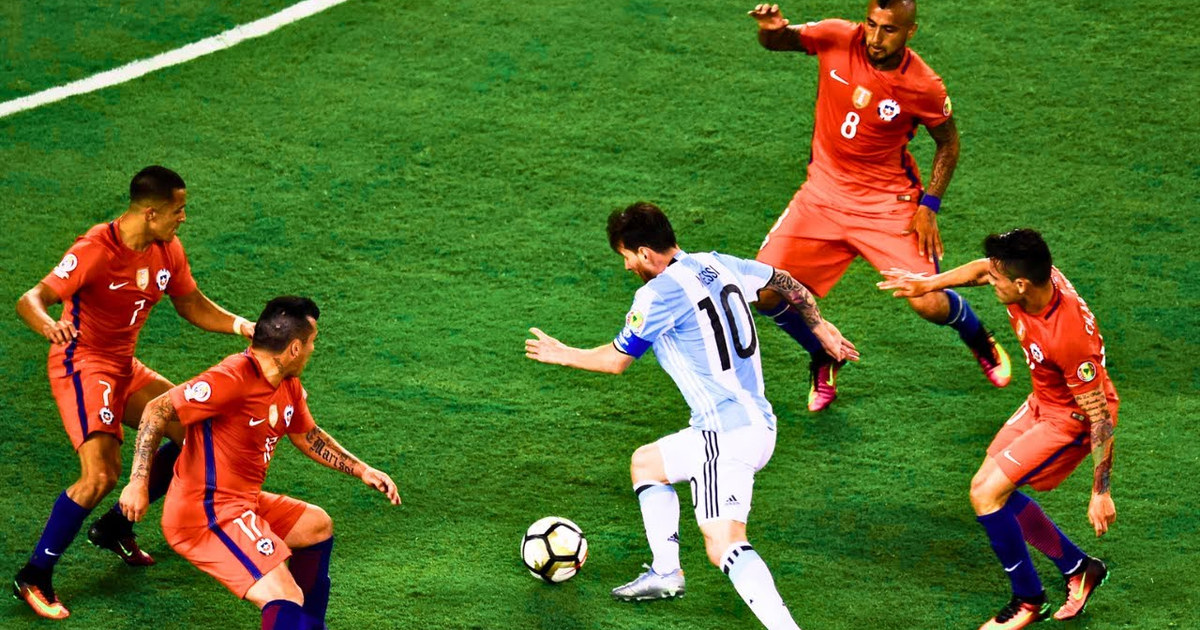
The grass at Wembley is a little long, the way it always is on a European night in late May, and you can hear the studs. That's the first thing. Not the roar — that comes later, a wave that breaks somewhere in the upper tiers and crashes down — but the small, dry click of metal on soil as Lionel Messi tiptoes. He is not running. He is tiptoeing, the way a man walks across a wet floor he doesn't trust. The ball is on his left foot, and it stays there. It is not dribbling in the ordinary sense. It is riding, glued, a satellite caught in a gravity well that happens to be attached to a 24-year-old from Rosario. Around him, Manchester United defenders arrive in pairs, then in threes, and each time he shifts his weight, they vanish like punctuation erased from a sentence. The crowd gasps — a single, collective intake of breath that sounds like the whole stadium remembering it has lungs. Then the hush. Not silence. A held note. The kind of quiet that only exists when thousands of people are waiting for one man to decide what happens next.
It is May 28, 2011. The Champions League final. Barcelona against Manchester United at Wembley Stadium. Pep Guardiola's side is already the best team on the planet, and Messi is already a three-time Ballon d'Or winner, already a legend at an age when most players are still learning how to lose gracefully. But on this night, he is something else. He is hungry. You can see it in the way he presses, the way he demands the ball from Xavi and Iniesta as if the game owes him something. The commentary, breathless and slightly disbelieving, says what everyone is thinking: "He is just brilliant. Best player in the world, bar none." It is not analysis. It is testimony.
I want to read that image the way I read a sentence. Messi's body is syntax. The way he drops his shoulder is a comma — a small pause that changes the meaning of everything after it. The way he accelerates is a paragraph break, a hard return that leaves the previous thought behind. And the way he finishes — the shot, low and sudden, past Edwin van der Sar — is the period at the end of a very long, very beautiful run-on sentence that somehow never lost its grammar. The ball sticks to his boot because his boot is not a boot. It is a clause. It is a dependent clause that refuses to be dependent on anything.
What makes Messi's play feel like literature? It is not just the skill. Plenty of players have skill. It is the narrative intelligence. He reads the game the way a novelist reads a room — noticing the small tensions, the unspoken alliances, the spaces between people that everyone else ignores. He does not beat defenders so much as edit them out. He does not score goals so much as resolve plots. And when he tiptoes past Nemanja Vidić and Rio Ferdinand, when he skips away from Park Ji-sung and Michael Carrick, he is not just playing football. He is writing a scene that will be read for decades.
But this was not the first time he had rewritten the rules.
The Repertoire: From Camp Nou to the World Stage
He is just brilliant. The words hang in the air like a photograph you can't stop looking at. But what makes Messi brilliant isn't one moment. It's a whole grammar of movement, a language he's been speaking since he was a teenager in La Masia. Each match adds a new sentence. Each defender becomes a character in his story.
Start with the nutmeg on Guardiola. Not Pep the manager—Pep the player, back in 2010, when Messi was already the best on the planet. The transcript captures it: 'Messi held up by Guardio. Messi away from Guardio.' A simple phrase, but it's a masterclass in compression. In that split second, Messi reads the angle of Guardiola's stance, slides the ball through the gate, and spins away. It's not disrespect. It's geometry. And it's the same trick he'd use years later against Benitez, against Yedlin, against anyone who dares to plant a foot.
Then there's the solo goal against Getafe in 2007. If you've never seen it, stop reading and go find it. It's a carbon copy of Maradona's 1986 masterpiece, but with Messi's own brushstrokes. He picks up the ball in his own half, slaloms past six defenders, and slots it home. The commentary in the transcript doesn't even try to describe it—it just says 'Brilliant! Brilliant! Brilliant!' Sometimes repetition is the only honest response.
But the repertoire isn't just about goals. It's about the pass that makes you gasp. The assist to Suarez in 2015 is a perfect example. The transcript lays it out: 'He gets a nutmeg, then he dribbles past another two defenders to get the shot off and the rebound comes off Roberto and the ball's put in the back of the net by Luis Suarez.' That's not a highlight. That's a short story with a beginning, middle, and end. Messi is the author, Suarez is the punctuation.
And the defenders? They're not just obstacles. They're foils. Yedlin, Scholes, Ashley Cole, Fred, Essien—each one frozen in the frame, each one a witness to something they'll tell their grandkids about. 'Messi spinning away from Benitez,' the transcript says. 'Skips over a second one.' 'Leaves one defender for dead.' These aren't just descriptions. They're character sketches. Messi makes them famous by making them look helpless.


