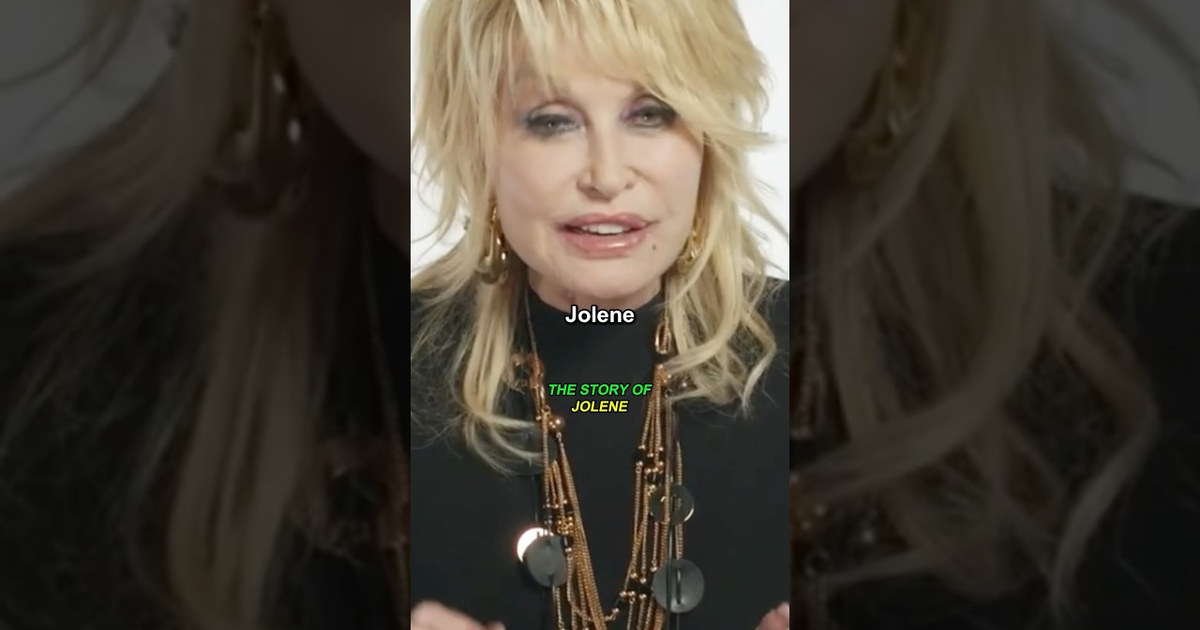
Part 1
There are exactly two kinds of people who opened this clip. The first came for the genre: the jealousy ballad, the country soap opera, the drama of a woman begging a rival to leave her man alone. The second came for the craft: how a song actually gets built, screw by screw, by somebody who has been doing it for decades.
This post is for both of you. We're not ranking you. We're not going to pretend the fan is shallow or the nerd is superior. Because here's the beautiful thing about the story Dolly Parton tells in this video — it rewards both readings at the exact same time.
Watch it as a fan and you get folklore: a legend manifesting one of the most famous songs in country music out of a stranger's name in an autograph line. Watch it as a builder and you get something even better — a live demo of a hook being captured, held, and shipped before it evaporates.
[[AD]]
The Seed Value: One Name, One Autograph, One Promise
Dolly starts with a correction, which is a great way to start anything. The name Jolene, she says, came from a little girl she was signing an autograph for. The song's Jolene is a different thing entirely. She borrowed a name. The woman in the song is invented.
And she says it like it's nothing: she'd never heard that name before. That's the whole spark. Not heartbreak. Not a cheating lover. Not some midnight revelation on a mountaintop. A name she'd never encountered, arriving by hand, on paper, from a kid who just wanted a signature.
Then she makes a promise out loud. She tells the girl: "That's a beautiful name. I'm going to write a song about that." And then she seals it: "If you ever hear a song about that, you'll know I wrote it about you."
Notice what just happened there. A random input became a stated intention. Most of us have a hundred moments like that every year and do absolutely nothing with them. Dolly said the sentence out loud — and then, critically, did not forget it.
[[AD]]
For the Genre Crowd: This Is How a Villain Gets Born
If you're here for the story, here's the story. Somebody says a word you've never heard. Instead of shrugging and moving on, your brain builds an entire person out of it. That person gets a name, a reputation, and — by the time the verses show up — a full emotional architecture.
All of it grows out of a signature. That's the genre pleasure of this clip: you get to watch a country song's antagonist walk on stage for the first time, and she walks on as a spelling.
The delivery matters too. Dolly isn't performing analysis for a documentary. She's remembering. She's half-laughing at her own brain, and the rhythm of the memory already sounds like the record. You can hear her landing on it in real time. You can almost hear the syllables stacking up before she says them out loud.
The Villain Who Never Shows Up
Here's the genre genius buried in the mechanics: the most famous name in the song never actually appears. The narrator begs. The listener imagines. Jolene does the rest of the work.
A borrowed name is cheaper than a scene, and it's infinitely more powerful. You never meet her, so you cast her yourself. That's a fan-level thrill. It's also a structural trick, and we'll come back to it in a second, because it deserves a second pass.
[[AD]]
For the Craft Crowd: Nine Repeats and a Volatile Register
Now switch brains. You're not watching an icon reminisce. You're watching a write-ahead log with no disk attached to it.
Dolly is walking back to the bus. She has no notebook open. She has a word and a melody fragment, and she says plainly that she did not want to forget it before she got back to the bus. So she does the only thing available to her. She repeats it. Over and over. "Jolene, Jolene, Jolene, Jolene, Jolene, Jolene, Jolene, Jolene."
That is not songwriting yet. That's a memory technique. She is manually keeping a value hot because she has nowhere safe to put it. Any programmer will recognize the panic instantly: you've got a value sitting in a volatile register and no persistence layer, and if anything distracts you for two seconds, the whole thing is gone.
Then the repetition does something else entirely. In the clip, it just becomes "Jolene, Jolene, Jolene, Jolene" — the count collapses, the meter locks in, and she hears it: "Well, there's a chorus right there."
Read that again. The memory hack and the hook are the same four syllables. She didn't sit down and decide to write a chorus. She noticed one had quietly assembled itself while she was busy not forgetting it.
[[AD]]
That's the pure-craft payoff of this clip, and it's worth sitting with for a second. Repetition isn't filler. Repetition is load-bearing structure. Nine mantras become four beats become the single thing an entire song hangs off of for the next fifty years.
"There's a Chorus Right There" — Then She Made Up the Verses
Her summary of the whole process is almost insultingly casual: "So, I just kind of made it into a song and then I made up those verses."


