Part 2
Maggie stood in the corridor and said: “You were singing like there were 10,000 people in that room. I counted 31. But you sang like it was 10,000.” Dolly laughed first, then cried harder, and that made both of them laugh.
A stagehand with a small instant camera took one shot. Dolly in her stage costume. Maggie in a college jacket with a tear in the left elbow. Both squinting in the flash. Dolly wrote on the back: “For Maggie, you were my 10,000. March 1967.”
[[VIDEO]]
This is the structure of A Star Is Born (1954, 1976, 2018)—the unknown who becomes known, and the person who saw them first. But Judy Garland’s and Barbra Streisand’s and Lady Gaga’s versions all end in tragedy or dissolution. Maggie Callaway’s version ends in a schoolteacher’s life in Sevierville, Tennessee. She taught music for 34 years. She attended every Dolly Parton concert she could reach by car. She raised two daughters, had six grandchildren, and never reached out. She said she didn’t want to become a story. She wanted to stay a memory.
That choice—to remain a memory rather than a story—is the quiet heart of this section. It’s also the reason the question from Section 1 matters: what do we owe the people who knew us before we were anyone?
Maggie kept the photograph inside her Bible. For decades, it stayed there, folded, soft-edged, a private relic. She never told anyone except her family. Not because she was ashamed, but because she understood something about fame: it consumes stories. She didn’t want to be consumed.
Then came November 2023. Stage four pancreatic cancer. Four to six months. Maggie told her family there was one thing she wanted to do before she was too ill to travel. Her daughter found the photograph inside the Bible and wrote three pages to Dolly’s management team.
Dolly called back within 24 hours. The arrangement was made in secret. The Tonight Show staff were told only that a specific guest would be seated in the third row and that the row was not to be disturbed. They were not told who she was. They were not told about the photograph.
Dolly’s instruction to her team: “I want her to feel like a person, not a moment.” That line is the answer to the question from Section 1. The cost of keeping a promise is refusing to turn it into content.
Maggie knew only that she had a seat in the third row. She did not know that Dolly had already found her face on the side stage monitor the moment the studio doors opened. And Dolly had carried her own copy of the photograph in the inside pocket of her ivory jacket since that morning.
So when Dolly stopped singing mid-verse on The Tonight Show in March 2024, it wasn’t a breakdown. It was a promise being kept. A promise made in a rainy corridor in 1967, when a 21-year-old girl with a guitar and a dream was told she sang like 10,000 people were listening. And she never forgot.
[[AD]]
The Answer: Why 57 Years of Silence Was the Loudest Thing in the Room
Dolly was singing when she saw Maggie hold the photograph up from the third row. She recognized it in less than a second. Not the image, but the shape of it. The worn edges. The way Maggie held it with both hands. The way you hold something that has waited a long time to be seen. Fifty-seven years of silence standing up in a third-row seat on shaking legs.
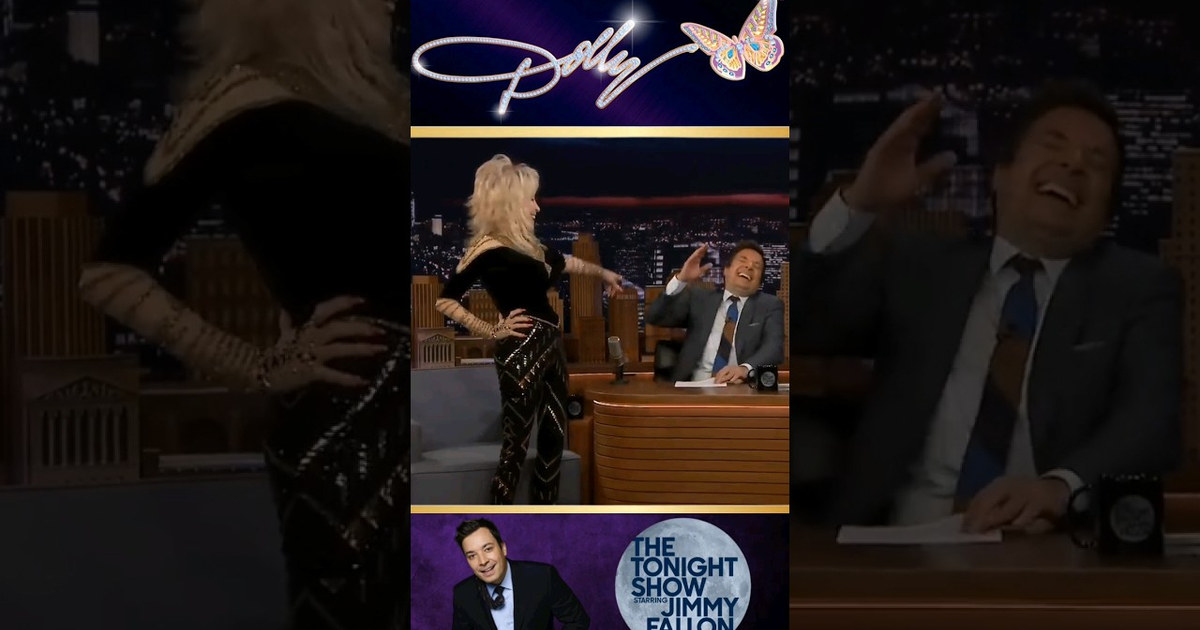
The song stopped. Not at the end of a line. Mid-word. Her voice simply quit, and her hand rose slowly to her mouth. Jimmy Fallon went still behind his desk. Three hundred people had come to watch a legend perform, and instead they were watching something no one had ever seen: Dolly Parton unable to continue. The Tonight Show had been on the air for 70 years. Nothing like this had ever happened. Not like this.
Then Dolly stepped down from the stage. Not the side stairs — directly off the front edge, a drop of about three feet. A stagehand moved to catch her. She waved him off without looking. Fallon came around his desk slowly and said, quietly, “Folks, I think we need to let this happen.” He did not try to narrate it. That restraint is the difference between a talk show and a documentary.
This is the emotional grammar of The Straight Story (1999), David Lynch’s film about an old man who drives a lawnmower across two states to see his estranged brother. No speeches. No grand reconciliation. Just presence. Dolly moved through the center aisle. The crowd parted not from instruction but from instinct. She reached the third row. Maggie was standing. Thin. Blue dress. 74 years old. Holding the photograph the way she had held it for 57 years — with both hands, carefully, the back turned away from the room.
Dolly put both hands around Maggie’s hands without taking the photograph. “You kept it.” Maggie’s hands were shaking. “Every day.” “I carried mine tonight.” Dolly reached into her jacket and drew out a folded piece of paper — her copy of the same photograph, older, edges softened, folded once, carried for longer than anyone in that room knew. She unfolded it slowly. “For Maggie, you were my 10,000. March 1967.”