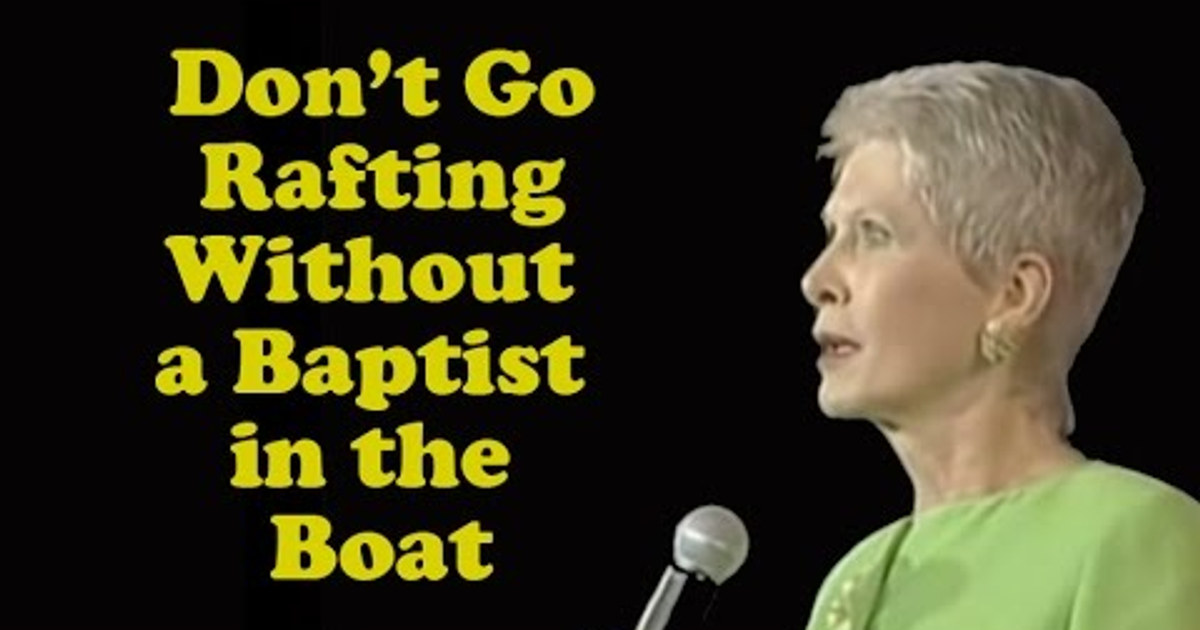
Part 1
First, look at this: notice the split second right before Jeanne Robertson says the word "slap." Her posture remains immaculately upright, her shoulders square, her facial expression radiating the effortless composure of a former Miss North Carolina who could navigate a high-society banquet blindfolded. She does not signal the punchline with an eyebrow twitch or a knowing smirk. She lets her vocal cadence coast into a breezy, almost throwaway anecdote about her son attending college—and then drops the acoustic hammer so casually that the audience laughs twice: once at the surprise percussion, and once more at the realization that they walked right into the trap.
Most casual viewers remember this performance as a funny yarn about an eighty-year-old Southern humorist getting soaked on a river raft. But if you step inside the archival vault and pull the reel, you realize this routine is a breathtaking exercise in technical comedic structure. Robertson is not merely recounting a vacation mishap; she is conducting a masterclass in dynamic tension, denomination-based subcultural satire, and the precise calibration of narrative stakes.
Welcome to the guided exhibition. We are going to walk through this celebrated routine in an unorthodox sequence—not from the polite beginning to the neat finale, but through five distinct analytical vantage points that reveal how Robertson engineered an enduring classic of modern American live theater. Leave your tourist assumptions at the door, look where the spotlight actually falls, and prepare to see a master technician at work.
[[AD]]
Stop 1: The Bathtub Submersion and the Mechanics of Near-Death Slapstick
We begin not on dry land, but at the absolute lowest geographical and psychological point of the journey: the twenty-foot drop into the churning Colorado River, seated squarely in the raft’s notorious front trough, affectionately dubbed "the bathtub." Why start here? Because this is the exact fulcrum on which the entire narrative pivots from mild discomfort to full-blown existential crisis.
Watch the physical blocking Robertson employs when describing Sparky the guide delivering his pre-rapids briefing. Sparky does not issue a friendly cautionary advisory; he delivers an operational decree of brutal simplicity: hold the ropes, because if you let go, you are swept downstream and retrieved later. Robertson plays this moment with deadpan restraint. Notice the economy of dialogue between Jeanne and her husband, affectionately christened "Left Brain." Left Brain asks what the guide said; Jeanne compresses the entire apocalyptic warning down to four words: "He said to hold on."
What happens when they submerge? The sensory description is visceral. Robertson strips away all visual reference points: no sky, no sunlight, just the suffocating pressure of opaque, churning river water. When they finally break the surface, gasping for air, the exchange between husband and wife is reduced to primal proof of life: a mutual nod confirming, against all odds, survival.
[[AD]]
Then comes the crowning comedic subversion. Robertson turns to her companion on the raft, an unfamiliar Baptist woman from South Carolina, expecting a shared gasp of secular terror. Instead, the woman evaluates Jeanne's rattled gasping and drops the ultimate regional diagnosis: "You're not a Baptist, are you?" It is a devastatingly sharp punchline because it reframes terrifying physical trauma through the lens of Southern immersion theology. To the Baptist, holding your breath beneath violent waters is practically a rite of passage; to everyone else, it is impending drowning. By anchoring physical peril to theological rivalry, Robertson converts pure panic into soaring observational gold.
Stop 2: The Bucket Analogy and the Geometry of Escalation
Step over to our second station. To understand how Robertson makes an eight-day, 227-mile trek palatable inside an eight-minute routine, you have to examine how she invents her central metaphor: the imaginary bucket of mud, sticks, and bugs. Pay close attention to how she singles out an audience member—Al Walker—and constructs an interactive miniature right on stage.
She does not ask you to picture the vast majesty of the Grand Canyon’s geological strata. She shrinks the vast natural monument down to a personal torture device. She asks you to imagine sitting peacefully in a folding chair, attempting to write correspondence, while a tormentor methodically stirs a bucket of filth, looks you dead in the eyes, and flings it straight into your face when your guard drops.
[[AD]]
Notice the arithmetic of her escalation rule. On Day One, the reaction is dramatic social indignation: "Hand me that towel, this has messed up my outfit!" It is vanity under siege. By Day Two, the physical strategy shifts to anticipatory defense: you see the arc of dirty river coming, you flinch, and you tuck your chin. By Day Three, habituation has erased all dignity: you simply pause midsentence, absorb the violent slap of silt-laden current, and continue speaking as though nothing out of the ordinary transpired.
The delivery of "our son graduated from Elon... slap... University" works because of Jeanne's impeccable internal metronome. She does not pause to let the audience anticipate the strike. She interrupts her own breath, absorbs the fictional blow with a dry swallow, and resumes the sentence without skipping a beat. It is the rhythm of pure comedy: turning catastrophic humiliation into daily routine.
Stop 3: The Campfire Wine Ritual and the Denominational Arc
Turn your attention to the nocturnal sections of the narrative. In amateur hands, stories about wilderness trips get bogged down in campfire logs and mosquito bites. Robertson ignores the scenery entirely and trains her forensic eye on social etiquette, religious decorum, and the slow, inevitable erosion of moral piety under the influence of extreme exhaustion.


