Part 1
First, look at this: notice the way Katie holds her cell phone against her ear while John Kelly sits directly across the small coffee shop table, sipping his drink in silence. She is speaking to David, her boyfriend of two years. She speaks with that lilting, slightly sing-song cadence people use when they want to sound entirely transparent while actively building a wall. She tells him she is simply reading, asks about his lunch, politely shoots down his request to host his buddies for the game, and promises to cook him a nice dinner instead. When she hangs up, she does not look guilty. She simply picks up her cup, steps across the street to buy tobacco, and leans in for a kiss from Kelly.
Most people remember syndicated surveillance reality television for its chaotic, screaming finales—the spilled soda, the flailing fists, the security guards lunging across strip-mall parking lots. But that is not where the truth of the show actually lives. If you want to understand how a show like Cheaters survived for decades, you cannot start at the finish line.
You have to step into the archive with me, walk past the velvet ropes of syndicated melodrama, and examine the machinery piece by piece. We are going to explore this artifact in an unusual order—not as a chronological tabloid scandal, but as a deliberate architectural tour of human rationalization, tactical production, and unexpected melancholy.
[[AD]]
Stop 1: The Pincer Movement and the Staging Ground
Let us begin our tour not at the beginning of the case, but right at the perimeter of the ambush. Look closely at the staging sequence right before the confrontation occurs. Host Clark Gable III sits in the lead van alongside the client, David Stevens. The vehicle is idling around the corner from Katie's apartment complex. Notice the language Gable uses: he does not talk like a television presenter; he talks like an infantry squad leader.
Why do the producers rely so heavily on tactical jargon? Gable talks about 'staging,' 'getting intel,' and coordinating with 'mobile units.' It is theater, certainly, but it serves a psychological purpose for the viewer. It transforms a sad, domestic breakdown between two ordinary twenty-somethings into a high-stakes sting operation against a rogue actor.
Observe the choreography of the cars. Gable receives the green light over the radio: 'Go go go go go.' He directs driver operations with cold precision: 'Park in the back of the white Accord... Van number two goes at the nose right there, swinging hard.' The cameras capture the sheer panic inside that white Honda Accord as two massive production vans physically box the vehicle into the curb.
[[AD]]
Take a look at the windows of the trapped car. Before a single door opens, you see two silhouettes frozen in place. They are not thinking about love, commitment, or apologies. In that microsecond, their brains are processing a tactical ambush. That mechanical entrapment is essential to the show's formula: by eliminating physical flight, the production forces emotional fight.
Stop 2: The Surveillance Reel — The Tragic Banality of the Grocery Run
Now, walk backward with me into the screening room. Before the vans ever blocked that street, David sat beside Gable in the darkened studio to view what the show terms 'the evidence.' Watch what the cameras chose to film during their days of tracking Katie.
What do viewers expect an illicit affair to look like? Expensive hotel lobbies, clandestine cocktail lounges, dimly lit speakeasies? Instead, look at this reel: Katie steps out of her domicile, hops into Kelly's car, and they drive to a suburban grocery store. Then they visit a pet supply outlet. Later, they grab fast food, eat it while driving around aimlessly, and stop at a liquor shop.
Notice the crushing mundanity of it all. Infidelity here is not rendered as grand, cinematic passion; it is documented as everyday household maintenance. Katie is not sneaking into the shadows; she is running Sunday errands. She has substituted David with Kelly in the most domestic chores of daily life.
[[AD]]
Listen to David's commentary during this sequence. He tells the producers that their conversations on the phone keep shrinking. Six months earlier, moving in together was an active conversation, postponed only so they could 'get the finances together.' Now, with David working two jobs to stabilize those finances, Katie cannot even give him a straight answer. The grocery bags captured on long-range telephoto lens become the cruelest exhibits: proof that she had already moved into a domestic life, just not with him.
Stop 3: The Sidewalk Tribunal and the Anatomy of an Excuse
**Spoiler warning:** The following section breaks down the raw dialogue and emotional unraveling of the live sidewalk confrontation.
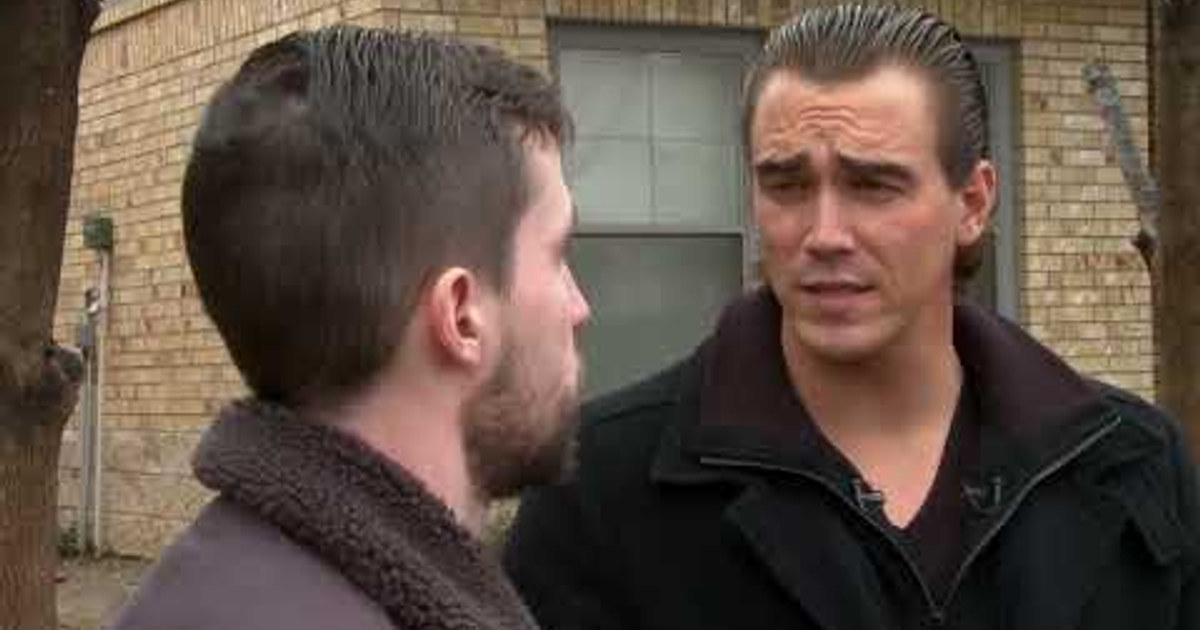
Step outside onto the pavement where the vans have slammed the doors open. Notice the perimeter that immediately forms. Security stands at the ready, Gable looms near the center, and the three principals—David, Katie, and John Kelly—form an awkward triangle of defensive body language.
Pay special attention to John Kelly. How does an unexpected third party react when shoved into the center of syndicated daylight television? Kelly does not panic. He attempts to retreat into street-level machismo and plausible deniability. He claims Katie told him she and David broke up a month ago. When David presses him, Kelly drops into patronizing paternalism: 'I met a nice girl, we're having a decent time. She's a grown woman, she can make her own decisions.'


