Part 1
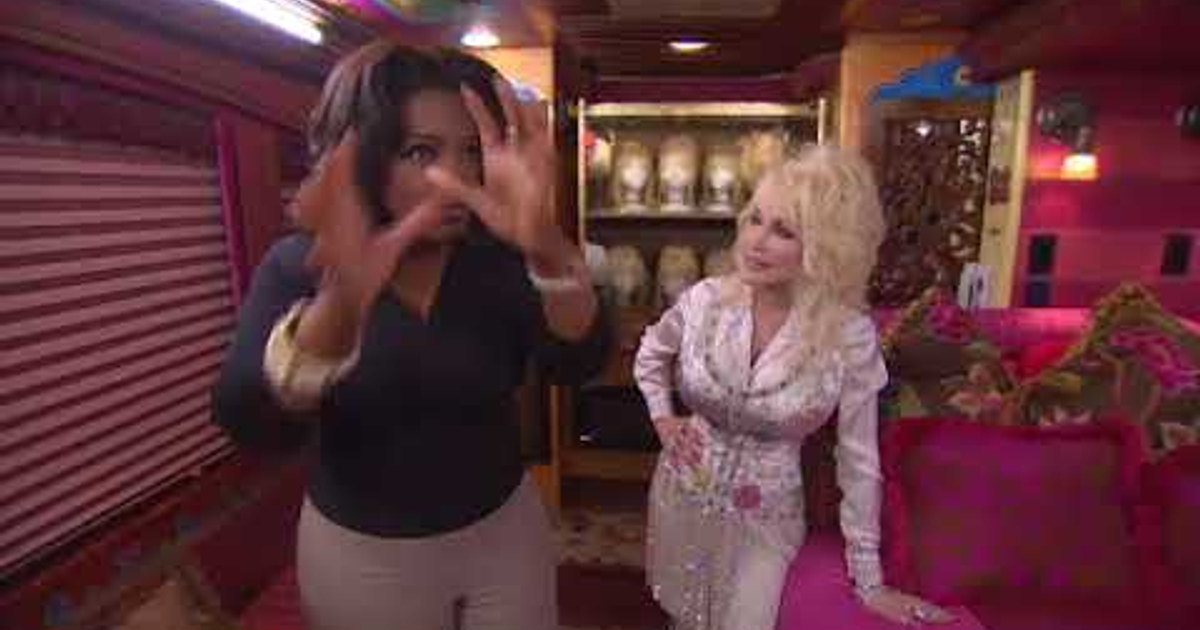
You have probably seen the short clips circulating across social feeds: Oprah Winfrey standing outside Harpo Studios at dawn, marveling at a massive motorcoach that looks less like a utilitarian transit vehicle and more like a mobile country palace. It cuts right to the heart of an enduring pop-culture paradox. How does someone who commands an entertainment empire, with private jets and five-star luxury suites at her beck and call, choose instead to dwell in a custom cabin on wheels parked beside an industrial curb?
The footage poses a fascinating question about modern celebrity: when you can afford the absolute pinnacle of domestic luxury anywhere on the planet, what does true sanctuary actually look like? For Dolly Parton, the answer isn’t a penthouse overlooking Central Park or an isolated estate in Malibu. It is a double-wide on wheels, stocked with winter tomatoes shipped straight from Los Angeles, a bespoke bathtub tailored precisely to her petite frame, and an altar where devotion meets daily life on the asphalt.
Watching Oprah step up the stairs into Dolly's custom suite feels like witnessing two opposing titans of American media negotiate the meaning of hospitality. While Oprah built an empire celebrating domestic taste—think of her legendary 'Favorite Things' or the architectural grandeur of her Promised Land estate in Montecito—Dolly's aesthetic has always favored the cozy, rhinestone-encrusted pragmatism of a working-class Appalachian girl who conquered the world without ever abandoning her roots.
[[AD]]
The Mobile Sanctuary: Autonomy on Eighteen Wheels
To understand the allure of Parton's rolling sanctuary, one has to look back at the grand tradition of American road architecture. In D.A. Pennebaker’s seminal 1967 documentary 'Dont Look Back', Bob Dylan's tour existence was defined by bleak hotel lobbies, aggressive journalists, and soulless green rooms. It was a life of dislocation, where fame detached the performer from any coherent sense of domestic reality. Dolly Parton engineered the ultimate antidote to that alienation: she brought the living room with her.
'I don’t ever check in hotels anymore,' Parton tells Oprah with absolute casualness, pulling back the curtain on a design philosophy built around radical autonomy. Why subject oneself to the endless logistical friction of hotel check-ins, prying eyes in the lobby, and sterile king-sized suites when your entire world can be customized down to the millimeter? For Dolly, the bus is neither an affectation nor a hardship; it is an impenetrable fortress of peace.
Inside this vessel, Parton controls the variables entirely. The space is partitioned with sliding accordion doors that create concentric layers of privacy. Up front, three bunks house drivers and crew; in the center, a bustling domestic space; and in the rear, a sanctuary where Dolly reads, sleeps, writes, and gets 'dollified.' It evokes the self-contained ingenuity of an ocean liner, distilled into the footprint of an interstate cruiser.
[[AD]]
Even the architectural scale reflects Dolly’s specific physical reality. When Oprah balks at the diminutive bathtub tucked into Parton’s private bathroom—protesting that no adult human could possibly fit inside such a 'teeny tiny baby tub'—Dolly simply laughs and points out that her miniature stature makes it a fully functional tub. Every inch of this rig is molded to her body and her habits, turning what would be a cramped constraint for anyone else into an intimate cocoon.
Altars, Wigs, and Low-Carb Domesticity
What makes this intimate tour so mesmerizing is the collision between grand mythmaking and mundane household rituals. Much like Martin Scorsese captured the delicate balance between high-strung artistry and backstage family dinners in 'The Last Waltz' (1978), this walkthrough reveals how Dolly balances high-camp iconography with down-home routine. Her sisters help manage the operations; her sister Rachel ensures the kitchen is stocked with low-carb quiches, pork rinds, and pepper jack cheese.
There is a hilariously relatable rhythm to Dolly describing her dietary strategy. She stays disciplined during the week with meat-skin pie crusts and gourmet cheese, only to indulge with stash-away ice creams when the weekend hits. It’s an unpretentious, lived-in reality that completely punctures the mystique of untouchable superstardom without diminishing her charisma by an ounce.
[[AD]]
Then comes the cosmetic corner: the altar of transformation where Dolly Parton becomes 'Dolly.' The petite swivel chairs, the glittering vanity, the array of wigs—her famous 'girls'—resting in custom slots, waiting to be summoned. To step into this alcove is to witness the backstage machinery of one of twentieth-century music's greatest theatrical creations. Yet sitting right alongside the hairpieces and cosmetics is a tiny, fold-out prayer altar, a handcrafted prie-dieu where she kneels to center herself.
The moment Oprah recognizes that prayer station is electric. Two self-made cultural icons instantly bond over their private spiritual architecture: Oprah describing her sunlit morning prayer chair at home, Dolly explaining that she builds chapels into every house she owns but preserves this exact, folding space so she never misses a morning devotion on the highway. Faith and fame do not compete here; they sit side by side next to the eyeliner.
The Double-Wide Aesthetic as Radical Authenticity
Oprah’s immediate observation upon walking through the threshold—'This is like a double wide'—carries genuine cultural weight. In mid-century and modern pop culture, mobile homes and double-wides have routinely been coded with classist punchlines. But Dolly embraces that exact aesthetic lineage, elevating it into luxury on her own terms. It recalls the defiant country pride celebrated in Robert Altman’s 'Nashville' (1975), where vehicles and touring rigs served as mobile signifiers of working-class triumph.


