Part 2
[[AD]]
That's the scene. But the scene is the end of an argument, not the end of a story.
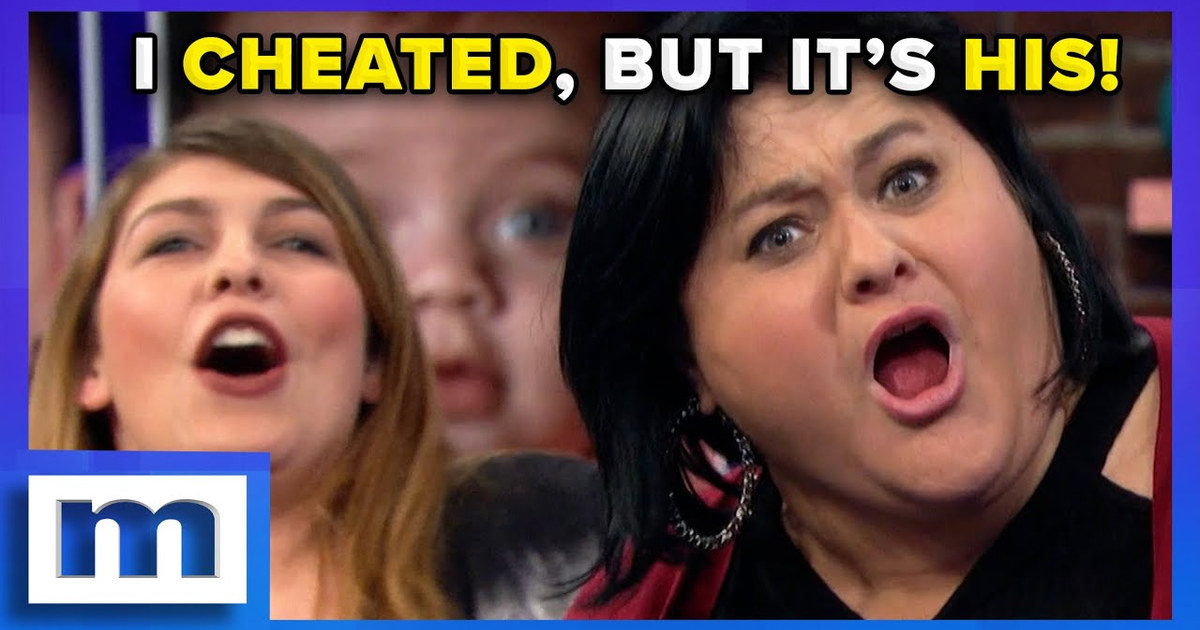
Because the argument started long before the envelope. It started, according to Lauren, with a single confession: she slept with an ex one time, around the time she got pregnant. She calls it "a mistake." She says it plainly, without decoration, the way you'd read a weather report. Tyler's response is to say he's had doubts "since day one" — that he knew she was sleeping around, that people had been coming up to him with proof, that the proof doesn't even matter because he already knows. Gunar, Tyler's cousin, has been the engine of the doubt. Lauren says Gunar doesn't know how to stay out of their relationship. Gunar says he told Tyler before he ever got with her. And Maria — Gunar's fiancée, sitting in the audience — gets asked whose side she's on and delivers the line that cuts through the whole circus: "They're both some fools."
She's not wrong. She's also not finished. Maria points at the baby photos and starts doing what everyone in the audience has been doing since the first commercial break: reading the child's face like a legal document. "That baby ain't got no forehead," she says. "He got a five-head just like him." She means Tyler. She means it as proof. The audience laughs, because it's funny, and because it's true, and because the whole genre runs on the idea that you can look at a four-month-old and see a paternity test in the shape of a skull.
[[VIDEO]]
But the DNA test was never going to settle the thing everyone was actually fighting about. Lauren insists Tyler is the father because she slept with him more than once. Tyler insists it "don't matter what proof you got." Gunar insists the baby looks nothing like Tyler. Maria insists the baby looks exactly like Tyler. Everyone is certain. Everyone is shouting. And underneath the shouting is a simpler, uglier question: who gets to decide what a family is? The test was framed as the end of that argument. It becomes the beginning of a different one.
Maury Povich has been hosting this particular ritual since 1991, when his show premiered in syndication. For more than three decades, the paternity-test episode has been a genre unto itself — a daytime courtroom where the verdict is written in nucleotides and the audience chants for the reveal like it's a prizefight. The catchphrases are part of the furniture now. "You are not the father." "You are the father." The running, the dancing, the collapsing, the woman who bolts from the stage and has to be chased down by a producer in a headset. It's theater. It's also, for the people on that stage, the worst day of their lives, filmed in high definition and cut to commercial.
What's striking about this episode — and what makes it worth watching past the initial shock — is how quickly Maury shifts from judge to counselor. The verdict is barely out of his mouth before he's telling Tyler not to "ruin your life." He's not talking about the baby. He's talking about the rage. He's talking about the version of Tyler who might walk out of the studio and do something he can't take back. It's rough wisdom, the kind you get from a man who has presided over thousands of these reveals and has learned to read the room for the moment before it turns. Maury doesn't just deliver the fact. He manages the fallout. He tells Lauren she'll "be glad to bring another fellow on if you want to test him" — a line that lands somewhere between a threat and a promise, depending on how you hear it.
Gunar, meanwhile, refuses the fact entirely. "I don't care what that says," he says. "I'll still be there." It's a strange thing to say when the test has just proved he was right. He spent months insisting Tyler wasn't the father. Now he's been told he was right — and he's still fighting. Which suggests the fight was never about paternity at all. It was about control. About who gets to define Lauren. About whether Tyler gets to be a father on his own terms or someone else's.
And then there's Tyler. The man who said, on camera, that if the baby was his he'd "supply everything." The man who said he'd had doubts since day one. The man who now has a piece of paper telling him he was right — and who has to sit there, in front of a studio audience and a national television viewership, and decide what kind of man he's going to be about it. Because the test didn't just answer a question. It took away the excuse. For months, Tyler could tell himself he was withholding because he wasn't sure. Now he's sure. And the baby — four months old, with a forehead that looks like his and a last name that belongs to Lauren's ex — is still there, still real, still needing diapers and wipes and someone to show up.
The camera finds Tyler's face after the verdict. He's not crying. He's not yelling. He's doing the thing people do when a fact they've been chasing finally catches them: he looks smaller. The chair seems bigger around him. His hands are still on the armrests. And somewhere in the audience, a woman who looks like she's been through this herself is shaking her head, because she knows what Tyler is about to learn — that the truth doesn't set you free. It just gives you a new set of problems to solve.


