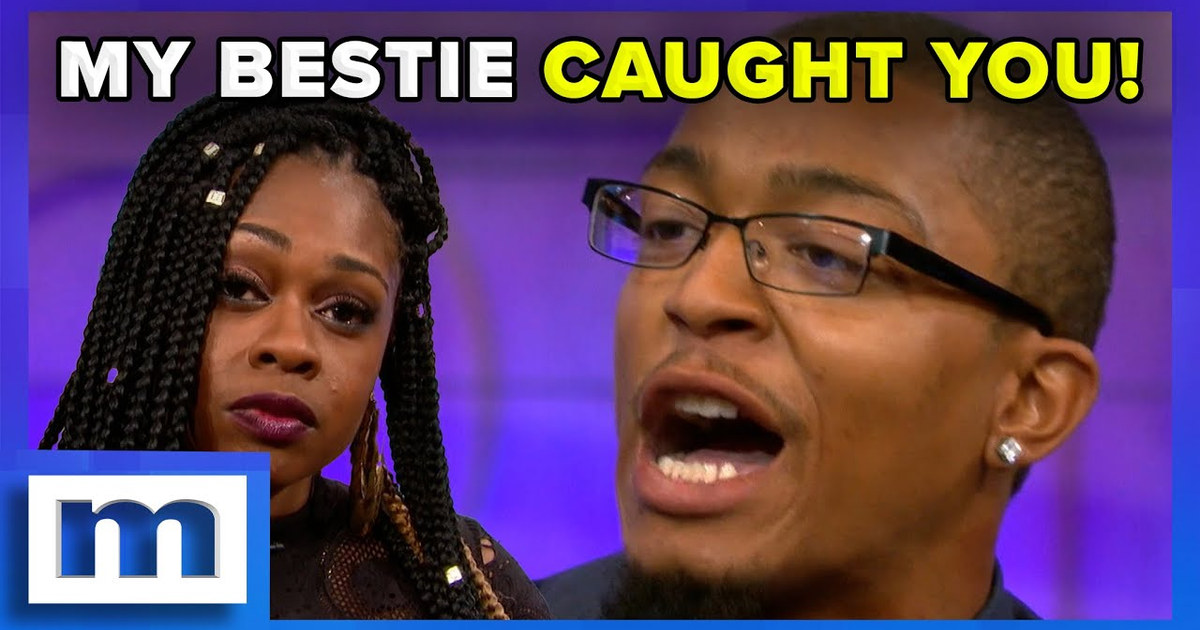
Part 1
The Setup: A Masterclass in Low-Budget Tension
The Maury Show's Michelle and Tyrone saga is a masterclass in low-budget third-act construction, and the lie detector is its deus ex machina. I say this as someone who's shot second-unit for a decade—cutting inserts, grabbing reaction shots, building tension out of whatever light and lens the production could afford. And what Maury Povich's team pulls off with a single studio camera and a polygraph is, structurally speaking, no accident. It's heist-film efficiency on a daytime-TV budget.
Let's start with the cold open. In under five minutes, the show lays out Michelle and Tyrone's entire backstory: three years ago, a woman named Daysha claimed Tyrone was the father of her baby. He denied it. The DNA test said otherwise. Strike one. Two years later, Michelle returned because she suspected Tyrone was cheating. She was right. Strike two. Now they're back, and Michelle is promising that strike three means he's out—done, finished, game over. That's exposition delivered with the ruthless economy of a heist film's opening reel. Think of the first ten minutes of 'Heat' (1995, Michael Mann, 170 min)—every detail about the crew, their methods, their vulnerabilities, laid out before the first score. Maury does it with a clip package and a voiceover.
What's brilliant is how the show weaponizes its own archive. The flashback footage isn't just recap; it's evidence. When we see Tyrone's earlier denials and the subsequent DNA reveal—'You are the father'—we're not just learning history. We're being trained to distrust him. By the time Michelle says, 'I'm willing to forgive a mistake. What I'm not willing to do is keep going over the same mistake,' we're already primed for the fall. It's the same narrative architecture as 'The Jinx' (2015, HBO, Andrew Jarecki) or 'Capturing the Friedmans' (2003, Andrew Jarecki), where accumulated documentary evidence builds an inexorable sense of dread. The difference is Maury does it in five minutes, not five hours.
Now, let's talk about the lighting. The Maury Show shoots in a flat, high-key studio setup—the kind of even, shadowless illumination that exposes every micro-expression. There's nowhere to hide. It's the same principle as the police interrogation room in 'The French Connection' (1971, William Friedkin, 104 min), where fluorescent overheads strip away any pretense. On Maury, that lighting turns Michelle's face into a topographical map of suspicion: the narrowed eyes when she describes the girl pulling up in the car, the tight jaw when she talks about the condoms, the weary resignation when she says she weighs them. Every flicker registers. A cinematographer shooting a thriller would kill for that kind of involuntary honesty.
And the lens? I'd bet my light meter they're using a long zoom—something in the 100-400mm range—to grab reaction shots from a distance. That's why the cutaways to Michelle's face feel so voyeuristic. We're not in the scene with her; we're observing her from across the studio, like a private investigator in a parked car. It's the same technique used in 'Zodiac' (2007, David Fincher, 157 min) during the surveillance sequences—long lenses compressing space, making the audience complicit in the watching. On Maury, that distance heightens the tension. We're not just hearing about Tyrone's alleged infidelities; we're watching Michelle relive them in real time, her expressions magnified and isolated.
The setup also knows how to pace its reveals. Michelle's story unfolds in escalating beats: the girl trying to push Tyrone into her car, the text messages on the extra app, the Facebook hacking, the missing condoms, the pocket-dialed audio recording. Each detail is a new piece of evidence, a new reason to believe Tyrone is guilty. It's the same structure as the opening of 'Gone Girl' (2014, David Fincher, 149 min), where every seemingly innocuous detail about Nick Dunne's behavior becomes a brick in the wall of suspicion. Maury's producers understand that tension isn't about big explosions; it's about accumulation.
By the time Michelle finishes her account, we're not just ready for the lie detector test—we're demanding it. That's the genius of the setup. It doesn't just tell us there's a conflict; it makes us feel the weight of every prior betrayal. And when Maury says, 'Now, the final thing before I bring him out here,' we're leaning forward, exactly where the show wants us. The third act is coming, and we're already hooked.
The Confrontation: Blocking, Pacing, and the Art of the Interruption
You want to talk blocking? Let’s talk blocking. Michelle is seated stage left, Tyrone stage right, and Maury Povich is the fulcrum between them. But the real third camera is backstage, where Samantha waits. That’s not a talk show set; that’s a three-camera sitcom layout—except the laugh track is a live audience that gasps, boos, and hollers like they’re watching a gladiator match. The lighting is flat, functional, and brutally honest: no soft boxes, no diffusion, just hard key light that makes every eye-roll and lip-purse read like a close-up in a Cassavetes film. The set is a pressure cooker, and the blocking is the lid.
Michelle’s story about the girl pulling Tyrone into her car is a masterclass in visual storytelling. She’s not just recounting events; she’s painting a scene. The way she describes him fighting like he doesn’t know her—‘He trying to fight like he don’t know her’—is pure cinema. It’s a moment of physical comedy that would make the Coen brothers proud, but the stakes are real. The girl says, ‘I’m the girl that kidnapped him.’ That line is a gut-punch, and the audience reacts like they’re watching a plot twist in a thriller. The camera cuts to Tyrone, who’s doing his best Ben Affleck in Gone Girl—blank face, slight head shake, the kind of denial that makes you wonder if he’s lying or just a terrible actor. David Fincher would have a field day with this guy.


