Part 3
The original Trio album has sold millions worldwide, and Trio II continued that streak, moving over a million copies in the U.S. alone. But the numbers only tell part of the story. The real legacy is in the way these three women redefined what a female collaboration could be. In the 1980s, country radio was still wary of women who didn’t fit a certain mold. Linda Ronstadt was already a rock icon, Dolly Parton a country-pop crossover queen, and Emmylou Harris a critically adored folk-country darling. Together, they didn’t just cross genres; they ignored the boundaries altogether. They sang Neil Young songs, old Appalachian ballads, and contemporary folk tunes with equal conviction. They proved that women could be commercial and artistic, collaborative and independent, nostalgic and forward-looking—all at once.
After the Trio: Three Solo Journeys, One Enduring Bond
After Trio II, each woman continued to carve her own path, but the trio’s shadow lingered—not as a limitation, but as a benchmark. Dolly Parton, already a legend, kept expanding her empire. She had starred in 9 to 5 (1980, directed by Colin Higgins, 109 minutes) and Steel Magnolias (1989, directed by Herbert Ross, 117 minutes), and she wrote the score for the 9 to 5 musical, which opened on Broadway in 2009. Her Imagination Library, founded in 1995, has gifted over 200 million books to children worldwide. Dolly never stopped working, never stopped giving, and never stopped being Dolly.
Linda Ronstadt, whose voice had powered rock anthems like “You’re No Good” and “Blue Bayou,” retired from performing in 2011 after being diagnosed with Parkinson’s disease. Her legacy, however, is untouchable: 11 Grammy Awards, induction into the Rock and Roll Hall of Fame in 2014, and a catalog that spans rock, country, Latin, and American standards. She also starred in films like The Pirates of Penzance (1983, directed by Wilford Leach, 112 minutes) and appeared on Broadway. Her voice may have been silenced by illness, but its echo is everywhere.
Emmylou Harris, the quiet force of the trio, kept releasing acclaimed albums. Red Dirt Girl (2000) won a Grammy for Best Contemporary Folk Album. Hard Bargain (2011) showed her songwriting still sharp. She collaborated with Mark Knopfler on All the Roadrunning (2006), a gorgeous duet record that proved she could hold her own with a rock guitar god. Emmylou also became a mentor to younger artists, from Alison Krauss to Taylor Swift, who has cited her as an influence. In 2018, Emmylou received a Grammy Lifetime Achievement Award. She’s still touring, still recording, still that warm, crystalline presence.
Breaking Barriers, Blending Eras
The cultural impact of Trio and Trio II goes beyond awards and sales. These three women broke down barriers for female artists in country and rock. They showed that women could be headliners, collaborators, and innovators without sacrificing their identities. Their harmonies influenced a generation of singers—from Alison Krauss and Gillian Welch to Taylor Swift and Kacey Musgraves. The glass harmonica, an 18th-century instrument invented (or at least improved) by Benjamin Franklin, became a symbol of their willingness to experiment, to blend the old with the new, to find beauty in the unexpected. That eerie, ethereal tone wasn’t just a gimmick; it was a statement. We are not afraid to be strange. We are not afraid to be fragile. We are not afraid to be timeless.
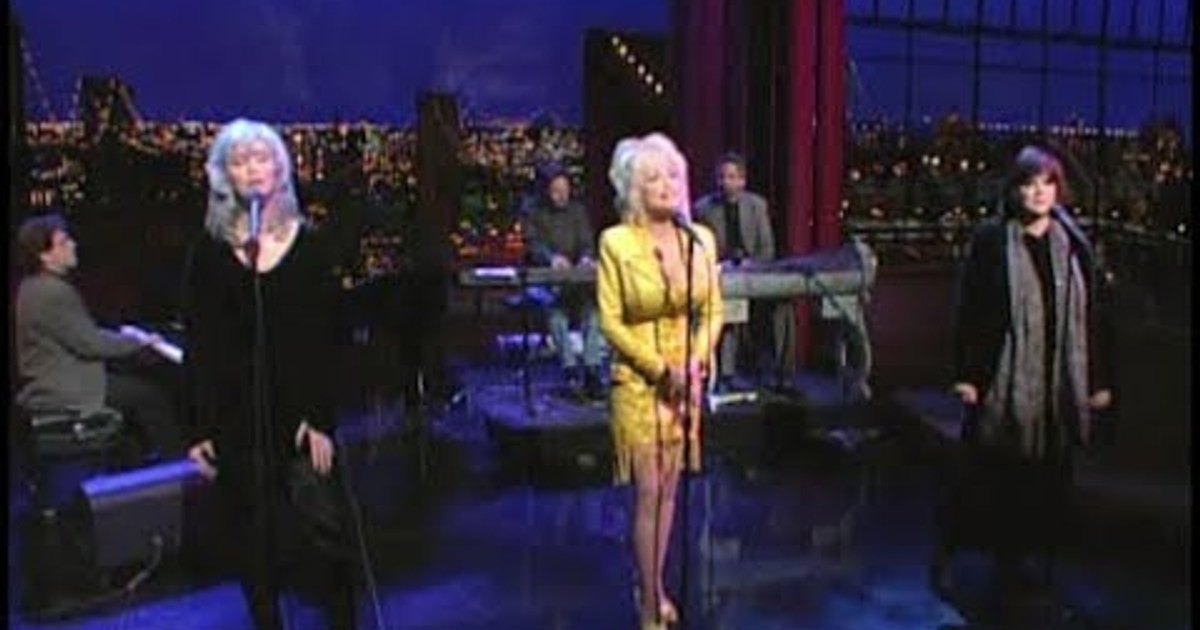
And that’s what makes the TV performance so resonant. It’s not just three legends singing a Neil Young song. It’s three friends who’ve weathered decades of ups and downs, who’ve watched each other’s careers soar and stumble, who’ve waited patiently for the right moment to sing together again. The glass harmonica’s ghostly hum is the sound of that patience. The host’s joke about electrocution is the world’s skepticism, quickly brushed aside. And the three voices—Dolly’s, Linda’s, Emmylou’s—are the answer. They rise together, separate, intertwine, and resolve. They sing about knights in armor, peasants singing, drummers drumming, silver spaceships, and children crying. They sing about a dream of a world that could be better. And for four minutes, it is.
The moment is gone. The TV broadcast is over. The glass harmonica is packed away. But the music remains. It remains in the millions of albums sold, in the Grammy on the shelf, in the singers who cite them as heroes, in the fans who still get chills when those three voices lock in. It remains in the way a strange instrument can become a symbol of everything that’s brave and beautiful about collaboration. It remains in the simple fact that Emmylou Harris, Linda Ronstadt, and Dolly Parton didn’t just make a record. They made a promise: that friendship, artistry, and persistence can outlast any trend, any genre, any decade. And they kept it.
Next time, we’ll dive into the making of Trio II, track by track. We’ll explore the stories behind each song, including the Neil Young classic and the hidden gems. We’ll hear from the producers, the musicians, and maybe even the glass harmonica player. Because if this moment taught us anything, it’s that the magic is in the details. And there are plenty more to uncover.


