Part 1
The Night Three Legends Walked On Stage
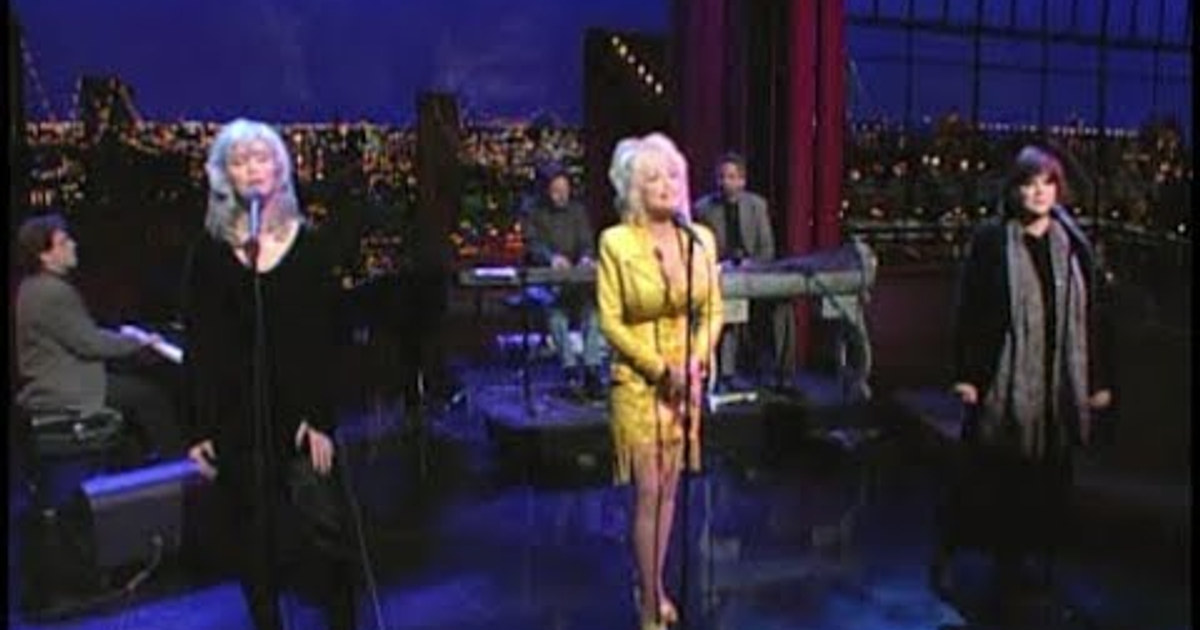
The host is mid-sentence, grinning like he’s about to pull off a magic trick. He’s talking about a glass harmonica—an instrument invented by Benjamin Franklin, of all people—and how it’s never been seen on this show before. There’s a nervous energy in the air, the kind that happens when something genuinely new is about to happen on live TV. Then he says it: “Our next guests are three great, great singers who have collaborated on this wonderful CD right here. It’s called Trio II, and it’s the follow-up to the Grammy Award-winning album they made over a decade ago.”
The audience doesn’t wait for the names. They already know. The roar starts low and builds into something primal—a wall of sound that says we’ve been waiting for this. And then: “Ladies and gentlemen, here they are—Emmylou Harris, Linda Ronstadt, and Dolly Parton.”
If you’ve never heard these three sing together, you’re missing one of the great musical collaborations of the 20th century. But let me back up, because if you’re new to this, you deserve to know why three women walking onto a stage can feel like a seismic event.
First, who are they? Dolly Parton is the country-pop icon who wrote “Jolene” and “9 to 5,” a woman who turned a East Tennessee childhood into a global empire without ever softening her accent or her wit. Linda Ronstadt is the rock and pop powerhouse behind “Blue Bayou” and “You’re No Good,” a voice so versatile she could slide from torch song to new wave without breaking a sweat. Emmylou Harris is the folk and country queen who sang with Gram Parsons, reinvented herself with Daniel Lanois on Wrecking Ball, and wrote “Red Dirt Girl” like it was a letter to her own ghost. Put them in a room together, and you don’t get a supergroup. You get a conversation between three distinct American musical traditions—and they all speak fluent harmony.
The album they’re promoting, Trio II, is the long-awaited follow-up to 1987’s Trio. That first record wasn’t just a hit; it was a landmark. It won a Grammy for Best Country Performance by a Duo or Group with Vocal, and it sold millions. More importantly, it proved that three women could share the spotlight without competing—each taking lead when the song demanded it, each falling back into a supportive blend that felt almost supernatural. The chemistry was so obvious that fans spent the next twelve years asking, “When’s the next one?”
On this night, they’re performing a song that’s not even theirs originally. It’s Neil Young’s “After the Gold Rush,” a track from his 1970 album of the same name. If you know the song, you know it’s weird. It’s apocalyptic. It’s beautiful. The lyrics talk about knights in armor, peasants singing, drummers drumming, archers with the tree—and then it drops the line that always gets me: “Look at Mother Nature on the 20th century.” That’s not a typo. Young wrote it that way, a grammatical stumble that somehow makes the dread feel more real. Later verses mention a burned-out basement, silver spaceships flying in the yellow haze of the sun, children crying, colors flying. It’s a fever dream of a song, and it shouldn’t work as a trio harmony. But it does.
When Emmylou, Linda, and Dolly sing it, the song becomes something else. It becomes a warning and a lullaby at the same time. Dolly’s voice has that high, quivering sincerity that makes you believe every word. Linda’s mezzo brings a grounded warmth, like she’s the one holding the whole thing together. Emmylou floats above it all, a ghostly presence that feels like memory itself. The blend is so tight you’d swear they’ve been singing together since childhood. They haven’t. They’re three solo artists with massive egos and even bigger talents, and yet here they are, sharing a microphone like it’s the most natural thing in the world.
The host’s glass harmonica comment is a perfect setup, by the way. It’s a quirky detail that sticks in your brain—Benjamin Franklin invented this instrument?—and it primes you for something unusual. Because that’s what this performance is. It’s not a standard country ballad. It’s not a pop hit. It’s a Neil Young deep cut, sung by three women who could each sell out arenas on their own, and they’re doing it on a late-night show with a weird instrument sitting off to the side. The whole thing feels like a fever dream, but the good kind.
If you’re wondering why this matters, think about what these three represent. Dolly Parton is the most successful female country artist of all time, with 25 number-one singles and a cultural footprint that extends from 9 to 5 to Buffy the Vampire Slayer to her own theme park. Linda Ronstadt is the highest-selling female rock artist of the 1970s, with a voice that could handle everything from Gilbert and Sullivan to Canciones de Mi Padre. Emmylou Harris is the patron saint of Americana, a woman who sang with Bob Dylan, Roy Orbison, and Willie Nelson, and who never stopped experimenting. When they come together, they’re not just three singers. They’re three decades of American music history, standing shoulder to shoulder.
And the song? “After the Gold Rush” is a perfect choice for them. It’s a song about looking back at a world that’s already gone, and these three women know something about that. They’ve watched genres change, careers rise and fall, and the industry reinvent itself. They’ve each been written off and come back stronger. When they sing “I was lying in a burned-out basement with the full moon in my eyes,” you believe them. You believe they’ve been there. That’s the magic of a great cover—it doesn’t erase the original, it adds a new layer of meaning.


