Part 1
A jagged shard of exposed metal at the front of a rumbling school coach, and a man's knee pressing deliberately, desperately into it. The metal bites through fabric, tearing into flesh until blood begins to bloom and spray across the floorboards. All of this self-inflicted violence is executed in absolute, agonizing silence, solely to prevent a laugh from escaping a throat. It is a moment of pure, visceral comedy, rendered with the dark intensity of a tragic novel.
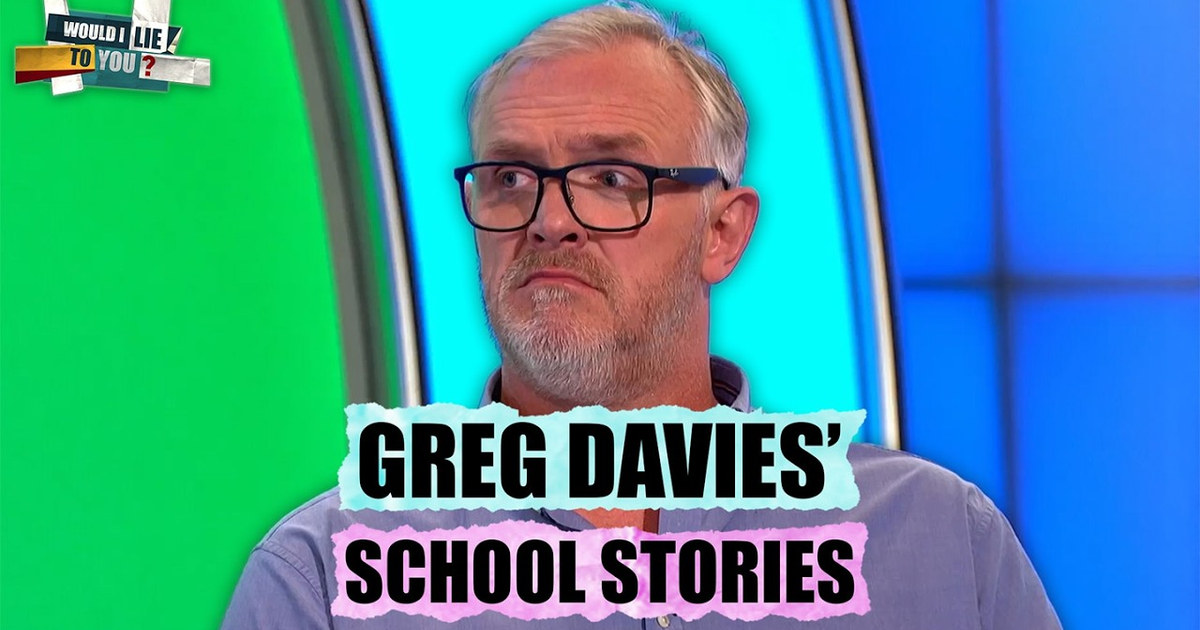
This is not a scene from a gritty psychological thriller, but rather a memory unearthed on the stage of the brilliant British panel show Would I Lie to You?. The storyteller is Greg Davies—a man whose physical stature is matched only by the sheer, gothic absurdity of his personal history. Sitting opposite the forensic skepticism of David Mitchell and the quick-fire cynicism of Lee Mack, Davies weaves tales that blur the boundary between suburban mundane reality and fever-dream fiction.
To watch Greg Davies on Would I Lie to You? is to witness a masterclass in narrative architecture. He does not merely tell jokes; he constructs worlds out of the damp, gray clay of British institutional life. Whether he is recalling his days as a deeply bored drama teacher or his own chaotic youth, Davies reads the human face like a map of comic desperation. His stories are populated by intense Austrian linguists, terrified schoolboys, and melting confectionery, all delivered with a theatrical flair that commands the room.
[[AD]]
The Architecture of the Lie: How Greg Davies Commands the Stage
Before we dissect the legendary tales that have defined Davies' legacy on the show, we must understand the arena itself. Would I Lie to You? is a battle of wits disguised as a parlor game. On one side sits David Mitchell, the embodiment of hyper-rational, middle-class anxiety, dissecting every claim with the precision of a surgeon. On the other sits Lee Mack, a lightning-fast working-class wit who hunts for logical inconsistencies like a bloodhound. To survive this gauntlet, a storyteller must possess more than just a good poker face; they must possess an ironclad sense of atmosphere.
Davies excels here because his performance style is deeply physical. At six-foot-eight, he dominates the screen, yet his comedy often relies on the contrast of his massive frame engaging in the most trivial, infantile pursuits. He uses his eyes to convey a sense of haunted mischief, inviting the audience into a conspiracy of silence before delivering a punchline that feels both inevitable and shocking.
SPOILER WARNING: Full spoilers ahead for several classic episodes of Would I Lie to You?, including the resolutions of Greg Davies' most famous stories. If you want to preserve the mystery of whether these bizarre tales are fact or fiction, bookmark this page and watch the clips first!
[[AD]]
The Melting Egg and the Courtyard Catapult
Let us begin with a story that perfectly captures the claustrophobia of the British school system. Davies claims that during his tenure as a drama teacher, he confiscated a catapult from a student. Rather than locking it away, he used it to launch an unwrapped, melting Cadbury's Creme Egg across a sunny courtyard into the open mouth of his colleague, Gavin, an economics teacher positioned at a second-floor window.
The imagery here is wonderfully cinematic. Davies paints a picture of the height of summer, the chocolate melting in his hand, and his friend Gavin frantically distracting his students with a mundane task before kneeling at a window that only opens halfway. The physical comedy of a grown man filling a narrow window frame with his head, waiting for a projectile of liquid sugar, is pure gold.
Yet, as David Mitchell's team quickly points out, the logistics are almost too perfect. The detail of the mini-fridge bought with abused drama department funds adds a layer of realistic guilt, but the central act—a twenty-five-foot catapult shot caught perfectly in the mouth—feels like a myth. When the truth is revealed to be a lie, we realize that Davies' genius lies in his ability to package a falsehood with such rich, authentic textures that we desperately want to believe it.
[[AD]]
The Austrian Linguist and the Holy Grail of Vegetables
If the catapult was a beautiful lie, the story of the Austrian head of languages is a terrifyingly beautiful truth. The premise is simple: Davies and a colleague became obsessed with the way an intense Austrian teacher pronounced the word "vegetables." This obsession culminated in a grueling, hour-long coach trip to Paris, during which Davies tried every conceivable conversational angle to force the man to utter the word.
The narrative tension of this story is exquisite. Davies describes the agonizing frustration of trying to steer a conversation toward healthy eating, only for the Austrian colleague to repeatedly bypass the word "vegetables" in favor of "greens," "protein," and "carbohydrates." It is a psychological chess match played on a moving bus, fueled by the manic energy of schoolteachers on the brink of madness.
When the word is finally spoken with explosive, operatic passion—"But of course, you must have vegetables!"—the release of tension is so violent that it causes physical injury. Davies' friend, unable to laugh out loud, deliberately rams his knee into a jagged piece of metal on the coach, resulting in a spray of blood. This detail, which sounds like a gothic exaggeration, is the very thing that anchors the story in reality. It is a testament to the dark, painful core of British humor.


