Part 6
The insult comic became a children's franchise. The guy who insulted everyone for sixty years became the comfort object.
Play that cut again. It lands different every time.
Beat Three: The Guy Who Doesn't Talk
Same year as the potato. Different movie. Different planet.
1995 again. Casino. Martin Scorsese. 178 minutes. Robert De Niro, Joe Pesci, Sharon Stone, Las Vegas, narration, and violence arriving on schedule. Five years after Goodfellas, the same director and the same two leads, playing the same kind of machinery — and a completely different temperature.
Don Rickles plays Billy Sherbert.
Billy runs the casino floor for Ace Rothstein. He doesn't do bits. He doesn't do insults. He wears a suit, holds the frame, and never — not once, not in nearly three hours of runtime — raises his voice.
Read that back slow. The most quoted late-career role of the century's greatest insult comic is a man who keeps his mouth shut.
That's the inversion, and it's the best argument in this piece. Rickles could do the other thing. He was famous for the other thing. But drop him into a Scorsese movie next to two guys who turned menace into a craft, and he plays the one man in the room who doesn't need it.
He never grabs the scene. He holds it. There's a difference. Scorsese knows it. Rickles knows it. If you've only ever watched the roast clips, that's the performance you're missing.
Take the two 1995 roles together and the arc writes itself. Same year. Same actor. A plastic toy and a casino executive. Both of them props in somebody else's machine. Both of them quieter than the man playing them.
Beat Four: Mr. Warmth
- HBO. Mr. Warmth: The Don Rickles Project. Directed by John Landis — the guy who made National Lampoon's Animal House in 1978 and An American Werewolf in London in 1981. A comedy director making a documentary about a comedian. Right hands, right room.
Sit with the title.
Mr. Warmth.
That's the funeral the Friars podium was rehearsing back in 1970. Every insult on that dais was aimed at a man everybody in the room loved, and everybody in the room knew it. The nickname is a lie so big it wraps all the way around into true.
He was warm. That's the part that never makes the clip.
Seven years later, the same joke in a softer register. Comedians in Cars Getting Coffee, 2014. Jerry Seinfeld in the driver's seat. Don Rickles in the passenger seat.
The guy who insulted Sinatra. Sipping coffee with the guy who wouldn't.
No audience. No podium. No roastmaster standing by to hand him a loaded bulletin. Just two men in a car, both of them in on it. Same material. Filmed at a different focal length.
Beat Five: The Format Outlived the Room
Follow the line forward.
Dean Martin's celebrity roasts. NBC. 1973 to 1984. Rerun forever. That's the template — a dais, a podium, a guest of honor who has to sit there and take it while the room eats steak.
Then Comedy Central picks up the torch. 2003 to 2019. New comics, new targets, same architecture.
Then Netflix takes it live in 2024. Same shape, different pipe.
And the Friars Club? The clubhouse went dark in the 2020s.
Read the ledger. The format outlived the room. Outlived the network. Outlived every man on that dais.
That's not a sad fact. It's a structural one. Roasts are elastic. You can drape one over a newsman in 1970, a pop star in 2010, a quarterback in 2024. The joke bends. It keeps bending. It never breaks. That's why it's still here and the clubhouse isn't.
Beat Six: The Tape
Now go find the tape.
It lives on YouTube. That's the distribution plan now. Uploaded, recommended, watched by people born decades after it was recorded.
Listen to the audio first. Hiss. Tape hiss. The kind you can't fake and can't clean.
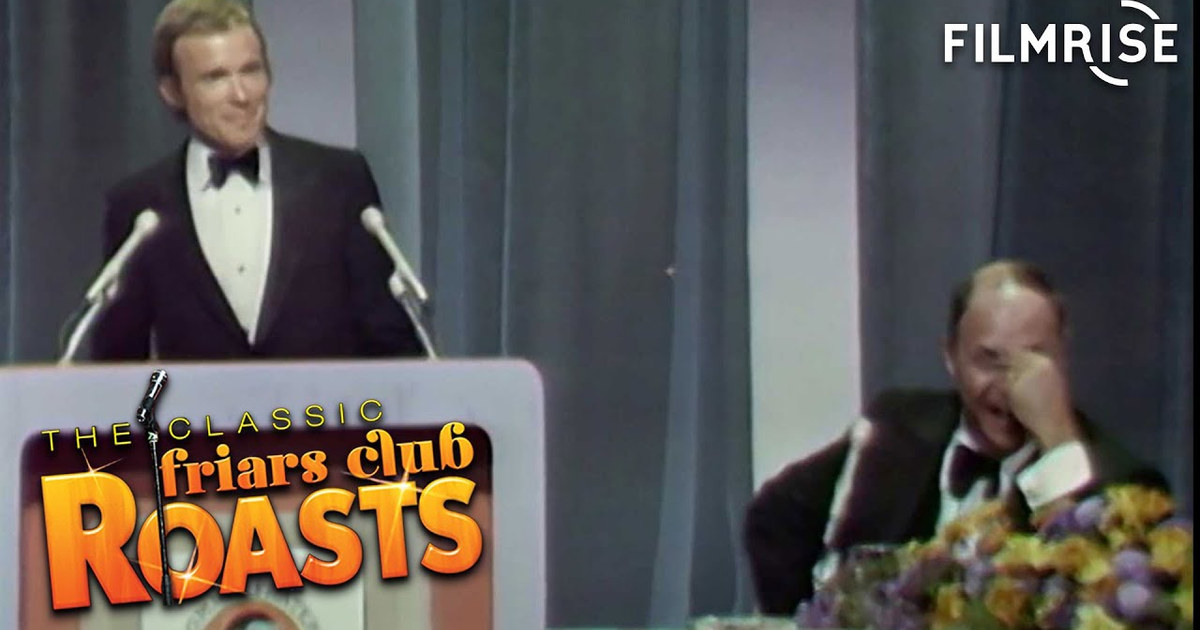
Watch the camera. It drifts. It loses the speaker for a beat and finds him again. No cutaways. No reaction shots punched in on cue. No captions. No graphics package. No lower-third telling you who anybody is. A sponsor card up top for CPC — “good food and good food ideas” — and that's your entire package.
Nobody in that room knew they were making a document. They thought they were making a Tuesday.
That's the whole reason it works. A crew with a couple of angles and a roll of tape isn't performing for history. It's just rolling. And what it caught turns out to be the artifact — the thing you send to the archive.
The Button
Replay it. Stripped.
Carson, at the top: “the words 'good night, Chet, good night, David' have become household words.”
Huntley, an hour later, at the podium, doing the only thing a newsman knows how to do when the set is over.
He says his own goodbye. Then he blows it up.
Two words, repurposed, pointed at a room that has spent the last hour laughing at a man they love. The entire roast in three seconds. Not the bulletins. Not the mother interview. Not the lobster. The button.
Good night, Walter. That's the line we opened on. That's the line we close on. A farewell, said on purpose, by a man who had said it ten thousand times, into a room that had never once heard it mean anything but this.
And here's why the tape still travels. It's a goodbye that refuses to be sad.
Stack the three goodbyes on top of each other. The room is saying goodbye to a career that just flopped. The club is saying goodbye to a member. The country is about to say goodbye to Huntley-Brinkley, and every man on that dais knows it, and not one of them says it out loud.
So they got together and made it a joke.
The joke landed. That's the whole product.
Fifty-five years later, the man is gone, the room is gone, the network is a logo in a vault — and the button still pulls a laugh out of a stranger's phone at one in the morning. That's not nostalgia. That's craft.
It was a joke about a farewell. It played like a funeral. Then it aged back into a joke about a farewell, and it still kills.
One more time.
Good night, Walter.
The tape ends mid-sentence. Carson is introducing a man at 11:30 — a man who's on opposite him. Part two picks up that cut: what the rival slot meant in 1970, who was standing in it, and why the tape stopping right there is the most 1970 thing about the entire night.


