Part 4
The landing word is the smallest word in the sentence. He doesn't land on 'stand.' He doesn't land on 'neither.' He lands on the pronoun. That's an editor's instinct, not a writer's.
Every strong beat of a roast is built like this. Setup. Stack. Small word. Cut.
Beat Three — The Historian, Then the Hand
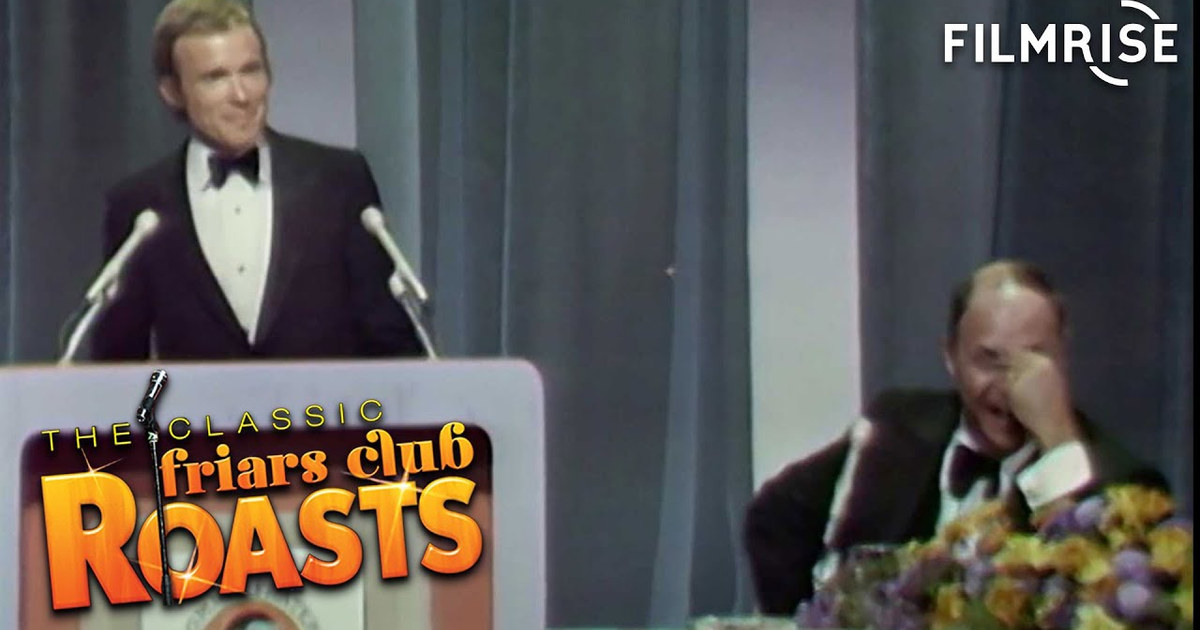
Alan King takes the podium as the club's own record keeper.
By his own count, twenty-four years in the job. Roastmaster and historian. Friars business. He doesn't walk on like a comic. He walks on like a clerk. And that's the persona he's cutting against.
So his material is mock-biography. The club ledger, read out loud. Don Rickles 'admitted to this [world] on May 8th, 1926.'
That's a real date. May 8, 1926, Queens, New York. A real man, born in a real borough, filed like a shipping manifest. The joke is the file. The joke is the department-of-records formality of the whole thing.
King keeps going. The family moved around so often that 'for some reason they would never tell Don where.'
See the edit? Real biography. Comedy cadence. Same clip, two strips of film.
But here's where King does the thing nobody else on the dais does. He puts the knife down and turns it into a hand.
The line, exactly: 'You are absolutely, unquestionably the boldest, sweetest cat I have ever known in my life and I love you.'
Sit with that. It should be corny. In any other context, it is corny. It lands here because of the twenty minutes of abuse in front of it.
That's not a sentiment. That's an edit. You can't cut from nothing to a handshake. You need the carnage first. The abuse is the setup. The affection is the payoff. Same splice mechanic, running on emotion instead of laughs.
This is why the Friars format outlives anyone's memory of the actual jokes. A roast is a structure. It has a floor and a ceiling. You can put a newsman, a Borscht Belt comic, a talk show host, and a club historian on the same riser, and the format holds all four.
Beat Four — Henny Doesn't Roast. He Performs.
Henny Youngman is the outlier. Keep your eye on him.
Borscht Belt one-liner machine. 'Take my wife — please.' He's working at a different speed than anyone else on the dais. A different century of comedy on the same riser.
His set barely touches Rickles. That's the point. He isn't roasting. He's performing. And the room lets him get away with it. Why? Because the frame is big enough to hold whatever you drop into it.
His rhythm tells you everything. No setups. Just teases, one after another, each about two seconds long. He works like a fader, not a scene.
One of his bits is the two astronauts. A knock on the door. 'Who's there?' 'Don Rickles and I came on the same day.'
You can barely diagram that joke. It doesn't need diagramming. The frame swallows it. Anything dropped into a roast gets stamped as material about the guest of honor, whether it is or not.
That's an editing law. The frame does the work. You can cut a shot from an entirely different movie into a trailer and the audience will assume it belongs.
Henny is that shot. He's from another reel. He fits anyway.
The Format That Eats Everything
Zoom out. Roast culture is an edit tradition. Full stop.
The Dean Martin Celebrity Roasts ran on NBC from 1973 to 1984. Comedy Central picked up the baton with the Roast of Denis Leary in 2003 and ran it through William Shatner in 2006, Donald Trump in 2011, and Justin Bieber in 2015. Netflix went live with The Roast of Tom Brady in 2024.
Same engine. Different decade. Same splice.
But watch the cut pattern change.
[[AD]]
Modern roasts live on reaction shots. The camera is a character. You cut to the victim mid-laugh. You cut to the sound byte. You cut to the face. The edit does a chunk of the comedy for you.
The 1970 tape doesn't cut to Rickles at all.
Think about that. The guest of honor. The man whose career is on the table. And the camera stays on the podium.
Everything you know about his face, you bring yourself. You've seen Kelly's Heroes — 1970, Brian G. Hutton, Rickles as Crapgame. You've seen the Carson appearances. You've seen him sweat and grin and call somebody a hockey puck.
You do the cutting in your head. That's a higher-wire act, and it's why the tape still works fifty-five years on. There's no laugh track for the visual. You're the laughs.
The grammar of the modern roast — the assassin in the middle, the closer with the biggest swing, the 'too soon' that lands right on time — got built by Jeff Ross, Greg Giraldo and Lisa Lampanelli through the 2000s. Every one of them is working downstream of a Friars podium in 1970.
Rickles' 1970 roast is the source file. Not the ancestor. The file.
Now the counter-beat, and it's a beauty. Two eras shaking hands in one room.
Henny's girdle joke — his wife found it in the glove compartment — is standing directly next to Chet Huntley reading a bulletin about a leaky film canister getting dumped at sea.
Two centuries of comedy. Same dais. Same air.


