Part 3
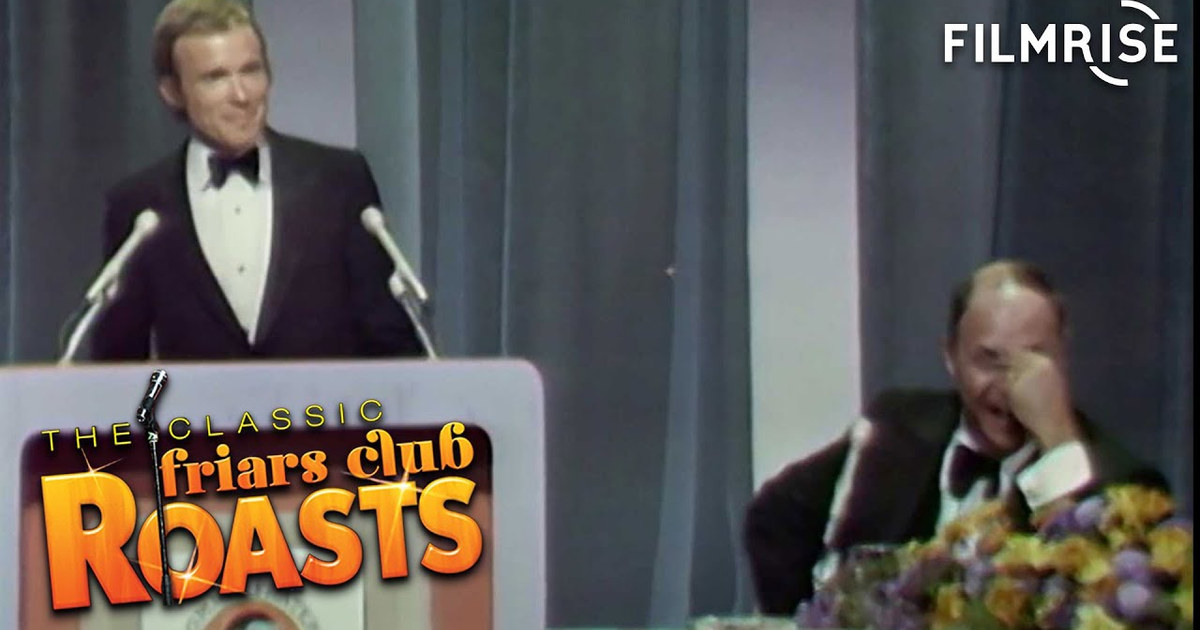
Cut back to Huntley. Same podium. Same line. But now watch what's underneath it.
The line is the softest thing American broadcasting ever made. The Huntley-Brinkley Report ran on NBC from 1956 to 1970. Two anchors, two cities, two goodnights. Chet in New York. David in Washington. The country said it back like a prayer.
Fourteen years of Vietnam. Fourteen years of riots, assassinations, campus fires, the nightly body count. And at the end of every one of those nights, that singsong farewell. No anger. No spin. Just the copy and the sign-off.
Now push that man onto a Friars Club podium in 1970. Same voice. Same cadence. Same face that never moved.
And he kills.
Here's the thesis, three beats. A roast isn't writing. A roast is an edit. You take a real person. You take their public persona. You cut one against the other. The joke is the splice, not the words.
That's the whole machine. Nine times out of ten, the words themselves are throwaway — filler you'd never laugh at on a page. What lands is the collision.
Beat One — The Anchor Reads the Copy
Start with the persona. The persona is the raw footage.
Chet Huntley was the man America let read it the worst news of the twentieth century. Not a comedian. Not a novelty. The 6:30 appointment. You sat with him while he told you what burned, what fell, what died.
So when he walks to the Friars microphone and starts talking about Don Rickles in bulletin form, the splice is already loaded. He doesn't have to be funny. He has to be the same. Same flat delivery. Same wire-copy rhythm.
'And here, if you please, is a bulletin that just came in.'
That's the form. The form is the joke.
Listen to the lead story he reads. The films of the old Don Rickles television show — cancelled two years earlier, ABC's The Don Rickles Show, 1968 into 1969 — have been encased in cement. The Army is taking them on a train to a seaport. They'll be dumped in the ocean. Outraged townspeople along the route, afraid of possible leakage.
That's a news bulletin. That's also a bomb. The distance between the two is the laugh.
Then he drops the best line of the night.
[[VIDEO]]
'The Nation's Waste Basket.' A proposed Sunday series. Starring, in his words, 'little known people of very little interest.' Naturally they thought of Don Rickles first. They wanted him in the studio for the opening show. Had to scrap it. A local health ordinance.
No adjectives. No mugging. No pause for applause. Huntley reads it like a farm report and the room falls apart.
Remember the room. Alan King. Henny Youngman. Johnny Carson. A dais full of men who had been funny professionally for thirty years. And the funniest thing in the first ten minutes is the guy who reads the news.
That's not an accident. That's an edit.
Here's the same mechanic a second time, so you can see a pattern and not just one gag.
Huntley walks the room through a segment they cut from that Sunday show. They wanted Don at home. They interviewed his mother instead. Mrs. Rickles explains her son's 'chronic hostility.' She says he'd been like that all his life. She says that even before he was born, he was known in medical circles as 'the Furious Fetus.'
Then the medical file. The family doctor, at Don's birth, yelled for hot water. He thought he had delivered a lobster. He was wrong. Just 'a nasty little shrimp.'
Same splice. News register. Absurd payload. Huntley never breaks. That's the trick. The anchor stays in character, and the character is the punchline.
Note the era, too. This is a 1970 newsroom voice. Unhurried. No anger. No wink. Just copy. Written for a commercial break, not a clip farm.
Huntley retired from the anchor desk that same year, 1970. He died in 1974. Nobody is booking him for another roast. This was a one-time cut.
Beat Two — The Roastmaster Is the Editor-in-Chief
Every cut needs a timeline. That's Johnny Carson.
He isn't a performer in the lineup. He's the frame. He's holding the reel. In 1970 he's deep into The Tonight Show Starring Johnny Carson, the NBC desk he'd hold from 1962 to 1992. Nearly a decade in already. Roastmaster for the night.
He sets the tone, plants the rule, then breaks it himself in the same breath.
Watch him lay it down. The Friars is a fraternal organization. Mutual interests. Friendship. Most importantly of all, getting your dues in on time. Past honorees: Al Jolson, George M. Cohan, Irving Berlin. 'And tonight Don Rickles, which should give you some indication of the deterioration of this club.'
Then the rule. 'All of these remarks are made in the spirit of good fun, mutual admiration and affection.' Beat. 'We're suspending these conditions tonight because of the nature of our guest.'
Setup and violation in one paragraph. Rule stated. Rule shredded. That's a trailer cut.
Then his own swing at the guest of honor. Here's the line. 'Don Adams could not be here, and I think Don might back me up on this — that Don Adams and I are probably the two closest friends that Rickles has and neither of us can stand him.'
Look at the craft. No adjectives doing the heavy lifting. No simile. No 'he's like a blank.' Just a stack and a drop. Stack: two closest friends. Drop: neither of us can stand him.


