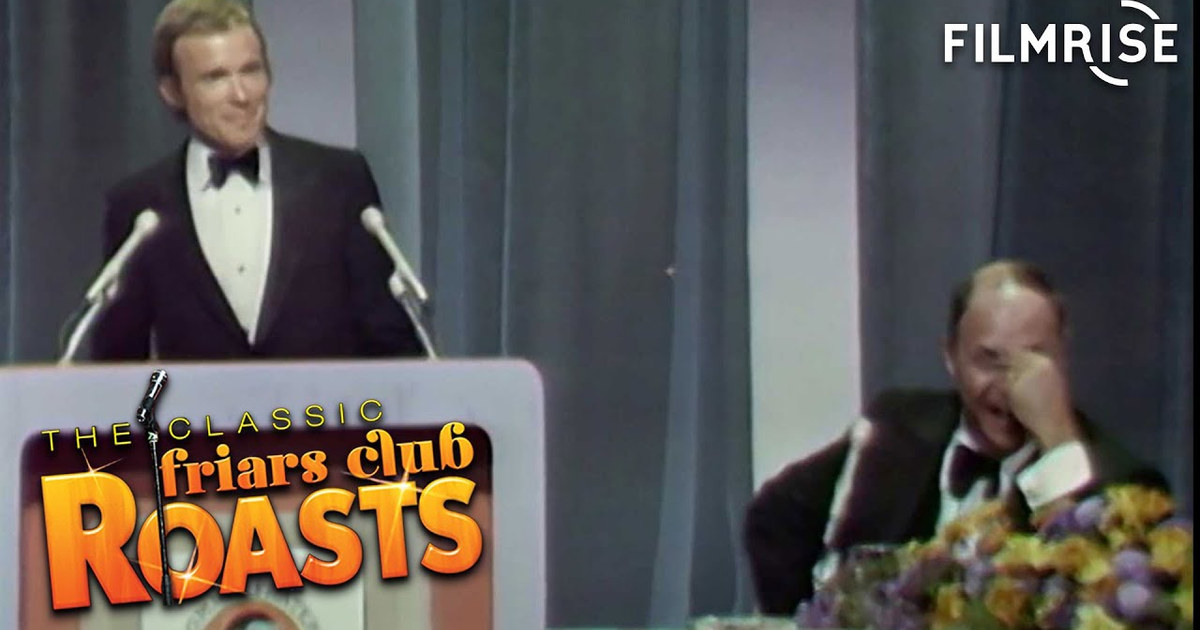
Part 1
Cold Open: “Good Night, Walter”
Silver hair. Glasses. A fistful of wire copy. The most trusted face on American television, standing at a Friars Club microphone in 1970.
He doesn't say hello. He doesn't warm up. He looks down at the paper.
And he reads.
Because Chet Huntley doesn't tell jokes. Chet Huntley delivers bulletins.
Here's the bit. Beat by beat.
A bulletin just handed to him as he walked into the studio.
The films of the old Don Rickles television show — cancelled two years ago — have been encased in cement.
The Army is taking them by train.
To a seaport.
Where they'll be dumped into the ocean.
Pause.
A great tide of protest has arisen from the towns through which that train will be passing.
Outraged townspeople.
They are afraid of possible leakage.
Land.
That's the gag. Three stacked images — cement, train, ocean — and a punchline built out of environmental panic. Deadpan the whole way. He never blinks. He never sells it. He reports it. The most formal voice in America, reading the death notice of a sitcom like it's a missile crisis.
You could not write a cleaner setup for Don Rickles. The target is a cancelled show. His cancelled show.
But the setup isn't why this tape is still circulating.
The button is.
Later in the set, Huntley stops. He looks up. And he says this:
“I should like to close by saying something I have wanted to say and have had a passion indeed to say for many years. Good night, Walter.”
Freeze there.
Walter. Not David. Walter.
Walter Cronkite. CBS Evening News. The other network. The competition.
For more than a decade, the most quoted farewell in America has been “Good night, Chet.” “Good night, David.” Two anchors. Two cities. One handshake at the end of the broadcast.
Huntley just turned it ninety degrees and fired it across the street at the guy on CBS.
That's not a joke. That's a drive-by.
Say the thread out loud, because this is the whole article.
A sign-off is a promise. A roast is a threat. In this room, for this man, they become the same thing.
A sign-off says: we'll be back. Same chair. Same desk. Same two cities. Tomorrow night, right after the sponsor.
A roast says: I know exactly where you're soft.
Same night. Same sentence. Both.
Here's why that line is a bomb and not a punchline.
The Huntley-Brinkley Report ran on NBC from October 1956 to July 1970.
Huntley in New York. Brinkley in Washington. Split screen. Two desks, hundreds of miles apart, one conversation.
The handoff went: “Good night, Chet.” “Good night, David.”
Kids parroted it. Comics stole it. It was the sound of the country going to bed.
And the most trusted man inside that ritual is standing in a banquet hall, using it as material.
Three months before it ends. For good.
July 1970. The format retires. Huntley retires with it. The sign-off he's quoting is a sign-off he is about to stop saying.
So when he says “Good night, Walter,” he isn't quipping. He's detonating his own format, in public, on a rival's name, at a roast for a guy ABC cancelled.
Network. Format. Rival. All three in one sentence.
And nobody in the room flinches. They laugh.
Cut to the room.
The Friars Club. Not a comedy club. A fraternity. New York showbiz in tuxedos, eating chicken, in a dining room built for debt and backslaps.
Carson says it was founded in 1914. The club's records say 1904. We're not correcting him on air.
He gives the mission statement anyway: “mutual interests, friendship, and most importantly of all, that you get your dues up on time every year.”
Brotherhood with an invoice. That's the Friars in one line.
The roast is an initiation rite. Look at the names Carson reads off. Al Jolson. George M. Cohan. Irving Berlin.
Then: “And tonight, Don Rickles — which should give you some indication of the deterioration of this club.”
That's the love. Wrapped in a towel snap.
You don't get roasted unless the room loves you. That's the rule under the rule.
Now the other rule. The one that matters.
Carson lays it down for the first-timers in the room.
“All of these remarks are made in the spirit of good fun, mutual admiration and affection.”
Standard. Safety on. Every roast opens this way.
Then he takes the safety off.
“We're suspending these conditions tonight because of the nature of our guest.”
There it is.
Promise, then revoke. Same paragraph. He guarantees warmth and withdraws it before the room can settle — and every joke that follows is licensed by that one line.
Say it plainly: the whole night is that one cut.
A warm occasion spliced onto a hostile guest. A sign-off spliced onto a threat.
Same move. Different reel.
The man holding the splice is Johnny Carson.
The Tonight Show. NBC. 1962 to 1992. Thirty years as the most famous straight man in America.
Listen to the tape and you hear the rhythm. Flat. Dry. Fast.
No punchline powder. He doesn't lean on a line. He doesn't ride a laugh. He files the joke and moves to the next one.
That's not laziness. That's a man who knows the room will catch up.
First line out of his mouth: Rickles “got his early start in show business as a heckler at Toots Shor's.”


