Every legendary public persona is built like a high-contrast optical shot designed to force the camera operator to hold focus exactly where the subject commands.
When you pull focus on vintage studio television, you realize pretty fast that the technical deck was rarely stacked in favor of women from rural America. In standard late-seventies network broadcasts, high-output studio Fresnels—probably standard 5K tungsten fixtures punching straight down from the grid—flattened out every subtlety, while soft-contrast vidicon tube cameras blew out highlights and smeared fast moves. Into that rigid, pristine studio box stepped Dolly Parton, completely defying the standard broadcast palette.
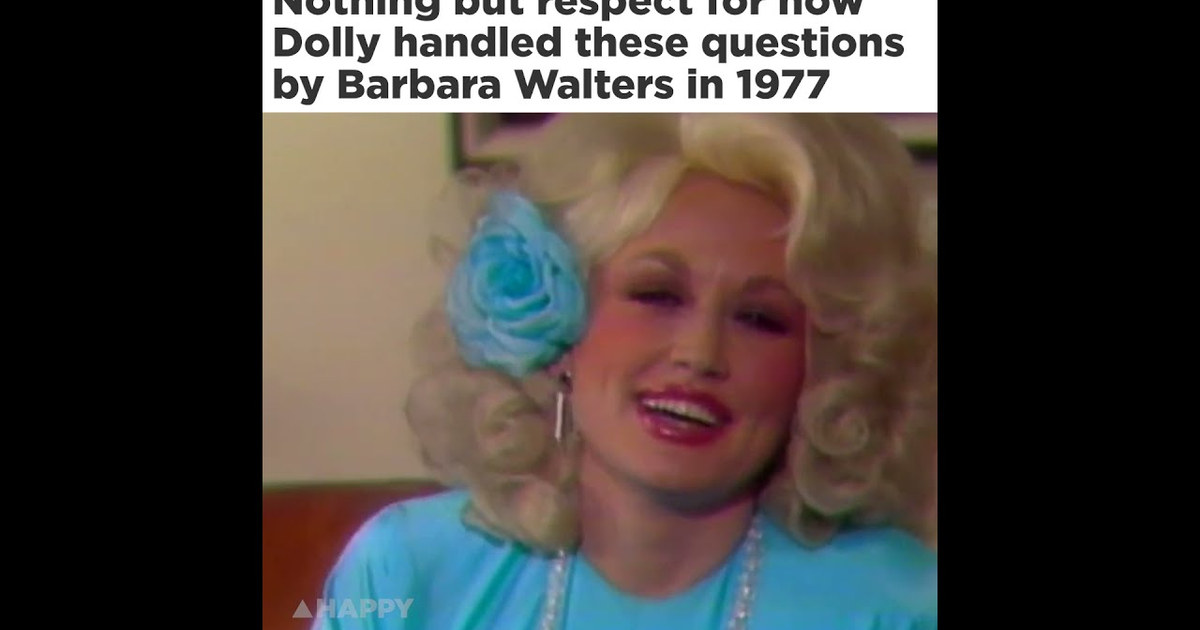
In her landmark 1977 sit-down with Barbara Walters, Parton delivered something far more intricate than simple Southern charm; she conducted an absolute clinic in visual authorship. If you study this footage the way second-unit cinematographers analyze raw rushes, you realize Parton was effectively directing the frame from inside the marks, anticipating every cynical pan and high-angle interrogation before the control room could even switch switchers.
[[AD]]
Beat One: Deflecting the 'Hillbilly' Stereotype with High-Key Composure
The exchange opens on the razor edge of an insult when Barbara Walters asks point-blank whether Parton would have felt offended being labeled a hillbilly back home. Most guests faced with that kind of loaded, class-coded opener tense their posture, tightening their shoulders and throwing off the natural lighting balance across their collarbones. Not Dolly.
Without flinching under the studio key light, Parton smiles, defuses the tension with razor-sharp comedic timing about kicking shins, and immediately reclaims the frame's narrative authority. She directly evokes the caricature—the Lil Abner and Daisy Mae archetypes that Madison Avenue and coastal television producers love to package—and flips the light balance entirely. She names it 'country class' powered by pure common sense and horse sense.
What makes this beat remarkable from an operator's perspective is how Dolly uses micro-expressions to hold Walters in her crosshairs. In television production, when an interviewer tries to establish cultural dominance, they lean back, relying on the wide two-shot to make the subject look isolated. Parton eliminates that distance by anchoring her eye-line firmly, never wavering, forcing the broadcast cut to hold her single rather than retreat to a patronizing wide angle.
[[AD]]
She owns the cultural label before the production can paste it on her as a chyron graphic. It is pure narrative blocking: step directly into the spot where the interviewer plans to drop a heavy shadow, flood it with charm, and leave the interviewer holding an empty prop.
Beat Two: The Physical Question and Radical Hyper-Visual Construction
The frame shifts into territory that would derail almost any modern celebrity press tour when Walters pivots directly to Dolly's figure, couching the interrogation under the guise of an off-camera assistant's curiosity: 'Is it all you?' The studio tubes catch the intense, invasive scrutiny that was commonplace on legacy network setups.
Parton does not drop her eyeline or betray embarrassment. Instead, she delivers a response that fundamentally rewrites the rules of physical authenticity on camera: 'If I hadn't have had it on my own, I'm just the kind of person that would have had me so made.' That single beat deconstructs the entire puritanical camera gaze that expects women to pretend extreme glamour happens by natural accident.
Look at the lighting on her blonde wig, the rhinestones, the hyper-saturated makeup. In television lighting terms, Dolly Parton built herself to withstand ten thousand foot-candles of hot, unflattering quartz-halogen light without ever dissolving into the background. She explains her visual architecture in crystal-clear operational terms: she would never stoop so low as to simply be fashionable, because being fashionable is the easiest, most derivative setup in the world.
[[AD]]
She built an unmistakable, high-definition silhouette so striking that nobody could look away. Once the audience survived the initial exposure spike of her outrageous aesthetic, they were forced to listen to the lyrics, the intellect, and the business acumen underneath. She calls show business a 'money-making joke'—and she clarifies, with surgical precision, that the joke was never on her; it was always on the public.
Beat Three: Reframing Domesticity, Independence, and the Carl Dean Mystery
The conversation cuts into Parton's personal life as Walters probes her marriage to Carl Dean, highlighting his near-total absence from the camera eye and asking why an independent woman on the road would even bother being married if she only sees her spouse a few weeks out of the year. The implied shot composition here is clear: Walters is attempting to frame Parton's unconventional domestic reality as lonely or fractured.
Parton counters with an airtight breakdown of emotional mechanics that completely flips the script. 'I need freedom. The man gives me freedom,' she explains without an ounce of defensive strain in her voice. When Walters presses the issue, asking why someone seeking freedom wouldn't just stay single, Dolly explains that mutual autonomy is the very foundation of lasting happiness.
From a storytelling standpoint, this beat cements Parton's total refusal to perform conventional vulnerability for the ratings meter. She states flat out that she has far better things to do with her head space than sit around in a green room or hotel suite fretting over where her husband is spending his evening. She possesses absolute internal certainty, and that self-possession radiates like a perfectly dialed 1.2K HMI rim light separating her from background clutter.
[[AD]]
She established a modern blueprint for public-facing partnerships decades ahead of her era: draw an iron-clad perimeter around the private home life, give the lens precisely what the public pays to see, and keep the sacred emotional core completely off-callsheet and off-camera.
[[VIDEO]]
What to Watch for in the Footage: The Director's Viewfinder
When you fire up the playback on this interview clip, ignore the soft 1970s tape artifacts and look straight at the framing dynamics between the two women. Notice how Walters repeatedly attempts to apply high-brow New York analytical pressure, waiting for Dolly's down-home persona to crack under the studio lights. Dolly never takes the bait; her posture remains perfectly relaxed, her shoulders squared to the lens.
Watch Parton's vocal cadence and rhythmic breathing during the invasive questions. In camera department terms, she never lets her shutter speed flutter. Where other guests stammer or nervously glance off-axis toward their publicist sitting in the shadows near craft services, Dolly looks straight into the interviewer's pupils with total calm, disarming hostile inquiries with self-deprecating wit backed by steel.
Dolly Parton understood media lenses better than the engineers who calibrated the pedestal cameras on that stage. She constructed an iconic pop persona out of pure intention, high-contrast visual signifiers, and unshakeable self-worth. If you ever need a crash course in how to control your narrative against overwhelming institutional pressure, study Dolly Parton in 1977—she never missed her mark once.


