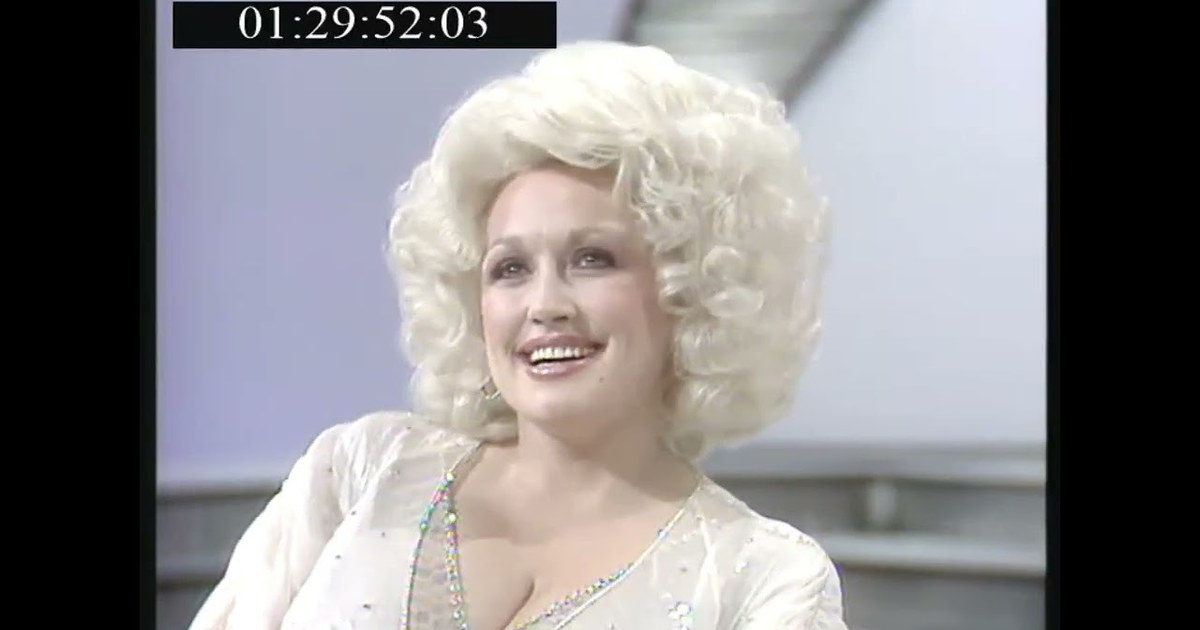
On a television set in London, in the late 1970s, Dolly Parton sat across from a host and remembered a doll. Not a porcelain doll, not a store-bought doll with glass eyes that opened and closed on a hinge. This was a doll made of corn. She and her siblings would take the dried husks, fashion a small figure, and give it eyes by pushing a hot poker through the corn. The poker sizzled. The eyes were dark, burned-in holes. She named this doll Little Tiny Tassel Top. And then she did what she had been doing since she was five years old: she made up a song about it. 'Little tiny tassel top,' she sang, her voice still carrying the Smoky Mountain lilt, 'I love you an awful lot. You're the only friend I got. I hope you'll always stay.'
The interview, which you can watch in the clip above, was meant to promote her new album, Heartbreaker, and its single 'Baby I'm Burning.' The host had asked about her childhood, about the twelve kids, the farm, the river baths. But when she sang that little song about a corn doll, the room changed. You could feel it. The flashy costumes, the wigs, the 1500 pairs of shoes—all of it fell away. For a moment, she was just a kid in East Tennessee, making art out of whatever was lying around. That's the thing about Dolly Parton. She never stopped doing that. She just got better materials.
The Smoky Mountain Childhood That Made Dolly Parton
Dolly Rebecca Parton was born in a one-room cabin in the Great Smoky Mountains of East Tennessee. She was the fourth of twelve children. Her father was a farmer—'the best,' she says—who later took construction work to feed the family. They were so poor they didn't know it. Bath night was in the river. They made their own soap. They washed their hair in the creek. 'That's the end of that story,' she jokes now, but you can hear the truth underneath. It was a hard life, but it was also a life full of stories, full of songs waiting to be written.
Her mother was lenient. Her father was strict. That combination would shape her. Her mother allowed makeup if someone had it, but since no one did, the kids made their own. They painted their lips with a red medicine—a stain that couldn't be removed. 'Daddy couldn't make us get it off,' she remembers. It was her first act of rebellion, a small one, but it taught her that beauty could be invented. You didn't need a store. You just needed imagination and a little bit of nerve.
[[AD]]
From Corn Dolls to Heartbreaker: The Songwriting Genius
She wrote her first song when she was five, before she started school. It was about that corn doll. But she didn't stop there. By the time she sat for this interview, she had written hundreds of songs. 'Probably 500 songs recorded,' she says, almost casually. She had released about 20 to 25 albums. Her new one, Heartbreaker, was on the way. The single, 'Baby I'm Burning,' was already catching fire. And she had a gift for rhyming that she calls 'natural.' She didn't learn it. She was born with it.
She also plays guitar. The host asks her to play, and she does, finger-picking with those famously long nails. 'When I'm going to be writing songs or playing,' she says, 'I usually file my nails down or take them off.' Sometimes the nails slip up under the strings. 'That could be nasty,' she laughs. But if she gets serious about it, she can quit. The point is, the nails are part of the package. The guitar is part of the package. The songs are the package. Everything about her is in service to the music, even if it looks like the music is in service to the image.
[[AD]]
The Dolly Parton Aesthetic: Tight Clothes, Wigs, and Diamonds in a Jar
She likes tight clothes. 'I like things next to me,' she says. She always has. Even as a schoolgirl, she wanted things that fit close, that showed her shape. And she likes flashy jewelry, bright colors, big hair. When she was a kid, they used to plow up shiny rocks that looked like diamonds. She kept them in a jar, washed them in the river, and dreamed of the day she'd have real rings. 'Which I do now,' she says. Yeah, she does.
She has several thousand stage costumes and at least 1500 pairs of shoes. That's a different pair every day for nearly four years. She has a whole collection of wigs—though only one black one, which she used once as a disguise for Christmas shopping. 'Everybody knew who I was,' she says. 'So that didn't work too well.' The host asks if her strict father made her go to extremes. She thinks it could have. But you get the sense it's simpler than that. She just loves beauty. She always has. And now she can afford it.
[[AD]]
The Interview Itself: A Meeting of Icons
This wasn't just any interview. It was a summit. The host mentions that Dolly came over for the Jubilee show in Glasgow last year, and she's going on tour later this month. He also mentions that Dolly is the second lady special guest star he's had on the show. The only other one? Bette Midler. 'She's great, she's lovely,' Dolly says. And then the host tells a story: he and Bette did the second part of her interview lying on the floor on two pillows, with a cup of tea. 'It was lovely,' he says. 'Why do you have to be so formal with me today?' Dolly laughs. 'I'm not the pushy sort.' She didn't get the same treatment. They didn't sing a song. But they did talk. And that was enough.
[[AD]]
The Legacy of Little Tiny Tassel Top
That corn doll is more than a childhood memory. It's a blueprint. Dolly Parton took what was available—a corn husk, a hot poker, a melody—and made something that lasted. She's been doing it ever since. The shiny rocks became diamonds. The red medicine became lipstick. The river bath became a story. The song became a seed. And from that seed grew a career that has touched millions of people. She still carries that little song through her career. She mentioned it in this interview. She probably mentions it in every interview. Because it's the beginning. It's the proof that you don't need much to make something beautiful. You just need to see the beauty in what you have.
[[VIDEO]]
Back in that London studio, Dolly finished the song. The host smiled. The audience applauded. But if you listen closely, you can hear something else: the echo of a five-year-old girl in the Smoky Mountains, singing to a corn doll. She didn't know she'd be a legend. She just knew she had a song. And that's the thing about Dolly Parton. She's still that girl. She's just got better clothes. And more diamonds. But the song is the same. It always was.
Stay tuned for the next part of our deep dive into this interview, where Dolly talks about her guitar playing, her thoughts on Bette Midler, and the one wig that failed. You won't want to miss it.


