Part 2
At just eight months old, Rosie was sitting on her Aunt Tay Tay’s lap when Marvin Gaye’s “What’s Going On” came on the radio. She began humming it perfectly in tune. Her mother, Liz, remembers thinking, “Oh, there’s just a whole lot more going on than they’re telling us.” That moment was a spark. But it was the Imagination Library that fanned it into a flame.
Around that same time, Liz and her husband signed Rosie up for Dolly Parton’s Imagination Library. The program, which launched in 1995, has given away nearly 200 million books. For Rosie, it meant something even more crucial: braille books. Only about 10% of blind children become braille-literate. Rosie was reading and writing braille before most kids read and write print. Today, she’s six years old, in first grade at RideOut Elementary School in Clay County, Florida, and her teachers say she may be gifted.
But the story doesn’t stop at literacy. It’s about identity. On The Kelly Clarkson Show, Liz shared how Rosie, spinning on her sit-and-spin, started singing “Amazing Grace.” When she got to the line “was blind, but now I see,” Liz’s heart cracked open. “My daughter does see,” she said. “She’s going to see the world through the love and the generosity of people like you, Dolly.” That’s the power of a book. It doesn’t just teach you to read. It teaches you to see.
[[AD]]
Compare Rosie’s journey to how blind children are usually portrayed on screen. In the documentary Blind (2014), directed by Frederik Jan Depickere, we follow five blind people navigating everyday life. It’s raw, unglamorous, and deeply human. Then there’s The Miracle Worker (1962), directed by Arthur Penn, where Anne Bancroft’s Annie Sullivan teaches Helen Keller, played by Patty Duke, to communicate. Both are powerful. But neither shows a child like Rosie, who learned braille before print and belted out Marvin Gaye at eight months old. Rosie isn’t a case study. She’s a star.
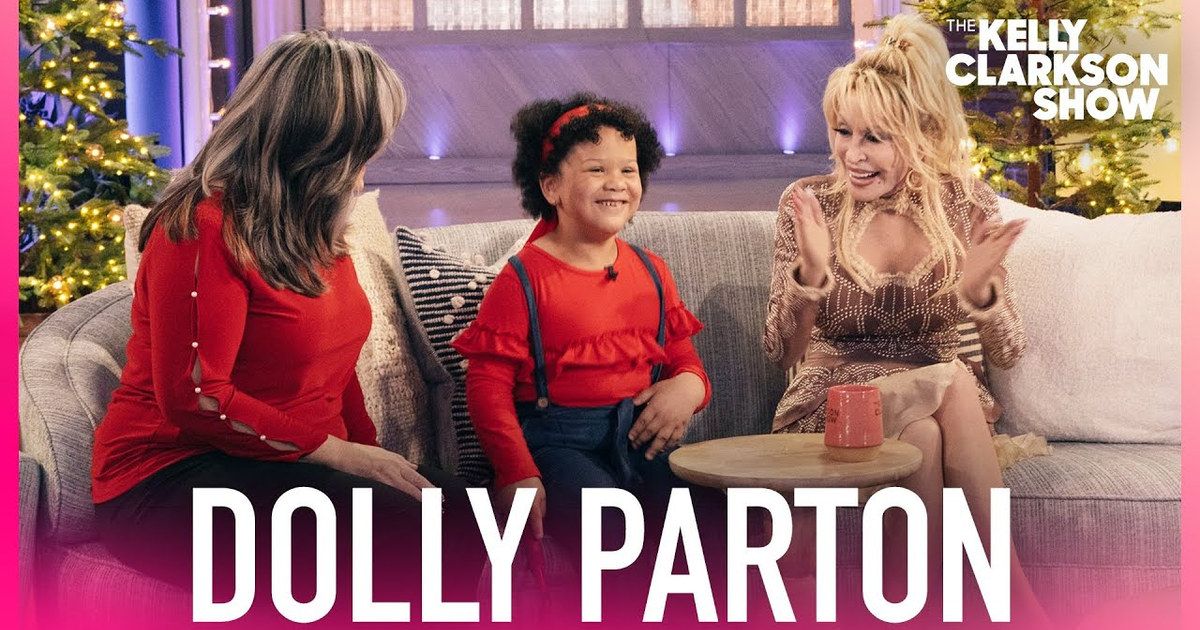
And like any star, she knows how to work a room. When Kelly Clarkson brought Rosie out to meet Dolly, the first thing Rosie said was, “Whoa! I didn’t think that was gonna happen.” Then she asked Dolly to sing her a song. Dolly, ever the gracious legend, suggested they sing together. Rosie wasn’t having it. “No, you sing it for me,” she said. Kelly Clarkson laughed. “I love a person that knows what they want.” That’s Rosie. She knows what she wants. And what she wants is music, stories, and maybe a little bit of Dolly Parton.
[[VIDEO]]
The trio launched into “Amazing Grace.” Dolly sang, Kelly sang, and Rosie joined in. When they hit the line “was blind, but now I see,” the audience erupted. It wasn’t just a cute moment. It was a testament to what happens when you give a child the tools to find their voice. For Rosie, those tools came in the form of braille books from the Imagination Library. For Dolly, it was a reminder of why she started the program in the first place. “That’s what makes it all worthwhile,” she said. “To think that a little child, you know, that the Imagination Library, that we have that in braille. You just never know.”
But Rosie’s story isn’t just about one girl. It’s about what’s possible when we invest in children who are too often overlooked. Only 10% of blind children become braille-literate. That means 90% are left behind. Rosie is one of the lucky ones. But why should luck have anything to do with it? The Imagination Library is available to any child under five in participating communities, regardless of income or ability. It’s a simple idea: give kids books, and they’ll learn to read. But for blind children, it’s revolutionary.
Liz put it best: “Our daughter was exposed to pre-braille and braille, and that is so important.” Without that exposure, Rosie might never have learned to read or write. She might never have discovered her love of music. She might never have stood on a stage and sung “Amazing Grace” with Dolly Parton. But she did. And that’s because someone, somewhere, decided that blind kids deserve books too.
Rosie’s story also challenges how we think about disability. In The Miracle Worker, Helen Keller is portrayed as wild and uncontrollable until Annie Sullivan breaks through. In Blind, the subjects are often defined by their limitations. Rosie is defined by her talents. She’s a singer, a reader, a first-grader who happens to be blind. Her blindness is part of her story, but it’s not the whole story. The Imagination Library helped her write the rest.
And what a story it is. At six years old, Rosie has already done more than most people do in a lifetime. She’s read braille, she’s sung with a country music icon, and she’s inspired thousands of people. But she’s just getting started. Her teachers think she might be gifted. Her mother thinks she sees the world in a way that sighted people can’t. And Dolly Parton thinks she’s “so special.” Rosie, for her part, just wants to sing. And that’s exactly what she’s going to do.
So the next time you see a trailer for a movie about a blind child overcoming the odds, remember Rosie. Remember that her story isn’t fiction. It’s real. And it’s happening because of a program that puts books in the hands of kids who need them most. Dolly Parton’s Imagination Library isn’t just about literacy. It’s about giving every child a chance to find their voice. Rosie found hers. And she’s not afraid to use it.


